
Precision in Every Connection: Your Ultimate Guide to Choosing a Reliable Rivets, Pins & Inserts Supplier in UAE
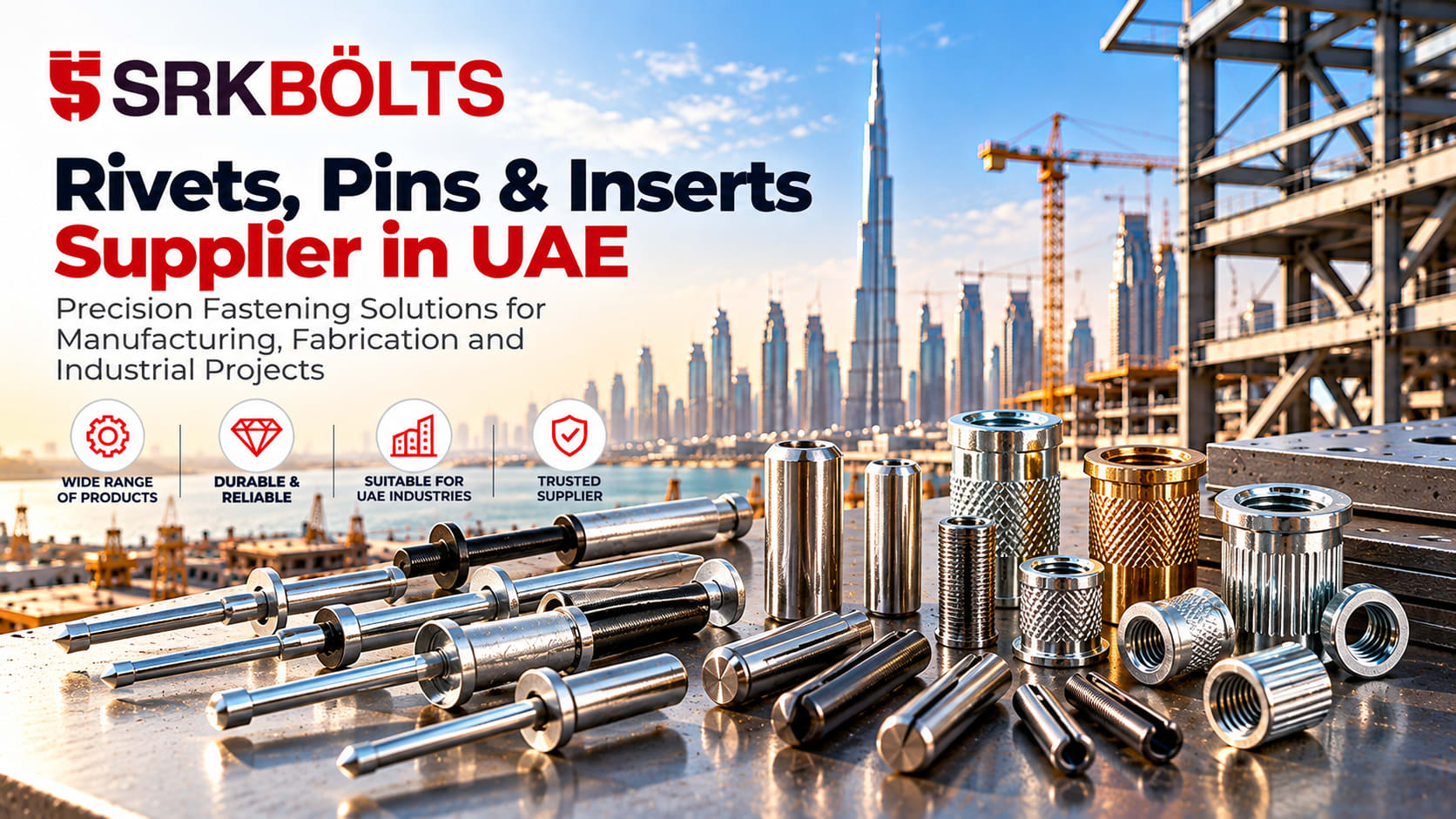
Introduction: Why Precision Fastening Matters in Modern UAE Industries
Walk into a metal fabrication workshop in Sharjah, an automotive assembly facility in Dubai, or a heavy equipment maintenance centre in Abu Dhabi, and you will notice something interesting.
While enormous machines perform the visible work, countless small components ensure that everything fits, moves, and stays connected as intended.
Among these components are rivets, pins, and threaded inserts.
They may not be as familiar as bolts and nuts, but they perform functions that ordinary threaded fasteners cannot always provide.
A blind rivet can permanently secure two metal sheets when only one side of the assembly is accessible. A precision dowel pin can maintain accurate alignment between machine components. A threaded insert can provide a durable fastening point in a thin metal panel or plastic housing.
Each of these applications requires a different approach to fastening.
For UAE industries, choosing the correct component is particularly important because mechanical assemblies often operate under demanding conditions, including vibration, high temperatures, humidity, and exposure to corrosive environments.
Using an incorrectly sized rivet may weaken a connection. An unsuitable locating pin can cause alignment problems, while a poorly installed threaded insert can pull out of its base material.
These issues can result in additional maintenance, interrupted production, or costly rework.
This is why selecting a dependable Rivets, Pins & Inserts Supplier in UAE matters.
A knowledgeable supplier can help procurement teams identify products that match their dimensional, material, and application requirements.
In this article, we explore the differences between rivets, pins, and inserts, their most important applications, technical standards, material options, and practical sourcing considerations for businesses across the UAE.
Understanding Rivets, Pins & Inserts: Three Different Fastening Solutions
Although rivets, pins, and threaded inserts are frequently listed together in industrial fastener catalogues, they serve different engineering purposes.
Rivets are mainly used to create permanent mechanical joints. During installation, part of the rivet is deformed or mechanically set to hold connected components together.
Pins are used for alignment, positioning, retention, or transmitting mechanical loads. Some are installed permanently, while others allow convenient removal during maintenance.
Threaded inserts provide internal threads in another material. They are commonly used to improve thread durability, create fastening points in thin materials, or repair damaged threaded holes.
Understanding these distinctions is the first step towards selecting suitable fastening components.
Types of Industrial Rivets Used in UAE
1. Blind Rivets: Convenient Fastening With One-Sided Access
Blind rivets, commonly called pop rivets, are widely used in metal fabrication.
Their main advantage is that they can be installed from one side of a workpiece.
This makes them useful when the rear surface of a connection is difficult or impossible to access.
A typical blind rivet consists of a tubular rivet body and a mandrel. During installation, a riveting tool pulls the mandrel, deforming the rivet body to create a mechanical joint.
Common applications:
Sheet metal fabrication
HVAC ductwork
Electrical cabinets
Vehicle body panels
Industrial enclosures
Lightweight equipment assemblies
Blind rivets come in different body materials, mandrel combinations, head styles, and grip ranges.
For example, ISO 15977:2002 specifies particular open-end blind rivets with an aluminium-alloy body, steel mandrel, and protruding head. The standard was reviewed and confirmed in 2023.
2. Solid Rivets: Traditional Permanent Fastening
Solid rivets consist of a solid shank and a manufactured head.
During installation, the opposite end is mechanically deformed to secure the connected parts.
They are used in engineered applications where a permanent mechanical connection is required.
Common applications:
Heavy metal fabrication
Industrial equipment
Transport manufacturing
Specialized structural assemblies
Aerospace-approved applications
Solid rivets generally require access to both sides of the connection, unlike blind rivets.
Their suitability depends on joint design, installation quality, material properties, and expected mechanical loads.
3. Semi-Tubular Rivets
Semi-tubular rivets feature a partially hollow shank.
Because the hollow portion is formed during installation, they can require less setting force than comparable solid rivets.
They are often used where mechanical parts must remain connected while allowing some movement.
Common applications:
Hinges
Mechanical linkages
Furniture fittings
Automotive components
Industrial assemblies
4. Countersunk Rivets
Countersunk rivets are designed to sit flush with the surrounding material when installed in a correctly prepared countersunk hole.
They are used where protruding fastener heads would interfere with movement, clearance, or surface appearance.
Common applications:
Equipment covers
Metal panels
Transport components
Precision assemblies
The correct countersink dimensions and installation procedures are essential.
5. Structural Blind Rivets
Structural blind rivets are engineered to meet specified mechanical performance requirements.
Depending on the product, they may offer particular tensile, shear, or mandrel-retention characteristics.
They are used in selected industrial assemblies where a standard general-purpose blind rivet may not provide the required performance.
Buyers should evaluate manufacturer test data and approved specifications rather than relying solely on the term structural.
Types of Industrial Pins Used in Manufacturing & Engineering
1. Dowel Pins: Precision Alignment Components
Dowel pins are cylindrical components designed to position or align machine parts accurately.
They are commonly manufactured to controlled dimensional tolerances and used in precisely prepared holes.
Common applications:
CNC machinery
Industrial tooling
Manufacturing fixtures
Gearbox assemblies
Precision mechanical equipment
An incorrectly sized dowel pin can affect alignment and assembly quality.
For precision applications, buyers should confirm diameter tolerance, pin material, surface finish, and the required fit.
2. Spring Pins (Roll Pins)
Spring pins are hollow, resilient components that compress during installation.
They are designed to exert pressure against the surrounding hole and provide mechanical retention.
Common designs include slotted spring pins and coiled spring pins.
Common applications:
Mechanical assemblies
Automotive components
Machinery linkages
Equipment maintenance
Industrial positioning systems
Their suitability depends on pin type, material, hole preparation, loading conditions, and manufacturer specifications.
3. Split Pins (Cotter Pins)
Split pins are commonly used to retain compatible nuts, shafts, and mechanical components.
After insertion through a hole, their legs are bent to prevent unintentional removal.
Common applications:
Castellated nut assemblies
Automotive equipment
Agricultural machinery
Mechanical linkages
Industrial maintenance
Split pins are generally inexpensive, but correct sizing and installation remain important.
4. Clevis Pins
Clevis pins are cylindrical pins typically featuring a head and a retention arrangement at the opposite end.
They are used in mechanical connections that may need to pivot or articulate.
Common applications:
Hydraulic equipment
Machinery linkages
Agricultural equipment
Mechanical control systems
Industrial maintenance
5. Taper Pins
Taper pins have a slightly changing diameter along their length.
They are installed into appropriately tapered holes and can provide controlled positioning or retention.
Common applications:
Mechanical alignment
Shaft connections
Machine assembly
Industrial equipment maintenance
The correct taper and hole preparation are critical for proper installation.
Threaded Inserts: Creating Stronger Fastening Points
Threaded inserts are useful when the base material cannot reliably support a conventional tapped thread or when repeated assembly and disassembly are expected.
1. Rivet Nuts (Nutserts)
Rivet nuts are internally threaded fasteners that can be installed into thin sheet metal or hollow sections from one side.
They provide a threaded attachment point for compatible bolts or screws.
Common applications:
Metal cabinets
Automotive assemblies
Electrical enclosures
Industrial equipment frames
Sheet metal fabrication
Correct hole dimensions, grip range, and installation force are essential.
2. Helical Thread Inserts
Helical thread inserts are specially formed wire components used to provide durable internal threads in prepared holes.
They are commonly used in aluminium components and for repairing certain damaged threaded holes.
Common applications:
Machinery repair
Engine components
Precision mechanical assemblies
Maintenance operations
3. Solid Threaded Inserts
Solid threaded inserts are manufactured from solid metal bodies and installed using methods appropriate to their design.
They can be used in selected metals, plastics, and other engineering materials.
4. Brass Heat-Set Inserts
Brass heat-set inserts are frequently used in thermoplastic components.
Controlled heat allows the insert to become embedded in the plastic, creating a durable threaded fastening point after cooling.
Common applications:
Injection-moulded products
Electronics housings
Plastic machinery covers
Industrial product assemblies
3D-printed thermoplastic components
Rivets vs Pins vs Threaded Inserts: Which Should You Choose?
Selection factor | Rivets | Pins | Threaded inserts |
|---|---|---|---|
Main function | Permanent joining | Alignment or retention | Providing internal threads |
Typical installation | Riveting or setting tool | Press fit or insertion | Setting, threading or heat |
Common materials | Steel, aluminium, stainless steel | Steel, stainless steel | Steel, brass, stainless steel |
Removal | Often destructive | Often removable | Depends on insert design |
Typical uses | Sheet metal and fabrication | Machinery and linkages | Thin metal, plastic, thread repair |
Practical example: If a UAE manufacturer needs to permanently join two sheet metal panels, a correctly specified blind rivet may be appropriate. If accurate alignment between machine components is required, a dowel pin could be suitable. If a thin metal enclosure needs a reusable threaded attachment point, a rivet nut may provide the required solution.
The final selection must still be based on mechanical loads, installation access, material properties, and applicable specifications.
Materials and Finishes: Choosing Fasteners for UAE Conditions
Material selection has a major influence on the performance and service life of industrial fasteners.
In the UAE, high ambient temperatures, coastal humidity, airborne salt, and industrial contaminants can create demanding operating environments.
Carbon Steel
Carbon steel rivets, pins, and inserts are commonly used in general industrial applications because of their mechanical properties and cost-effectiveness.
However, corrosion protection may be required for outdoor installations.
Stainless Steel
Stainless steel fasteners are frequently selected for corrosion-resistant applications.
A2 stainless steel, commonly associated with the 304 family, is used in many general-purpose environments.
A4 stainless steel, commonly associated with the 316 family, generally offers improved resistance to certain chloride-containing conditions.
For marine-related projects in Dubai and Abu Dhabi, the correct stainless steel grade should be selected according to actual exposure conditions and mechanical requirements.
Aluminium
Aluminium rivets are lightweight and commonly used in sheet metal, automotive, and equipment fabrication.
They are useful where weight reduction is important, but their strength and galvanic compatibility with adjoining materials must be considered.
Brass
Brass is widely used for certain threaded inserts, particularly those installed in thermoplastics.
The material offers useful corrosion-resistance characteristics and can provide durable internal threads when properly specified and installed.
Protective Coatings
Zinc plating, passivation, and other treatments may be applied to suitable fastening components.
The coating must be compatible with the installation process, base material, operating environment, and required mechanical properties.
Important International Standards for Rivets, Pins & Inserts
Industrial buyers should understand the standards relevant to each fastening component.
Standard | Product category |
|---|---|
ISO 15977 | Specific aluminium/steel open-end blind rivets |
ISO 8734 | Hardened parallel pins |
ISO 2338 | Unhardened parallel pins |
ISO 8752 | Heavy-duty slotted spring pins |
ISO 1234 | Split pins |
ISO 2341 | Clevis pins with head |
DIN 6325 | Hardened cylindrical pins |
DIN 94 | Split pins |
These specifications address different designs and mechanical characteristics. They should not be considered interchangeable simply because products have similar dimensions.
For threaded inserts, specifications often depend on the exact insert design and manufacturer system.
Engineering drawings and product data sheets should always be checked before ordering.
Where Are Rivets, Pins & Inserts Used Across UAE Industries?
Construction and Steel Fabrication
Steel fabrication workshops rely on different permanent and removable fastening systems.
Blind rivets are commonly used in sheet metal enclosures, cladding components, and fabricated assemblies, while pins may be used in machinery and positioning equipment.
Automotive and Transportation
Automotive businesses use rivets, threaded inserts, and mechanical pins in selected body panels, interior assemblies, brackets, and mechanical systems.
Each fastener must meet the performance requirements of its intended application.
Manufacturing and Heavy Machinery
Dowel pins help align machinery components, while spring pins provide retention in selected mechanical assemblies.
Threaded inserts can also provide durable fastening points in equipment housings and other components.
Electrical and Switchgear
Electrical enclosure manufacturers frequently use blind rivets and rivet nuts to assemble panels and create threaded mounting points.
Material selection and installation accuracy are important for these applications.
Marine and Shipbuilding
Marine equipment may require stainless steel or appropriately corrosion-protected fastening products.
Saltwater exposure, galvanic compatibility, and mechanical loads must be considered.
Maintenance, Repair and Operations
Industrial maintenance teams often need replacement pins, rivets, and inserts for equipment repairs.
Correct dimensional matching is especially important when sourcing replacements for existing machinery.
How to Choose a Reliable Rivets, Pins & Inserts Supplier in UAE
Finding a suitable supplier involves more than checking product prices.
Procurement teams should evaluate whether a supplier can respond accurately to technical specifications and support the required quantities.
1. Product Range and Availability
A broad industrial fastener range can simplify procurement, especially when a project requires several types of rivets, pins, and inserts.
However, catalogue listings do not guarantee current stock availability.
2. Technical Specification Support
The supplier should be able to process detailed enquiries covering standards, dimensions, materials, tolerances, finishes, and quantities.
3. Material and Quality Documentation
Depending on the project, buyers may need manufacturer test data, material certificates, dimensional inspection reports, or traceability documents.
4. Bulk and Project-Based Orders
For manufacturing facilities and construction projects, quantity requirements can vary significantly.
Suppliers should be able to clarify availability, lead times, and any minimum order quantities.
5. Non-Standard Fastener Sourcing
Certain projects require components manufactured according to engineering drawings or samples.
For these requirements, supplier access to appropriate manufacturing and sourcing capabilities is valuable.
6. Regional Supply Capability
For businesses operating across the UAE and GCC, a supplier familiar with regional industrial procurement requirements can support coordinated sourcing.
Common Mistakes Buyers Should Avoid
A common mistake is ordering a rivet based only on its diameter.
For example, requesting a 4.8 mm blind rivet without specifying grip range, body material, mandrel material, and head design can result in an unsuitable product.
Similarly, specifying a dowel pin without its dimensional tolerance may cause problems in precision machinery.
Other avoidable mistakes include using the wrong hole size for rivet nuts, assuming stainless steel grades are interchangeable, and selecting inserts without checking the strength of the base material.
The solution is to prepare a complete technical enquiry before requesting quotations.
Sample RFQ for Industrial Rivets, Pins & Inserts
For UAE procurement professionals, the following example demonstrates how to communicate product requirements clearly.
Specification | Example requirement |
|---|---|
Product | Open-end blind rivet |
Standard | ISO 15977 |
Nominal diameter | 4.8 mm |
Body material | Aluminium alloy |
Mandrel | Steel |
Head style | Protruding head |
Grip range | As per approved drawing |
Quantity | 5,000 pieces |
Delivery location | Sharjah, UAE |
Documentation | Manufacturer specifications and required inspection records |
Providing complete requirements makes it easier for suppliers to identify the correct fasteners and prepare accurate quotations.
SRK Bolt: Rivets, Pins & Inserts Supplier in UAE
SRK Bolt is a UAE-based industrial fastener supplier supporting construction, fabrication, manufacturing, automotive, marine, and general engineering applications.
Established in 2015, SRK Bolt has developed a catalogue covering more than 5,000 industrial fastener SKUs, with sourcing relationships across India, Europe, and the Far East.
Its rivets, pins, and inserts category supports enquiries for permanent fastening, precision positioning, mechanical retention, and thread reinforcement requirements.
Customers can provide technical specifications, drawings, dimensions, material preferences, and quantities for sourcing and quotation assistance.
SRK Bolt's catalogue also identifies products such as split pins, R-pins, clevis pins, spring dowel pins, and retaining rings, supporting a range of mechanical assembly requirements.
The company serves industrial markets including Dubai, Abu Dhabi, Sharjah, and Ajman, with regional sourcing support for other GCC countries.
For industrial buyers looking for a Rivets, Pins & Inserts Supplier in UAE, SRK Bolt provides a dedicated category page for submitting project and bulk-order enquiries.
Its online category listings are currently being updated, so specific product availability should be confirmed directly before ordering.
Buyers can also explore complementary industrial fastening products, including bolts, nuts, washers, and other industrial fasteners.
Frequently Asked Questions
What are the most commonly used industrial rivets?
Blind rivets, solid rivets, semi-tubular rivets, countersunk rivets, and structural blind rivets are commonly used in different industrial applications.
What is the difference between a rivet and a pin?
A rivet is generally used to create a permanent mechanical joint.
A pin is commonly used for positioning, alignment, retention, or connecting components.
What are rivet nuts used for?
Rivet nuts provide threaded attachment points in suitable thin materials or hollow sections, especially where installation access is available from only one side.
Which pins are commonly used in industrial machinery?
Dowel pins, spring pins, clevis pins, split pins, and taper pins are frequently used in different machinery applications.
Are stainless steel rivets suitable for outdoor applications in UAE?
Certain stainless steel rivets may be suitable for outdoor environments, depending on their grade, expected corrosion exposure, and mechanical requirements.
Can threaded inserts repair damaged threads?
Yes. Certain threaded insert designs are specifically used to repair or reinforce damaged threaded holes in compatible base materials.
Where can businesses buy rivets, pins, and inserts in bulk in UAE?
Industrial businesses can explore SRK Bolt's rivets, pins, and inserts range and submit their specifications for bulk sourcing and quotation.
Conclusion: Reliable Engineering Starts With Precision Fastening
Industrial rivets, pins, and threaded inserts are essential components in modern manufacturing, fabrication, and engineering.
Although they perform different mechanical functions, they share one important characteristic: their effectiveness depends on correct product selection and installation.
For UAE businesses, purchasing decisions should consider dimensions, material properties, corrosion resistance, mechanical performance, relevant standards, and application requirements.
An unsuitable fastener can create problems that are much more expensive than the component itself.
By using detailed specifications and selecting dependable sourcing partners, procurement teams can reduce purchasing errors and support better long-term assembly performance.
For contractors, manufacturers, engineers, and industrial buyers seeking a Rivets, Pins & Inserts Supplier in UAE, SRK Bolt provides industrial fastening solutions and specification-led sourcing support.
Explore the category at www.srkbolt.com/rivets