
Small Protection, Big Performance: Why Protective Washers Matter for Industrial Fastening in UAE
Introduction: The Small Component That Protects the Entire Connection
Imagine a construction contractor installing steel components for an industrial warehouse in Dubai.
The bolts are correctly sized, the nuts meet the required strength specifications, and the steel framework has been manufactured according to the approved drawings.
During installation, however, an unexpected problem occurs.
As the nuts are tightened, the protective coating around several fastening points becomes damaged. In another location, excessive bearing pressure begins deforming a relatively thin metal component.
Neither problem necessarily means that the bolts themselves are defective.
The issue may be related to the bearing surfaces, fastening arrangement, or washer selection.
This is where protective washers become important.
Although washers are among the simplest components in industrial fastening systems, correctly selected designs help protect material surfaces, distribute contact pressure, support sealing arrangements, and provide appropriate bearing conditions.
For industrial projects in the United Arab Emirates, their importance can be even greater.
The UAE's climate presents challenges such as high ambient temperatures, coastal humidity, airborne salt, industrial contaminants, and abrasive dust.
Fastening systems exposed to these conditions require careful material selection and appropriate corrosion protection.
From manufacturing plants in Sharjah to construction developments in Dubai and industrial equipment installations in Abu Dhabi, engineers must consider the performance of the complete fastening assembly.
Choosing a suitable Protective Washers Supplier in UAE can help procurement teams source washers according to their dimensional, material, and application requirements.
This guide explores protective washer types, their materials, industrial applications, technical standards, and the important factors to consider when purchasing washers for UAE projects.
What Are Protective Washers?
Protective washers are fastening components selected or designed to help protect connected materials, fastening surfaces, or particular joint interfaces.
The term protective washer describes a function rather than one universal internationally standardized washer type.
Depending on their design, material, and finish, protective washers may perform several functions:
Distribute bearing pressure over a wider contact area.
Reduce localized indentation or deformation.
Help protect painted, coated, or finished surfaces.
Provide barriers against moisture or contaminants in suitable sealing applications.
Offer improved corrosion resistance.
Provide electrical isolation where required.
Support appropriate bearing conditions in engineered bolted connections.
However, not every protective washer performs all these functions.
For example, a plain steel washer may distribute load but will not provide a watertight seal.
Similarly, a rubber sealing washer may be suitable for weatherproofing applications but unsuitable for a heavily loaded structural steel connection.
Understanding the primary purpose of each washer is therefore essential.
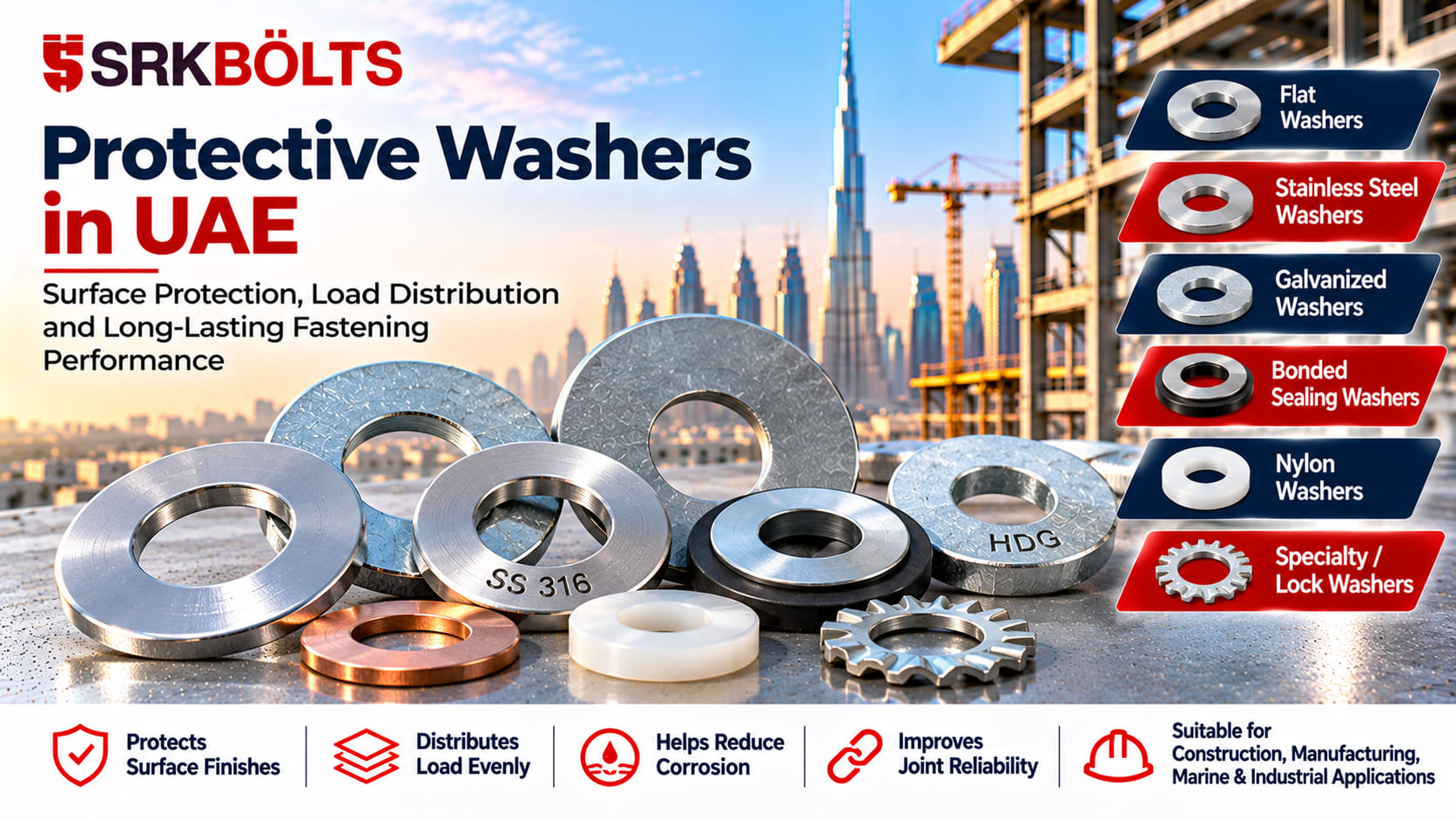
Types of Protective Washers Used in UAE Industries
1. Flat Protective Washers
Flat washers are among the most widely used components in general construction and industrial engineering.
They provide a bearing surface between the bolt head or nut and the connected component.
This helps distribute contact pressure and may reduce localized damage caused during tightening.
Common applications:
Steel fabrication
Machinery assembly
Industrial equipment
General construction
Mechanical installations
Equipment maintenance
Flat washers are available in different sizes, materials, hardness classes, and protective finishes.
ISO 7089:2000 is a recognized dimensional specification for normal-series plain washers of product grade A.
A flat washer should not automatically be considered a locking or sealing component.
2. Stainless Steel Protective Washers
Stainless steel washers are commonly selected where corrosion resistance is important.
They are especially relevant to suitable outdoor, coastal, and industrial applications.
Common stainless steel families include A2 and A4.
A2 Stainless Steel: Commonly associated with 304-type stainless steel and used in many general corrosion-resistant applications.
A4 Stainless Steel: Commonly associated with 316-type stainless steel and generally offers improved resistance to certain chloride-containing environments.
Common applications:
Outdoor architectural fittings
Marine-related equipment
Food-processing machinery
Industrial enclosures
Coastal infrastructure
Selected chemical-processing installations
Although stainless steel offers useful corrosion resistance, the appropriate material grade depends on the exposure conditions.
Stainless steel washers should also be checked for mechanical compatibility with the mating bolts, nuts, and connected materials.
3. Galvanized Steel Washers
Galvanized washers feature a protective zinc coating designed to reduce corrosion of the underlying steel.
They are frequently considered for outdoor industrial assemblies.
Common applications:
Structural steel fabrication
Outdoor equipment
Industrial warehouses
Utility installations
Pipe supports
Construction projects
Hot-dip galvanizing can provide suitable corrosion protection where the coating system is correctly specified.
ISO 10684:2004 primarily covers hot-dip galvanized threaded fasteners, but its requirements may also be applied to non-threaded steel components such as washers.
Coating thickness, mechanical requirements, and compatibility with other fastening components must be evaluated.
4. Large-Diameter Protective Washers
Large-diameter washers have a greater outside diameter relative to their central opening than regular plain washers.
Their wider bearing area can help distribute pressure over a larger surface.
Common applications:
Sheet metal assemblies
Equipment panels
Lightweight fabrication
Timber connections
Selected structural supports
These washers can be useful where the base material is relatively thin or softer than the fastening component.
However, a larger washer is not automatically suitable for a higher mechanical load.
Thickness, hardness, and material strength remain important.
5. Bonded Sealing Washers
Bonded sealing washers typically combine a metal washer with an elastomeric sealing element.
The elastomer helps create a seal around a correctly installed fastener.
Common applications:
Metal roofing
Exterior cladding
Fluid-handling equipment
Industrial enclosures
Selected mechanical assemblies
EPDM is one material commonly used in weather-resistant bonded sealing washers.
Manufacturers such as SFS identify bonded sealing and related washer designs as important components in weather-resistant commercial fastening systems.
The sealing material must be compatible with the expected temperature, environmental exposure, and application requirements.
6. Nylon and Plastic Protective Washers
Non-metallic washers may be used where electrical insulation, surface protection, or material separation is required.
Common materials include nylon, PTFE, and certain engineered polymers.
Common applications:
Electrical equipment
Electronics housings
Instrumentation
Lightweight assemblies
Selected architectural installations
Plastic washers can help separate incompatible surfaces or prevent direct metal-to-metal contact.
However, polymers can creep, deform, or lose strength under particular loads and temperatures.
They should not be substituted for structural steel washers without engineering approval.
7. Hardened Steel Washers
Hardened washers are manufactured to meet specified hardness or mechanical-property requirements.
They are used where a fastening assembly requires resistance to bearing deformation.
Common applications:
Structural steel connections
High-strength bolting
Heavy machinery
Industrial equipment installation
Engineered steel assemblies
ASTM F436/F436M is commonly specified for hardened steel washers in appropriate structural fastening systems.
Unlike softer protective washers, hardened washers are intended to maintain specified bearing characteristics under demanding fastening loads.
8. Copper and Soft-Metal Sealing Washers
Copper washers are commonly used in selected mechanical sealing applications.
They can deform under controlled compression, helping form a seal between suitable mating surfaces.
Common applications:
Hydraulic fittings
Automotive equipment
Fluid systems
Drain plugs
Selected mechanical assemblies
The correct design, dimensions, material condition, and installation method must be matched to the application.
Protective Washer Types: A Practical Comparison
Washer type | Primary purpose | Typical application |
|---|---|---|
Flat steel washer | Distribute bearing pressure | Construction and machinery |
Stainless steel washer | Improve corrosion resistance | Outdoor and marine-related assemblies |
Galvanized washer | Protect underlying steel from corrosion | Exposed structural installations |
Large-diameter washer | Provide wider bearing support | Sheet metal and timber |
Bonded sealing washer | Resist moisture or fluid ingress | Roofing and enclosures |
Nylon washer | Provide separation or insulation | Electrical and lightweight assemblies |
Hardened washer | Resist bearing deformation | High-strength bolting |
Copper sealing washer | Provide a compression seal | Compatible fluid connections |
The most appropriate washer depends on the fastening system, operating conditions, and required mechanical performance.
Why Protective Washers Are Important in UAE Conditions
Protection Against Corrosion
Outdoor fastening systems in the UAE may experience humidity, airborne salts, and industrial contaminants.
Appropriate stainless steel or corrosion-protected washers can help reduce deterioration in suitable applications.
However, washers alone cannot guarantee corrosion resistance for the entire joint.
The bolt, nut, washer, coating, and connected materials must be considered together.
Protection of Coated Surfaces
Painted, powder-coated, or galvanized components can experience localized damage during installation.
A correctly specified washer may help distribute bearing pressure and reduce certain forms of surface damage.
However, washers that rotate against a coating can still cause damage.
The tightening procedure and complete connection design therefore remain important.
Improved Load Distribution
When a nut or bolt head bears directly against a relatively soft material, localized pressure may cause indentation or crushing.
A suitable washer can provide a larger bearing surface.
Support for Moisture Sealing
Bonded sealing washers can help reduce water ingress around compatible fastening points.
This is particularly relevant to selected roofing and exterior cladding applications.
Reduced Material Damage
Correctly specified washer dimensions, hardness, and materials can help avoid unwanted deformation and surface damage.
This can contribute to more consistent assembly performance.
Major Industries Using Protective Washers in UAE
Construction and Infrastructure
Construction contractors use protective washers in steel assemblies, equipment supports, fabricated components, and building services.
For exposed installations, corrosion protection and surface compatibility are particularly important.
Manufacturing and Heavy Machinery
Manufacturers use washers in machinery frames, motors, enclosures, conveyors, and mechanical assemblies.
Correct bearing conditions can help reduce localized deformation and support installation reliability.
Marine and Shipbuilding
Marine equipment may be exposed to moisture, salts, and corrosive conditions.
Suitable stainless steel or appropriately protected fastening assemblies may be required.
Special attention should be given to galvanic corrosion where different metals are connected.
Oil and Gas
Industrial equipment in oil and gas facilities may require washers with specified mechanical properties, materials, or sealing characteristics.
Some applications involve high temperatures, pressure, or chemical exposure.
General-purpose washers should not replace specialized engineered components.
Electrical and MEP Installations
Electrical cabinets, HVAC systems, pipe supports, and equipment enclosures use washers for different mechanical and protective purposes.
Insulating washers may also be appropriate where electrical separation is specifically required.
Roofing and Cladding
Bonded sealing washers are commonly used in suitable metal roofing and cladding fastening systems.
Correct installation compression is important to achieving the intended sealing performance.
Protective Washers: Material and Surface Finish Selection
One of the most important purchasing decisions involves selecting the appropriate material and finish.
Material or finish | Main consideration |
|---|---|
Plain carbon steel | Economical but may require corrosion protection |
Zinc-plated steel | Protective coating for specified environments |
Hot-dip galvanized steel | Corrosion protection for suitable outdoor applications |
A2 stainless steel | General corrosion-resistant applications |
A4 stainless steel | Improved resistance to certain chloride exposure |
Nylon or PTFE | Insulation or separation, subject to load and temperature limits |
Copper | Selected compression-sealing applications |
Hardened steel | Specified mechanical bearing requirements |
Material selection should be based on the complete application.
For example, a plastic washer that protects a painted surface may not have sufficient stiffness for a high-strength structural connection.
Similarly, a stainless steel washer with excellent corrosion resistance may not meet the hardness required by a structural bolting specification.
Understanding Protective Washer Dimensions and Standards
Industrial washers are manufactured according to specifications defining dimensions, material properties, tolerances, and other characteristics.
Commonly referenced standards include:
Standard | Product or requirement |
|---|---|
ISO 7089 | Normal-series plain washers |
ISO 7090 | Chamfered normal-series plain washers |
ISO 7093-1 | Large-series plain washers |
DIN 125 | Traditional plain washer specification |
DIN 9021 | Large outside-diameter plain washers |
ASTM F436/F436M | Hardened steel washers |
ISO 10684 | Hot-dip galvanized fastener coatings |
DIN 2093 | Disc springs |
These standards cover different product characteristics and should not automatically be treated as interchangeable.
For example, the dimensions of a normal-series plain washer differ from those of a large-series washer.
Similarly, coating specifications do not necessarily establish the mechanical properties of the underlying washer.
How to Choose the Right Protective Washers for Your Project
Selecting washers should begin with the application rather than the product's appearance.
1. Identify the protection required. Determine whether the washer must distribute pressure, protect a finished surface, resist corrosion, provide sealing, or perform another function.
2. Confirm the dimensions. Check the inside diameter, outside diameter, thickness, and any application-specific geometry.
3. Verify mechanical compatibility. For heavily loaded connections, confirm the appropriate washer hardness and material strength.
4. Evaluate the operating environment. Consider moisture, coastal exposure, chemicals, temperature, and dust.
5. Select suitable materials and finishes. Choose protection appropriate to the complete fastening assembly.
6. Check applicable standards. Confirm all engineering and project requirements.
7. Consider installation procedures. Incorrect tightening can damage coatings or compromise sealing performance.
8. Request technical documentation. Material certificates, manufacturer data, or inspection reports may be needed depending on the application.
Common Mistakes to Avoid When Buying Protective Washers
One common mistake is assuming that all washers with the same nominal hole size are interchangeable.
For example, two M12 washers may have different outside diameters, thicknesses, materials, or hardness specifications.
Another mistake is using a soft plastic washer in a connection that requires a hardened steel bearing surface.
Buyers may also assume that a stainless steel washer guarantees corrosion protection for an otherwise unprotected carbon steel assembly.
This is not necessarily the case.
Other problems include selecting sealing washers with unsuitable elastomers, overtightening bonded washers, and using components with incompatible surface finishes.
For industrial procurement, complete specifications help avoid these mistakes.
How to Prepare an Accurate RFQ for Protective Washers
A well-prepared Request for Quotation can help suppliers identify the correct washers and provide accurate quotations.
Specification | Example requirement |
|---|---|
Product | Plain protective washer |
Standard | ISO 7089 |
Nominal bolt size | M12 |
Material | Stainless steel A4 |
Inside diameter | As per specified standard |
Outside diameter | As per specified standard |
Thickness | As per specified standard |
Finish | As specified by project |
Quantity | 10,000 pieces |
Delivery location | Dubai, UAE |
Documentation | Manufacturer and inspection records as required |
For specialized protective washers, buyers should also provide a drawing or product data sheet identifying the required geometry and functional requirements.
Why Choosing a Reliable Protective Washers Supplier in UAE Matters
For construction companies, manufacturers, and engineering contractors, washer procurement involves more than comparing prices.
A suitable supplier should understand the technical differences between general-purpose washers, sealing washers, hardened washers, and corrosion-resistant products.
This can help buyers source components according to their project specifications.
For large industrial projects, coordinated supply can also be valuable.
A contractor may need bolts, nuts, plain washers, hardened washers, and specialized sealing components for the same installation.
Sourcing these components through a structured procurement process can simplify purchasing and reduce specification mismatches.
Supplier responsiveness, access to different materials, technical information, and support for bulk quantities are important considerations.
SRK Bolt: Protective Washers Supplier in UAE
SRK Bolt is a UAE-based industrial fastener supplier serving construction, structural steel, manufacturing, oil and gas, marine, and engineering industries.
The company provides sourcing support for industrial washers in different materials, dimensions, and finishes.
Its Industrial Washers Collection specifically highlights protective washers, material and finish options, dimensional matching, load distribution, joint protection, and prevention of surface damage.
SRK Bolt also supports enquiries for plain washers, spring washers, tab washers, bonded sealing washers, and specialty washer designs.
The company lists more than 5,000 fastener SKUs across its broader catalogue, with products sourced through manufacturers in India, Europe, and the Far East.
Based in Sharjah, SRK Bolt serves industrial buyers throughout the UAE and supports regional enquiries from Bahrain, Qatar, Kuwait, Saudi Arabia, Oman, Iraq, and Jordan.
For contractors, engineers, maintenance teams, and procurement professionals, the company supports specification-led enquiries involving washer standards, dimensions, materials, finishes, and project quantities.
Businesses can explore the Protective Washers range at SRK Bolt and submit their requirements for sourcing assistance and quotation.
For complete fastening assemblies, buyers can also explore the company's industrial bolts, industrial nuts, and industrial fasteners catalogue.
Specific product availability and technical documentation should be confirmed directly before ordering.
Frequently Asked Questions About Protective Washers in UAE
What are protective washers used for?
Protective washers are used to distribute bearing pressure, help protect connected surfaces, provide corrosion resistance, support sealing, or perform other protective functions depending on their design.
What is the difference between protective washers and ordinary flat washers?
A flat washer primarily provides a bearing surface and distributes pressure.
The term protective washer is broader and may include flat, sealing, corrosion-resistant, insulating, and specialized washer designs.
Which protective washers are suitable for outdoor applications in UAE?
Depending on the application, stainless steel, galvanized steel, or appropriately designed bonded sealing washers may be suitable.
The correct choice depends on mechanical loads and environmental exposure.
Are stainless steel washers corrosion-proof?
No. Stainless steel offers improved corrosion resistance in many environments but can still corrode under certain conditions.
The appropriate grade should be selected for the actual exposure.
Can protective washers prevent bolts from loosening?
Not necessarily.
Plain protective washers do not automatically prevent vibration-related loosening.
Specialized locking arrangements may be necessary where required by the joint design.
What are bonded sealing washers used for?
Bonded sealing washers are used in appropriate fastening systems where resistance to moisture or fluid ingress is required, including certain roofing, cladding, and mechanical applications.
Can nylon washers protect painted surfaces?
Nylon washers may help separate surfaces and reduce certain forms of contact damage.
However, their mechanical strength and temperature limits must be suitable for the application.
What information is needed to order protective washers in bulk?
Buyers should provide the washer type, dimensional standard, inside diameter, outside diameter, thickness, material, surface finish, quantity, and required documentation.
Where can I find a Protective Washers Supplier in UAE?
Businesses can explore industrial and protective washers through SRK Bolt and submit their project requirements for quotation and availability confirmation.
Conclusion: Better Protection Begins With the Right Washer
Protective washers may be small components, but they perform important functions in industrial fastening systems.
From distributing bearing pressure and helping protect surface finishes to providing corrosion resistance and specialized sealing, the correct washer can contribute to dependable connection performance.
For businesses operating in the UAE, washer selection requires an understanding of material compatibility, mechanical requirements, environmental exposure, dimensions, and technical standards.
A washer that is suitable for one application may be inappropriate for another.
This is why industrial buyers should avoid selecting washers based solely on appearance or price.
Instead, they should focus on specification accuracy, appropriate materials, and compatibility with the complete fastening assembly.
For businesses searching for a dependable Protective Washers Supplier in UAE, SRK Bolt offers industrial washer sourcing support for construction, manufacturing, machinery, marine, and engineering requirements.
Explore the complete washer category at www.srkbolt.com/washers