
Heavy Duty Fasteners in UAE: Built for Extreme Strength, Engineered for Demanding Industrial Applications
Introduction: When Industrial Connections Cannot Afford to Fail
Imagine a large steel fabrication project in Dubai where massive structural beams are being assembled to support a commercial building.
Or consider a heavy manufacturing facility in Sharjah, where powerful machinery operates continuously under demanding mechanical loads.
In both situations, reliability depends not only on the large structural components and equipment but also on the fasteners holding those components together.
This is where heavy duty fasteners become essential.
Unlike general-purpose fastening components, heavy-duty fasteners are selected for applications involving substantial mechanical loads, demanding service conditions, or specialized engineering requirements.
They may be required to withstand high tensile forces, shear loads, vibration, fatigue, temperature changes, and environmental exposure.
A fastener that performs adequately in a lightweight assembly may be completely unsuitable for a heavily loaded steel connection.
For example, a standard low-strength bolt should not replace a specified high-strength structural bolt. Similarly, a heavy-duty industrial machine may require specially graded bolts, compatible nuts, hardened washers, and carefully controlled tightening procedures.
Across the United Arab Emirates, industries such as construction, infrastructure, manufacturing, energy, marine engineering, and steel fabrication depend on reliable fastening solutions.
However, selecting heavy-duty fasteners involves more than simply choosing the largest bolt or highest available strength grade.
Engineers and procurement professionals must consider material properties, thread specifications, mechanical strength, corrosion resistance, load conditions, and applicable international standards.
Working with an established Heavy Duty Fasteners Supplier in UAE can help businesses source suitable fastening components for their industrial requirements.
In this guide, we explore the different types of heavy-duty fasteners, their applications, strength grades, materials, and the most important factors to consider when purchasing industrial fastening products in the UAE.
What Are Heavy Duty Fasteners?
Heavy-duty fasteners are mechanical fastening components designed or specified for demanding load-bearing, structural, industrial, or mechanical applications.
They are used to connect, secure, support, or position components that may experience significant forces during operation.
The term heavy duty is a general industry description rather than a universal engineering strength classification.
A product's actual performance depends on its material, dimensions, manufacturing standard, mechanical properties, and intended application.
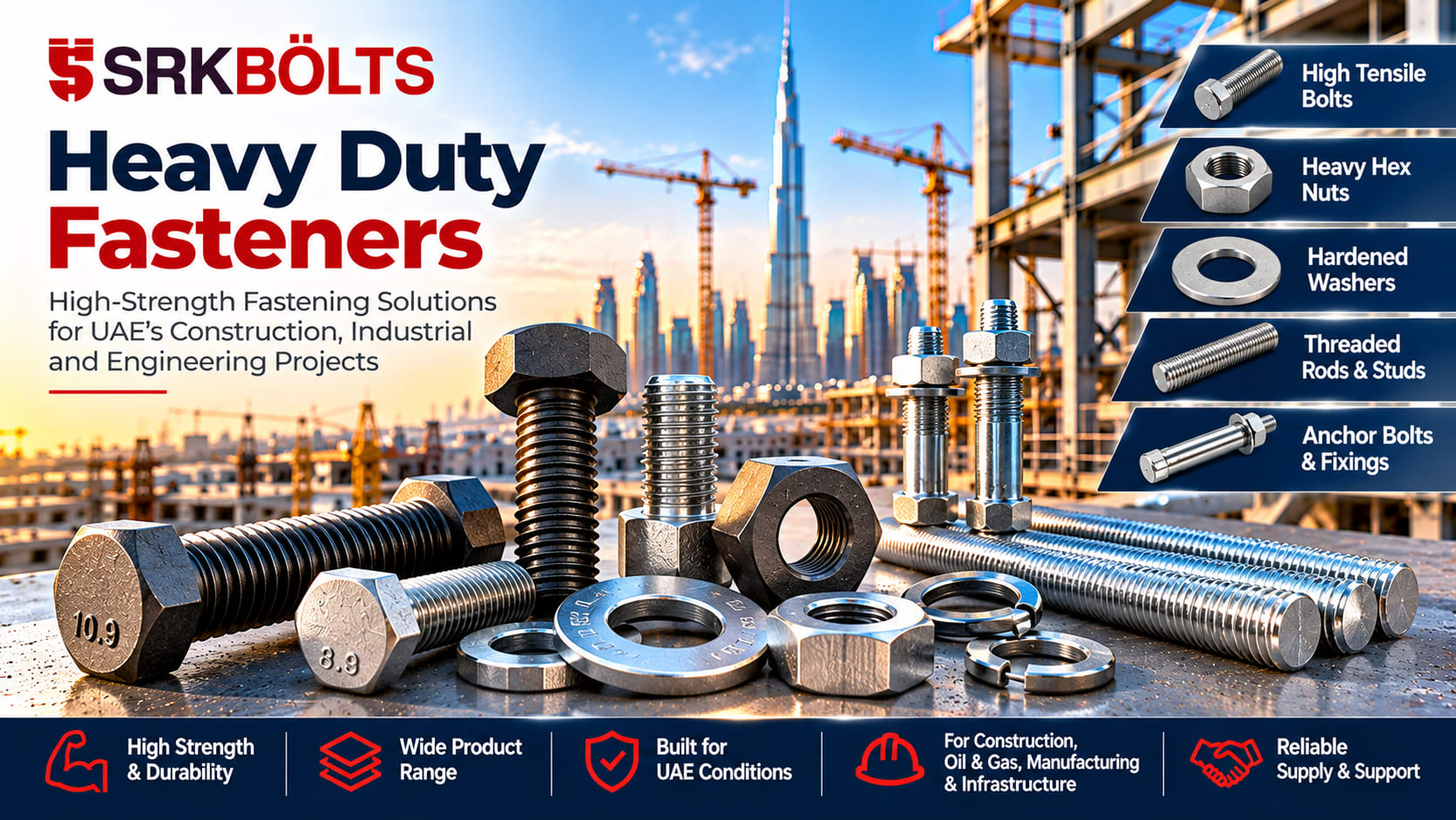
Common heavy-duty fastening components include:
High tensile bolts
Structural steel bolts
Heavy hex nuts
Hardened steel washers
Threaded rods and studs
Anchor bolts and heavy-load fixings
Specialized socket head bolts
Engineered locking fasteners
These products are used in applications where standard general-purpose fastening solutions may not meet the required mechanical specifications.
Major Types of Heavy Duty Fasteners Used in UAE
1. High Tensile Bolts
High tensile bolts are among the most important components used in heavily loaded mechanical assemblies.
They are manufactured to meet specified mechanical property classes and are commonly used in machinery, steel fabrication, and engineered connections.
Metric property classes frequently include 8.8, 10.9, and 12.9.
Common applications:
Heavy machinery
Industrial equipment
Steel fabrication
Mechanical power transmission
Automotive assemblies
Engineered fastening systems
Property class 8.8 is commonly specified for many industrial applications, while classes 10.9 and 12.9 may be used where higher mechanical strength is required.
However, a higher property class does not automatically make a bolt more suitable for every application.
The correct grade must be selected according to the engineering design.
2. Heavy Hex Bolts
Heavy hex bolts have larger head dimensions across the flats than standard hex bolts of comparable nominal diameters.
They are commonly used in particular structural and industrial fastening applications.
Common applications:
Steel buildings
Infrastructure projects
Structural steel fabrication
Bridges
Heavy industrial structures
For structural applications, heavy hex bolts must comply with the required structural bolting specification.
They should not be confused with ordinary hex bolts simply because the products appear similar.
3. Structural Steel Fasteners
Structural fasteners are designed for engineered steel connections.
They are commonly supplied as compatible fastening assemblies consisting of bolts, nuts, and washers.
Different structural connections may require snug-tightened, pretensioned, or slip-critical installation arrangements, depending on the approved design.
Common applications:
High-rise buildings
Industrial warehouses
Steel bridges
Infrastructure developments
Heavy steel frameworks
In these applications, proper installation is just as important as correct fastener selection.
4. Heavy Hex Nuts
Heavy hex nuts provide larger wrenching dimensions than regular hex nuts of comparable nominal thread sizes.
They are frequently specified for certain structural bolting assemblies and demanding industrial connections.
Common applications:
Structural steel
Heavy equipment
Industrial fabrication
Infrastructure installations
Engineered mechanical connections
The nut must be compatible with the bolt's thread, material, strength requirements, and applicable assembly standard.
5. Hardened Steel Washers
Hardened washers are important components in many high-strength bolted connections.
They provide a suitable bearing surface and help resist excessive deformation beneath bolt heads or nuts.
Common applications:
Structural bolting
Heavy machinery installation
Steel construction
Equipment supports
Industrial assemblies
ASTM F436/F436M is commonly referenced for specified hardened steel washers.
Using an unsuitable soft washer in a high-strength fastening assembly may affect the intended bearing conditions.
6. Heavy Duty Threaded Rods
Threaded rods are elongated externally threaded components used in mechanical supports, anchoring systems, and industrial assemblies.
They are available in different diameters, lengths, materials, strength grades, and finishes.
Common applications:
Industrial pipe supports
Machinery installation
Equipment anchoring
Mechanical services
Structural attachment systems
Industrial fabrication
The appropriate threaded rod must be selected according to tensile loading, thread engagement, corrosion exposure, and other applicable design requirements.
7. Anchor Bolts and Heavy-Load Fixings
Heavy-duty anchor bolts and fixing systems are used to secure components to concrete, masonry, and other suitable supporting materials.
Common designs include mechanical expansion anchors, cast-in anchor bolts, concrete screws, and engineered adhesive anchoring systems.
Common applications:
Machinery foundations
Structural equipment supports
Steel column connections
Industrial installations
Building infrastructure
Heavy equipment anchoring
Anchor design must consider concrete strength, cracking conditions, edge distances, embedment depth, spacing, and installation procedures.
A product should never be selected based solely on its nominal diameter or an advertised heavy-load description.
8. High-Strength Socket Head Cap Screws
Socket head cap screws are widely used in precision machinery and mechanical engineering.
Their internal hexagonal drive can be useful in assemblies where access is limited.
Certain designs are available in high-strength property classes for mechanically demanding applications.
Common applications:
Industrial machinery
Automation equipment
Heavy mechanical assemblies
Precision engineering
Machine maintenance
The correct screw grade, thread engagement, and tightening method must be selected according to the assembly design.
Understanding Heavy Duty Fastener Grades
Strength grading is one of the most important aspects of fastener selection.
For many metric carbon and alloy steel bolts, ISO 898-1 specifies mechanical property requirements.
Property class | Nominal tensile strength | Typical use |
|---|---|---|
4.6 | 400 MPa | General lower-strength connections |
8.8 | 800 MPa | Industrial machinery and engineered assemblies |
10.9 | 1,000 MPa | Higher-strength mechanical connections |
12.9 | 1,200 MPa | Specialized high-strength applications |
These nominal values are not permissible working loads. Actual bolt capacity depends on diameter, threaded area, joint design, loading conditions, and installation requirements.
ISO 898-1:2013 remains current following its 2025 review, and explicitly notes that properties established at ambient test temperatures may not be retained under elevated or low-temperature service conditions.
Does a Higher Bolt Grade Always Mean Better Performance?
Not necessarily.
For example, a property class 12.9 bolt offers higher nominal tensile strength than a class 8.8 bolt, but it may not be suitable for the same environment, coating process, or connection design.
High-strength fasteners can also require special attention to fatigue, hydrogen embrittlement, material toughness, and installation conditions.
Engineers should select the grade that meets the complete application requirements rather than automatically choosing the strongest available product.
Heavy Duty Fastener Materials for UAE Industrial Conditions
The United Arab Emirates presents a combination of demanding climatic and industrial conditions.
Fasteners may experience high temperatures, coastal humidity, salt exposure, industrial chemicals, and abrasive dust.
These factors make material and coating selection especially important.
Carbon Steel
Carbon steel is widely used for industrial fastening components.
It offers useful mechanical properties and is available in various grades and dimensions.
However, untreated carbon steel can corrode when exposed to moisture and aggressive environments.
Alloy Steel
Alloy steel fasteners are commonly selected for demanding mechanical applications.
Depending on the material and heat treatment, they can provide high strength, hardness, and other specialized mechanical properties.
They are often used in heavy machinery and engineered equipment.
Stainless Steel
Stainless steel offers improved corrosion resistance in many industrial environments.
Common A2 and A4 families are used in appropriate fastening applications.
A4 stainless steel generally offers better resistance to certain chloride-containing environments than A2.
However, common stainless steel property classes should not automatically replace higher-strength carbon or alloy steel fasteners.
Mechanical suitability and corrosion resistance must both be verified.
Hot-Dip Galvanized Steel
Hot-dip galvanizing provides a protective zinc coating.
It is frequently considered for suitable outdoor structural and infrastructure applications.
However, not all high-strength fasteners are suitable for every galvanizing process.
Coating restrictions, thread tolerances, and the applicable fastener standard must be checked.
Specialized Materials
Certain industrial environments may require fasteners manufactured from specialized alloys.
These applications can include high-temperature equipment, chemically aggressive processing systems, and other demanding service conditions.
Material selection should follow the applicable engineering specification.
Where Heavy Duty Fasteners Are Used Across UAE Industries
Construction and Structural Steel
Large construction projects require reliable mechanical connections between steel beams, columns, braces, equipment supports, and other structural components.
In Dubai, Abu Dhabi, and other major UAE construction markets, high-strength structural fasteners are essential for many engineered steel assemblies.
The correct bolt grade, nut, washer, and installation method must meet the approved structural design.
Oil, Gas and Petrochemical Industry
Oil and gas facilities use specialized fasteners in machinery, equipment supports, pressure-related assemblies, and industrial installations.
Some applications involve demanding temperatures, corrosive chemicals, high pressures, or cyclic mechanical loads.
These environments require careful specification of fastener materials, mechanical properties, and applicable technical standards.
Manufacturing and Heavy Machinery
Heavy industrial machinery depends on appropriately specified fastening systems.
Bolts, nuts, washers, and studs help secure machine frames, motors, gearboxes, production equipment, and other assemblies.
Vibration, fatigue, maintenance access, and preload requirements are important considerations.
Marine and Shipbuilding
Marine installations expose fastening components to moisture, salt, and potentially corrosive conditions.
Heavy-duty fasteners used in ports, shipyards, vessels, and marine equipment must provide the required mechanical strength alongside suitable corrosion resistance.
Infrastructure and Transportation
Bridges, transport infrastructure, industrial platforms, and engineered support systems use specialized structural fastening assemblies.
For these applications, documented material properties and correct installation procedures are particularly important.
Power Generation and Renewable Energy
Power infrastructure, industrial energy equipment, and solar installations require fastening systems suitable for their mechanical and environmental conditions.
Factors such as wind loading, vibration, temperature variation, and long-term corrosion exposure can influence fastener selection.
Important International Standards for Heavy Duty Fasteners
Industrial buyers should understand the relevant fastener standards before placing orders.
Standard | Main application |
|---|---|
ISO 898-1 | Mechanical properties of specified steel bolts, screws and studs |
ISO 898-2 | Mechanical properties of applicable steel nuts |
ISO 4014 | Hexagon head bolts |
ISO 4032 | Regular hexagon nuts |
ISO 4762 | Hexagon socket head cap screws |
ASTM F3125/F3125M | High-strength structural bolts and assemblies |
ASTM F436/F436M | Hardened steel washers |
ISO 3506-1 | Mechanical properties of specified stainless steel bolts, screws and studs |
For structural bolts, ASTM F3125/F3125M consolidates several earlier structural bolting specifications, including A325, A490, and their metric counterparts. Its 2026 edition is listed as current.
When purchasing fasteners, the exact edition required by the project's approved documents should be confirmed.
How to Choose the Right Heavy Duty Fasteners: Eight Essential Factors
Selecting industrial fasteners requires attention to the complete mechanical connection rather than individual components alone.
1. Identify the load requirements. Determine whether the connection will experience tension, shear, vibration, fatigue, or combined loading.
2. Confirm the required standard. Verify the applicable ISO, DIN, ASTM, EN, or other project specification.
3. Select the correct strength grade. Choose the required property class or structural bolting grade according to the approved design.
4. Verify dimensions and thread specifications. Confirm diameter, length, pitch, thread engagement, and dimensional tolerances.
5. Evaluate corrosion resistance. Consider exposure to humidity, salt, chemicals, and operating temperatures.
6. Match nuts and washers correctly. The entire bolting assembly must be compatible and meet the applicable requirements.
7. Review installation procedures. Tightening methods, preload requirements, lubrication, and inspections can influence connection performance.
8. Request technical documentation. Depending on the project, buyers may need material certificates, inspection records, manufacturer data, or traceability information.
Common Mistakes to Avoid When Buying Heavy Duty Fasteners
Heavy-duty fastener procurement involves several potential risks.
One frequent mistake is assuming that all high tensile bolts are interchangeable.
For example, a property class 10.9 hex bolt is not automatically an acceptable substitute for a specified structural bolt assembly.
Another mistake is ordering fasteners by diameter and length without specifying the required grade, standard, or finish.
Procurement teams may also overlook compatibility between nuts, bolts, and washers.
Incorrect coating choices can be particularly problematic for certain high-strength fasteners.
Other common issues include inappropriate tightening, insufficient thread engagement, and using general-purpose anchors in applications requiring engineered fixing systems.
Avoiding these mistakes starts with complete technical specifications and proper engineering verification.
Preparing an Accurate RFQ for Heavy Duty Fasteners
For industrial buyers, a detailed Request for Quotation helps suppliers identify suitable products and confirm availability.
The following example illustrates the information typically required.
Specification | Example requirement |
|---|---|
Product | High tensile hexagon head bolt |
Standard | ISO 4014 |
Nominal diameter | M20 |
Length | 100 mm |
Thread pitch | Metric coarse |
Property class | 10.9 |
Material | Carbon/alloy steel |
Surface finish | As per approved project specification |
Quantity | 2,000 pieces |
Delivery | Dubai, UAE |
Documentation | Material certificates and inspection records as required |
A supplier may also require the relevant drawing, bill of quantities (BOQ), or technical schedule for specialized products.
Why Choosing a Reliable Heavy Duty Fasteners Supplier in UAE Matters
Industrial fastening requirements can involve large quantities, demanding specifications, and strict project schedules.
A contractor installing a steel framework may need several bolt sizes, heavy hex nuts, hardened washers, and threaded studs.
A manufacturing facility may require high-strength socket head cap screws, flange bolts, and replacement fasteners for industrial machinery.
In both cases, supplier reliability matters.
A suitable supplier should provide clear product specifications, sourcing support for different strength grades and materials, and accurate quotations.
The ability to process project drawings, technical schedules, and bulk enquiries can also simplify procurement.
For industrial buyers, dependable sourcing is not simply about purchasing fasteners. It is about obtaining components that match the intended engineering requirements.
SRK Bolt: Heavy Duty Fasteners Supplier in UAE
For contractors, manufacturers, engineering companies, and procurement professionals searching for a Heavy Duty Fasteners Supplier in UAE, SRK Bolt provides industrial fastening products and project-based sourcing support.
Established in 2015, SRK Bolt is a UAE-based supplier serving construction, structural steel, oil and gas, marine, manufacturing, and engineering applications.
The company lists more than 5,000 fastener SKUs, sourced through an international network of manufacturers across India, Europe, and the Far East.
Its catalogue includes heavy-duty fastening options such as high tensile black bolts in property classes 8.8 and 10.9, heavy hex structural bolts, threaded bars, hot-dip galvanized threaded rods, and specialized industrial fasteners.
SRK Bolt supports customers across Dubai, Abu Dhabi, Sharjah, Ajman, Ras Al Khaimah, and other UAE markets, as well as regional enquiries throughout the GCC.
Businesses can explore the Industrial Fasteners & Heavy-Duty Fixings collection and submit their required dimensions, material grades, standards, finishes, quantities, and drawings for quotation and availability.
For related requirements, buyers can also explore industrial bolts, industrial nuts, and industrial washers.
Frequently Asked Questions About Heavy Duty Fasteners in UAE
What are heavy duty fasteners?
Heavy-duty fasteners are mechanical fastening components designed or specified for demanding industrial, structural, or load-bearing applications. They include high tensile bolts, structural nuts, hardened washers, threaded rods, and specialized fixings.
What is the difference between standard bolts and high tensile bolts?
High tensile bolts are manufactured to meet specified mechanical strength requirements, often higher than those of general low-strength bolts. Their suitability depends on the complete engineering specification.
Which bolt grades are commonly used for heavy machinery?
Property classes 8.8, 10.9, and 12.9 are used in different industrial mechanical applications. The correct grade depends on the machinery design and manufacturer requirements.
Are stainless steel fasteners suitable for heavy-duty applications?
Certain stainless steel fasteners may be suitable for demanding applications, but their mechanical strength and corrosion resistance must meet the relevant engineering requirements.
What fasteners are used in structural steel construction?
Structural steel connections may use specified high-strength structural bolts, compatible nuts, and hardened washers. The complete assembly and installation must meet the applicable structural standards.
Can heavy-duty fasteners be galvanized?
Some heavy-duty fasteners can be supplied with appropriate galvanized finishes. However, coating suitability depends on the fastener grade, manufacturing standard, and applicable restrictions.
What information is needed for a bulk fastener quotation?
Buyers should provide the product type, dimensions, standard, property class, material, finish, quantity, delivery location, and any necessary certification requirements.
Where can I find a Heavy Duty Fasteners Supplier in UAE?
Industrial buyers can explore heavy-duty fastening products through SRK Bolt and submit project-specific requirements for sourcing and quotation assistance.
Conclusion: Heavy-Duty Performance Begins With the Right Fasteners
In construction, manufacturing, infrastructure, and industrial engineering, reliable connections are essential.
Heavy-duty fasteners perform important functions in assemblies that may experience substantial loads, vibration, fatigue, or demanding environmental conditions.
However, high strength alone does not guarantee reliable performance.
Material compatibility, dimensions, grades, protective coatings, installation procedures, and relevant technical standards all influence the suitability of a fastening system.
For businesses operating in the UAE, selecting appropriate heavy-duty fasteners can help reduce premature connection problems, unnecessary maintenance, and procurement complications.
The most effective approach is to prioritize engineering specifications, product compatibility, and dependable sourcing rather than purchasing solely on price.
For contractors and industrial procurement teams seeking Heavy Duty Fasteners in UAE, SRK Bolt offers a broad industrial fastener catalogue and specification-based sourcing support for demanding project requirements.
Explore fastening solutions at www.srkbolt.com/products