
The Unsung Heroes of Strong Connections: Choosing the Right Industrial Washers Supplier in UAE
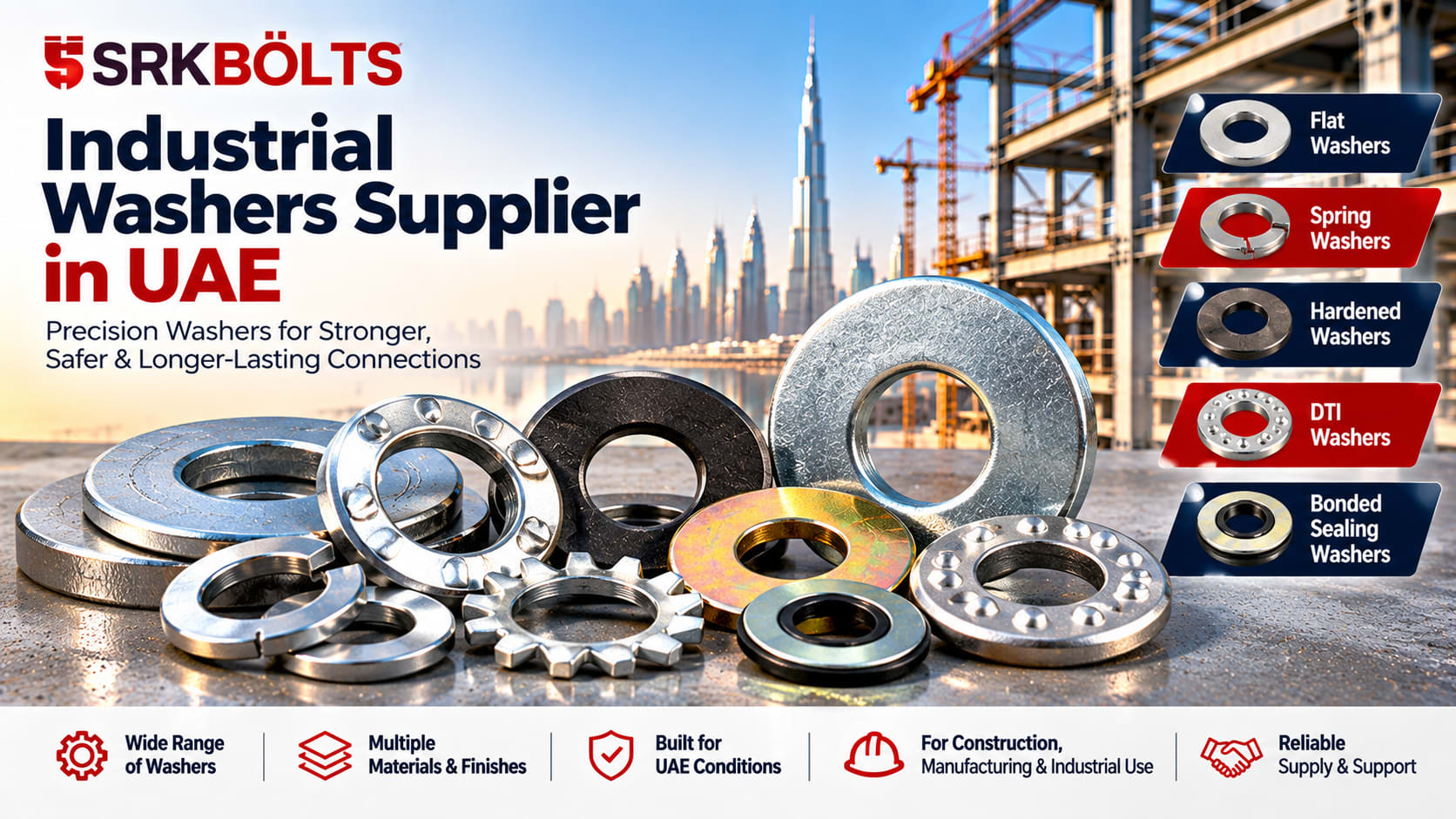
Introduction: Why a Small Washer Can Make a Big Difference
Imagine a heavy industrial machine operating continuously inside a manufacturing facility in Sharjah.
Thousands of components work together, and numerous bolted connections keep the equipment assembled. The bolts and nuts may be correctly sized, but what happens if the washers beneath them are unsuitable for the application?
The bearing surface could deform, the protective coating could become damaged, or the joint might fail to maintain its required clamping conditions.
Such problems demonstrate why even the smallest fastening components deserve careful attention.
Industrial washers are essential parts of many mechanical assemblies. They help distribute contact pressure, protect connected surfaces, provide appropriate bearing conditions, and perform specialized functions such as sealing, tension indication, or mechanical locking.
Across the United Arab Emirates, industries depend on these components for everything from steel construction and machinery installation to marine engineering and industrial maintenance.
However, not all washers are designed for the same purpose.
A standard flat washer may be appropriate for a general mechanical assembly, while a high-strength structural connection may require a hardened washer manufactured to a specific standard.
Similarly, a stainless steel washer may provide useful corrosion resistance, but it cannot automatically replace a hardened carbon steel washer in a highly loaded assembly.
For contractors, engineers, and procurement managers, understanding these differences is essential.
Working with a reliable Industrial Washers Supplier in UAE can help businesses source the correct washers according to their project requirements.
This guide explores the most commonly used industrial washers, their materials, technical standards, applications, and important factors to consider when buying washers across Dubai, Abu Dhabi, Sharjah, and the wider UAE.
What Are Industrial Washers?
Industrial washers are mechanical components, usually shaped like thin discs with central openings, that are installed as part of fastening assemblies.
They are commonly positioned beneath bolt heads or nuts, although specialized washer designs may be used in other configurations.
Depending on their design, washers perform several important functions:
Distributing contact pressure over a suitable bearing area.
Protecting connected materials from localized surface damage.
Providing controlled bearing conditions during tightening.
Supporting particular locking or retention arrangements.
Creating seals in compatible fluid-handling connections.
Helping assess bolt tension in specialized structural assemblies.
Accommodating specific spacing or mechanical design requirements.
The important point is that washer functionality depends on the washer type.
A plain washer should not be assumed to prevent vibration-related loosening, and a general-purpose washer should not replace a specifically engineered sealing or structural component.
Choosing the right washer requires understanding the complete fastening assembly.
Common Types of Industrial Washers Used in UAE
1. Flat Washers: Essential for Load Distribution
Flat washers, also known as plain washers, are among the most commonly used fastening components.
Their simple circular shape provides a bearing surface between the bolt head or nut and the connected material.
They can help distribute contact pressure and reduce localized damage to the surface.
Common applications:
Steel fabrication
Machinery assembly
Building construction
General engineering
Industrial equipment installation
Maintenance operations
Flat washers are available in various inside diameters, outside diameters, thicknesses, materials, and finishes.
ISO 7089:2000 specifies normal-series plain washers of product grade A.
The correct washer should be selected according to the fastener size, bearing requirements, and applicable engineering specifications.
2. Spring Washers: Supporting Specific Fastening Requirements
Spring washers are designed to exhibit elastic behavior under particular loading conditions.
Different designs include split helical spring washers, conical spring washers, and wave spring washers.
Their mechanical behavior varies significantly.
Conventional split spring washers are frequently found in general machinery and equipment assemblies.
However, they should not be assumed to prevent loosening under severe vibration.
For demanding applications, engineers may specify appropriate prevailing-torque fasteners, wedge-locking washer systems, or other validated locking arrangements.
Common applications:
General machinery
Mechanical equipment
Automotive assemblies
Industrial maintenance
Selected electrical installations
The correct spring washer design depends on the required mechanical function.
3. Stainless Steel Washers: Corrosion Resistance for Demanding Environments
Stainless steel washers are commonly used where improved resistance to corrosion is required.
They are particularly relevant to certain outdoor, coastal, and industrial environments in the UAE.
Common stainless steel material families include A2 and A4.
A2 stainless steel is generally associated with the 304 family.
A4 stainless steel is generally associated with the 316 family and offers improved resistance to certain chloride-containing conditions.
Common applications:
Marine-related equipment
Outdoor infrastructure
Architectural installations
Food-processing machinery
Selected chemical-processing applications
Although stainless steel provides useful corrosion resistance, the appropriate grade must be selected according to the operating environment and mechanical requirements.
4. Heavy-Duty and Hardened Washers
Hardened washers are manufactured to meet specified hardness or mechanical property requirements.
They are commonly used in engineered connections involving high-strength fasteners.
Their function includes providing a suitable bearing surface and resisting excessive deformation under high clamping loads.
Common applications:
Structural steel connections
Heavy machinery
Industrial equipment
Bridge construction
Engineered steel assemblies
Depending on the application, hardened washers may be specified according to standards such as ASTM F436/F436M.
Using a soft washer where a hardened washer is required can compromise the intended bearing conditions.
5. Large-Diameter Washers
Large-diameter washers have a greater outside diameter relative to their central hole than many regular plain washers.
They are useful when a wider bearing area is required.
Common applications:
Sheet metal assemblies
Lightweight fabrication
Equipment covers
Selected timber connections
General construction
ISO 7093-1:2000 covers large-series plain washers of product grade A.
The increased outside diameter does not automatically make a washer suitable for heavy structural loads. Thickness, hardness, and material specifications must also be considered.
6. Direct Tension Indicator (DTI) Washers
Direct tension indicator washers are specialized components used to help assess the pretension developed in particular bolted connections.
They typically contain raised protrusions that compress as the bolt assembly is tightened.
The resulting gap is evaluated according to the manufacturer's instructions and the applicable installation procedure.
Common applications:
Structural steel construction
Heavy engineering
Bridges
Industrial steel frameworks
Preloaded bolting assemblies
DTI washers are particularly relevant where achieving specified bolt pretension is important.
SRK Bolt also publishes information about DTI Washers in UAE.
7. Bonded Sealing Washers
Bonded sealing washers typically combine a metal washer with an elastomeric sealing element.
They are designed to create a seal around a compatible fastener connection.
Common applications:
Hydraulic equipment
Fluid-handling systems
Industrial machinery
Selected roofing installations
Mechanical equipment assemblies
The elastomer must be compatible with the operating temperature, fluid, pressure, and installation conditions.
8. Conical and Disc Spring Washers
Conical spring washers and disc springs are designed to provide controlled elastic deflection under load.
They can be used in specialized mechanical assemblies where spring characteristics are required.
DIN 6796 and DIN 2093 are commonly referenced specifications for particular conical washer and disc spring designs.
Common applications:
Heavy mechanical assemblies
Industrial equipment
Specialized fastening systems
Machinery requiring defined elastic behavior
These products must be selected based on appropriate load-deflection characteristics.
SRK Bolt's published catalogue includes washer designs such as DIN 125 plain washers, DIN 9021 large-diameter washers, DIN 6796 conical spring washers, DIN 137 wave spring washers, and DIN 2093 disc spring washers.
Industrial Washer Comparison Guide
Washer type | Primary function | Typical application |
|---|---|---|
Plain washer | Bearing surface and pressure distribution | Construction and machinery |
Split spring washer | Elastic behavior in selected assemblies | General equipment |
Hardened washer | Resist bearing deformation | High-strength bolting |
Large-diameter washer | Provide a wider bearing area | Sheet metal and fabrication |
DTI washer | Indicate specified bolt tension | Structural connections |
Bonded sealing washer | Provide a seal | Fluid systems and roofing |
Conical spring washer | Provide elastic load-deflection behavior | Specialized mechanical systems |
Tab washer | Provide mechanical retention | Machinery and bearing assemblies |
This comparison highlights why selecting washers by appearance alone is unreliable.
Selecting Washer Materials for UAE Environmental Conditions
Industrial washers used in the UAE may experience high temperatures, humidity, airborne salt, dust, and chemical exposure.
Material and surface-finish selection can therefore significantly influence long-term performance.
Carbon Steel Washers
Carbon steel washers are widely used because of their availability, mechanical properties, and cost-effectiveness.
They are suitable for many general engineering applications.
However, untreated carbon steel may corrode when exposed to aggressive environments.
Stainless Steel Washers
Stainless steel washers provide improved corrosion resistance in many applications.
For coastal installations in Dubai and Abu Dhabi, appropriate stainless steel grades may be beneficial.
However, stainless steel should not automatically be selected where a particular washer hardness or mechanical grade is required.
Galvanized Steel Washers
Galvanized washers feature zinc coatings designed to protect the underlying steel.
They are commonly considered for suitable outdoor construction and infrastructure installations.
The coating should be compatible with the complete fastener assembly.
Hardened Alloy or Carbon Steel Washers
These washers are used when particular hardness or load-bearing characteristics are required.
They are especially relevant to engineered high-strength bolted connections.
Brass and Copper Washers
Brass and copper washers are used in selected sealing, electrical, and mechanical applications.
Copper crush washers, for example, may be used in compatible fluid-sealing arrangements.
They should not be substituted for structural steel washers without engineering approval.
Understanding Washer Dimensions and Technical Specifications
One of the most common purchasing mistakes is assuming that any washer with a matching central hole will work with a particular bolt.
For industrial procurement, several dimensions are important.
Inside diameter (ID): The diameter of the central opening through which a bolt or threaded component passes.
Outside diameter (OD): The overall washer diameter, which influences its bearing area.
Thickness: The washer's axial dimension, which affects its geometry and mechanical behavior.
Hardness: An important property in applications where resistance to bearing deformation is required.
Material and finish: These influence mechanical compatibility and corrosion performance.
Applicable standard: This defines the specific dimensional or performance characteristics required for the product.
For example, a washer described only as "M16 plain washer" may not provide enough information to identify the required outside diameter, thickness, material, and standard.
An accurate purchase order should contain the complete specification.
Important International Standards for Industrial Washers
International standards help define washer dimensions, materials, mechanical properties, and other technical characteristics.
Standard | Common application |
|---|---|
ISO 7089 | Normal-series plain washers |
ISO 7090 | Chamfered normal-series plain washers |
ISO 7093-1 | Large-series plain washers |
DIN 125 | Traditional plain washer specification |
DIN 9021 | Large outside-diameter washers |
DIN 6796 | Conical spring washers for bolted connections |
DIN 137 | Wave spring washers |
DIN 2093 | Disc springs |
ASTM F436/F436M | Hardened steel washers for specified applications |
ASTM F959/F959M | Compressible-washer-type direct tension indicators |
Standards should be selected according to the specific application.
Different washer specifications are not necessarily interchangeable, even when nominal dimensions appear similar.
Where Are Industrial Washers Used Across UAE Industries?
Construction and Structural Steel
Structural steel projects require suitable bolts, nuts, and washers to create engineered connections.
Depending on the application, hardened washers or specialized tension-indicating components may be necessary.
Oil and Gas
Industrial washers are used in selected piping, equipment, machinery, and supporting assemblies.
Material compatibility and operating conditions are especially important in demanding environments.
Marine and Shipbuilding
Marine installations can expose fastening components to saltwater, humidity, and corrosive conditions.
Proper material selection, corrosion protection, and compatibility with adjoining components are essential.
Manufacturing and Heavy Machinery
Manufacturing facilities use washers in machine frames, equipment housings, conveyors, motors, and other mechanical assemblies.
Correct washer selection supports appropriate bearing conditions and assembly reliability.
Electrical and MEP Installations
Electrical panels, HVAC installations, cable tray systems, and mechanical supports use different washer types according to installation requirements.
Renewable Energy
Solar installations and power infrastructure use washers as parts of specified fastening assemblies.
Outdoor exposure and compatibility with structural materials are important considerations.
Seven Common Mistakes When Buying Industrial Washers
Even experienced purchasing teams can encounter problems when ordering washers.
1. Ordering Only by Nominal Bolt Size
A purchase order that states "M12 washers" may not identify the required washer standard, hardness, or dimensions.
2. Ignoring Washer Hardness
A general-purpose soft washer may not be suitable for a high-strength structural bolting application.
3. Assuming Every Spring Washer Prevents Loosening
Different spring washer designs perform different mechanical functions.
Conventional split washers are not universal vibration-locking devices.
4. Choosing Material Based Only on Appearance
Two visually similar washers may have different material grades, corrosion resistance, and mechanical properties.
5. Mixing Incompatible Coatings
Surface finishes can influence corrosion behavior and the compatibility of a fastening assembly.
6. Using Sealing Washers for Structural Purposes
Bonded sealing washers are designed for particular sealing functions and should not replace engineered structural washers.
7. Overlooking Product Documentation
For industrial projects, missing specifications or required inspection records may cause procurement and installation delays.
Avoiding these mistakes begins with complete technical descriptions.
How to Prepare an Accurate RFQ for Industrial Washers
A Request for Quotation should identify the washer type and all necessary technical specifications.
Here is an illustrative example for a UAE industrial procurement enquiry.
Specification | Example requirement |
|---|---|
Product | Plain washer |
Standard | ISO 7089 |
Nominal bolt size | M16 |
Material | Carbon steel |
Hardness | As required by joint design |
Finish | As specified by project |
Quantity | 10,000 pieces |
Delivery location | Dubai, UAE |
Documentation | Manufacturer data and inspection records as required |
This example is for quotation preparation only. The final technical specifications must be approved for the intended application.
Providing complete information makes it easier for suppliers to identify the correct product and clarify availability.
Why Choosing a Reliable Industrial Washers Supplier in UAE Matters
Industrial procurement involves more than finding products at competitive prices.
Construction contractors and manufacturing companies often require washers with specific dimensions, materials, hardness levels, finishes, and certifications.
A dependable supplier should be able to respond accurately to these requirements.
Access to complementary fasteners can also simplify procurement.
For example, a structural steel contractor may need high-strength bolts, compatible nuts, and hardened washers for the same project.
Sourcing these components together can help reduce specification mismatches and streamline purchasing.
Supplier responsiveness, technical information, product range, and sourcing capability should all be considered.
SRK Bolt: Industrial Washers Supplier in UAE
For contractors, engineers, manufacturers, and procurement professionals searching for an Industrial Washers Supplier in UAE, SRK Bolt offers industrial washer sourcing support for construction, structural steel, machinery, and engineering applications.
Established in 2015, SRK Bolt is a UAE-based industrial fastener supplier serving customers across the UAE and GCC.
Its broader product catalogue includes more than 5,000 fastener SKUs, with sourcing relationships across India, Europe, and the Far East.
SRK Bolt's washer category covers enquiries for plain washers, spring washers, tab washers, bonded sealing washers, and other specialized washer designs.
The company supports specifications involving different dimensions, materials, finishes, and project quantities.
With its head office in Sharjah, SRK Bolt serves industrial markets including Dubai, Abu Dhabi, Sharjah, and Ajman, alongside regional markets such as Saudi Arabia, Qatar, Kuwait, Bahrain, and Oman.
Businesses can explore the Industrial Washers Collection at SRK Bolt and submit their technical specifications for sourcing and quotation.
For complete fastening requirements, buyers can also explore SRK Bolt's industrial bolts, industrial nuts, and industrial screws.
Current product availability should be confirmed directly, as the company's online washer listings are being updated.
Frequently Asked Questions About Industrial Washers in UAE
What are industrial washers used for?
Industrial washers are used for load distribution, bearing support, surface protection, sealing, tension indication, and other specialized fastening functions depending on their design.
What is the difference between flat washers and spring washers?
Flat washers primarily provide bearing surfaces and help distribute contact pressure.
Spring washers are designed to provide particular elastic characteristics or support specialized fastening arrangements.
Which washers are suitable for outdoor use in UAE?
Appropriately specified stainless steel or galvanized washers may be suitable for outdoor applications.
Material selection depends on corrosion exposure, mechanical requirements, and compatibility with the complete fastening assembly.
What are hardened washers used for?
Hardened washers are used where specified hardness and resistance to bearing deformation are required, particularly in certain high-strength bolted connections.
What is a DTI washer?
A Direct Tension Indicator washer is a specialized component used to help assess bolt pretension during installation.
Are stainless steel washers better than carbon steel washers?
Neither is universally better.
Stainless steel generally offers improved corrosion resistance in suitable environments, while particular carbon or alloy steel washers may offer mechanical properties needed for heavily loaded applications.
Can industrial washers be ordered in bulk in UAE?
Yes. Industrial suppliers such as SRK Bolt support project-based and bulk enquiries.
Buyers should provide the washer standard, dimensions, material, finish, quantity, and required documentation.
Where can I find an industrial washers supplier in UAE?
Businesses can explore industrial washer products at SRK Bolt and submit their project specifications for quotation and availability confirmation.
Conclusion: Reliable Connections Depend on More Than Bolts and Nuts
Industrial washers may be simple in appearance, but their functions are essential to many mechanical and structural assemblies.
From supporting bearing loads and protecting surfaces to providing sealing and specialized tension-indication functions, different washers contribute to connection performance in different ways.
For businesses operating in the UAE, selecting the correct washer requires understanding the complete fastening system.
Material compatibility, dimensions, mechanical properties, environmental exposure, installation conditions, and applicable international standards must all be considered.
Choosing products solely on price or appearance may lead to avoidable procurement mistakes and maintenance costs.
Instead, contractors, engineers, and procurement teams should prioritize technical suitability and accurate specifications.
For companies looking for a dependable Industrial Washers Supplier in UAE, SRK Bolt offers access to industrial washer options and sourcing support for construction, manufacturing, oil and gas, marine, and general engineering requirements.
Explore the complete product category at www.srkbolt.com/washers