
Beyond Strength: How the Right Industrial Bolts Keep UAE's Biggest Projects Together
Introduction: Why the Right Bolt Matters More Than Its Size
A steel structure can be designed to withstand enormous loads, but its performance still depends on the connections between its individual components.
Consider a warehouse under construction in Dubai. Steel columns and beams are positioned, alignment checks are completed, and workers begin installing hundreds of bolts to connect the framework.
From a distance, these bolts may look nearly identical. However, their specifications can differ considerably.
Some are intended for general fabrication, others for structural steel connections, and certain high-tensile bolts are designed for demanding mechanical assemblies.
Choosing the wrong type can create problems that are not immediately visible.
A mismatched bolt grade may compromise the intended connection performance. Incorrect thread engagement can damage components. An unsuitable protective finish can accelerate corrosion, particularly in exposed industrial environments.
For construction and engineering companies operating across the UAE, these are important considerations.
The country's industrial activities range from commercial construction and logistics facilities to petrochemical installations, marine engineering, manufacturing, and infrastructure development.
Each sector has different requirements for mechanical strength, material compatibility, corrosion protection, and installation.
This is why sourcing bolts involves more than finding the right diameter at the lowest price.
It requires an understanding of how different bolt types perform and how their specifications relate to the complete fastening assembly.
A knowledgeable Industrial Bolts Supplier in UAE can help businesses identify suitable products according to their engineering and procurement requirements.
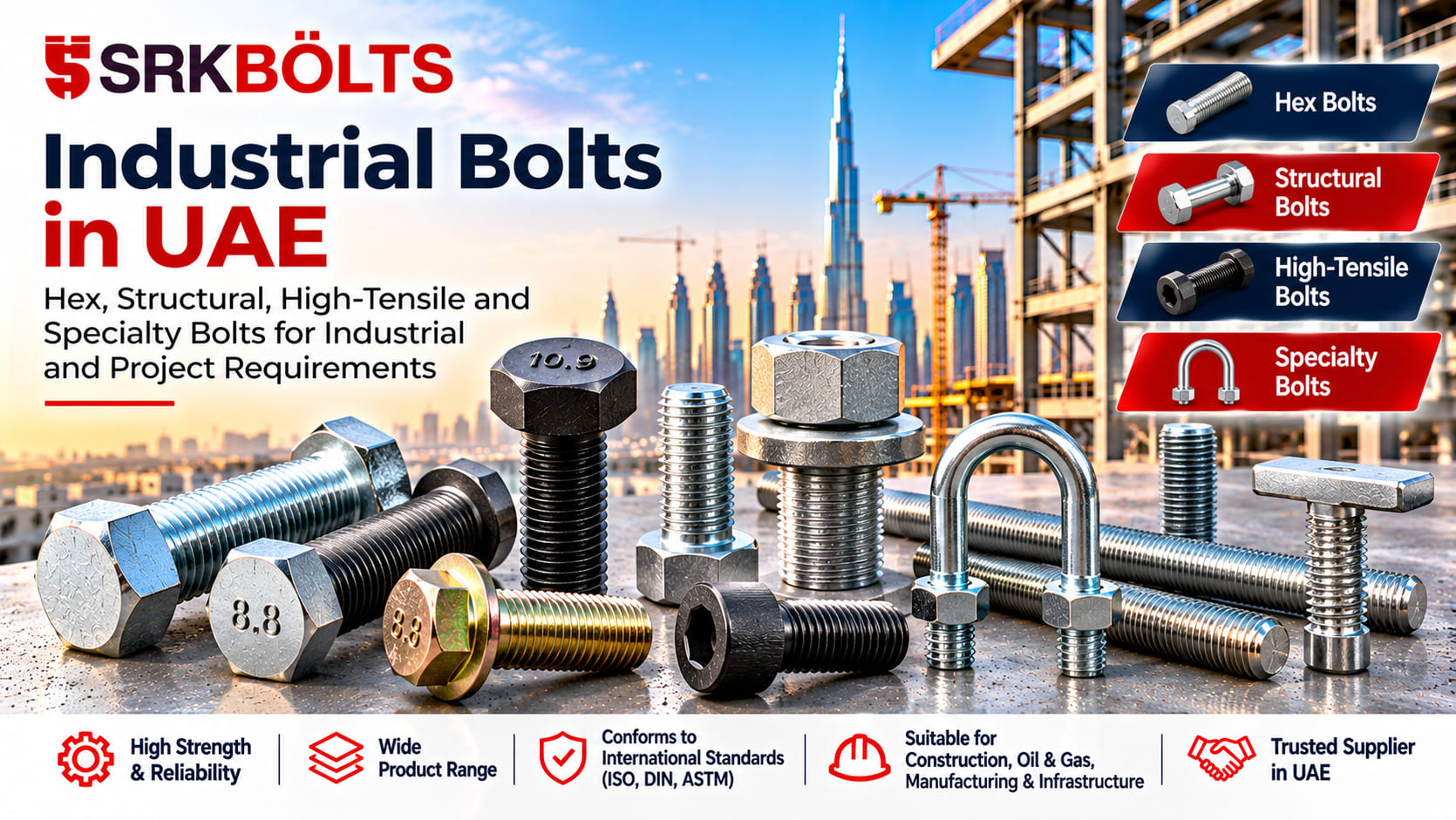
In this article, we explore hex bolts, structural bolts, high-tensile bolts, and specialty fastening products, along with practical advice for selecting quality industrial bolts for UAE projects.
What Are Industrial Bolts?
Industrial bolts are externally threaded mechanical fasteners used to connect or secure components.
They are commonly installed with compatible nuts and washers, although certain designs may engage directly with threaded holes.
When correctly tightened, a bolted connection develops clamping force that helps maintain contact between connected parts.
The required performance depends on several factors, including:
Bolt diameter, length, and thread pitch
Material composition and strength grade
Joint geometry and loading conditions
Nut and washer compatibility
Surface finish and corrosion protection
Tightening method and required preload
Temperature, vibration, and fatigue exposure
Applicable engineering standards
Unlike welded joints, many bolted connections can be disassembled for maintenance or component replacement.
However, not every fastener is suitable for reuse. Certain high-strength structural bolting assemblies have specific reuse restrictions.
Major Types of Industrial Bolts Used in UAE
1. Hex Head Bolts: The Everyday Workhorse of Industrial Fastening
Hex head bolts are among the most commonly used bolts in industrial and construction applications.
They feature a six-sided head that can be tightened or loosened using suitable spanners, sockets, or other installation tools.
Their straightforward design makes them useful in a wide variety of assemblies.
Common applications:
Structural steel fabrication
Industrial machinery
Mechanical equipment
Building construction
Automotive components
General engineering installations
Hex bolts are available in different materials, lengths, thread configurations, and strength classes.
Two commonly referenced dimensional specifications are DIN 931 for partially threaded hex bolts and DIN 933 for fully threaded hex bolts.
Relevant ISO specifications include ISO 4014 and ISO 4017.
Fully Threaded vs Partially Threaded Hex Bolts
A fully threaded hex bolt has threads extending along most of its shank.
A partially threaded hex bolt includes an unthreaded portion between the head and the threaded section.
Neither design is universally stronger.
The correct choice depends on grip length, connection geometry, shear-plane location, thread engagement, and the approved engineering design.
2. Structural Bolts: Engineered for Steel Connections
Structural bolts are used in engineered steel connections where particular mechanical properties and installation requirements must be satisfied.
These fasteners are frequently used in heavy steel frameworks and infrastructure installations.
Common applications:
Industrial warehouses
Steel-framed buildings
Bridges and infrastructure
Heavy structural platforms
Commercial steel construction
Structural bolting systems may include high-strength heavy hex bolts or specialized tension-control bolt assemblies.
Under ASTM specifications, commonly recognized structural grades include A325 and A490, along with their metric counterparts.
These grades are covered within ASTM F3125/F3125M, which consolidated several earlier structural bolting standards.
For structural steel applications, correct bolt selection is only one part of the process.
Engineers must also specify compatible nuts and washers, connection type, tightening method, and inspection requirements.
3. High-Tensile Bolts: When Mechanical Strength Is Essential
High-tensile bolts are manufactured to meet specified mechanical strength requirements.
They are commonly used in industrial machinery, engineered mechanical assemblies, and other applications involving demanding loads.
Popular metric property classes include 8.8, 10.9, and 12.9.
Common applications:
Heavy manufacturing machinery
Industrial equipment
Mechanical power transmission
Automotive engineering
Equipment frames
Specialized mechanical assemblies
High-tensile bolts are commonly manufactured from suitable carbon or alloy steels.
Their mechanical properties depend on material composition, manufacturing controls, and heat treatment.
One important consideration is that a higher strength class is not always the better choice.
For certain applications, fatigue behavior, toughness, corrosion conditions, or coating restrictions may make another grade more suitable.
4. Flange Bolts
Flange bolts feature an integrated flange beneath the bolt head.
The flange provides a larger bearing area than the head alone and can eliminate the need for a separate washer in certain approved applications.
Common applications:
Automotive manufacturing
Industrial equipment
Mechanical assemblies
Fabricated steel components
Machinery installation
DIN 6921 is a commonly referenced dimensional specification for hexagon flange bolts.
5. Socket Head Cap Screws (Allen Bolts)
Socket head cap screws feature an internal hexagonal drive.
Their design is useful in mechanical assemblies where installation space is limited or an external wrench cannot be conveniently used.
Common applications:
Precision machinery
Industrial automation
Equipment manufacturing
Mechanical maintenance
Automotive components
ISO 4762 and DIN 912 are commonly referenced for these fasteners.
The appropriate mechanical strength class should be selected according to the application.
6. U-Bolts
U-bolts have a U-shaped body with threaded ends.
They are commonly used to secure pipes, tubes, and cylindrical components to compatible supports.
Common applications:
Industrial pipe supports
Mechanical installations
Vehicle suspension systems
Utility infrastructure
Equipment mounting
DIN 3570 is a commonly referenced specification for certain pipe U-bolts.
Correct sizing should consider pipe diameter, support geometry, material, and service loads.
7. Carriage Bolts
Carriage bolts typically feature a rounded head and a square neck beneath it.
The square neck helps resist rotation when installed in suitable materials.
Common applications:
Timber construction
Furniture manufacturing
Industrial fixtures
Architectural assemblies
Selected equipment installations
DIN 603 is a commonly referenced specification.
8. Threaded Rods and Engineering Studs
Threaded rods and studs are used where an elongated threaded connection or attachment arrangement is required.
Depending on their design, they may be fully threaded or have threaded portions at their ends.
Common applications:
Machinery installation
Industrial support systems
Pipe supports
Equipment assemblies
Structural attachments
Maintenance and repair
Threaded rods and engineering studs should be selected according to the relevant grade, dimensions, installation geometry, and expected loads.
9. Specialty Bolts for Project-Specific Requirements
Not every industrial application can be addressed using a standard hex bolt.
Specialty bolts may be required for unusual connection geometries, limited installation space, particular load conditions, or customized manufacturing requirements.
Examples include T-head bolts, welding studs, countersunk socket bolts, low-head socket screws, and other engineered fastening products.
The appropriate design should be selected from approved drawings and product specifications.
Hex, Structural, High-Tensile & Specialty Bolts: Key Differences
Bolt category | Main characteristic | Typical application |
|---|---|---|
Hex bolts | Versatile six-sided head | General machinery and construction |
Structural bolts | Defined structural bolting specifications | Steel frameworks and infrastructure |
High-tensile bolts | Specified mechanical strength | Heavy machinery and mechanical engineering |
Flange bolts | Integrated bearing flange | Equipment and automotive assemblies |
Socket head screws | Internal-drive head | Precision machinery |
U-bolts | U-shaped threaded body | Pipe supports and equipment mounting |
Engineering studs | Threaded connection without conventional bolt head | Industrial equipment |
Specialty bolts | Application-specific geometry or performance | Customized engineering projects |
These categories can overlap. For example, a structural bolt may also be a high-strength heavy hex bolt.
The most important factor is ensuring the selected fastener meets the application's exact engineering requirements.
Understanding Industrial Bolt Grades: 8.8, 10.9 and 12.9
When purchasing industrial bolts, strength classification is one of the most important technical considerations.
For applicable metric carbon and alloy steel fasteners, ISO 898-1 specifies mechanical properties associated with different property classes.
Bolt property class | Nominal tensile strength | Typical use |
|---|---|---|
4.6 | 400 MPa | Lower-strength general assemblies |
5.8 | 500 MPa | Selected general engineering |
8.8 | 800 MPa | Industrial machinery and engineered connections |
10.9 | 1,000 MPa | Higher-strength mechanical assemblies |
12.9 | 1,200 MPa | Specialized high-strength applications |
These values are nominal tensile strengths, not permissible working loads.
The actual capacity of a connection depends on bolt diameter, thread engagement, joint design, loading, and installation conditions.
ISO 898-1:2013, reviewed and confirmed in 2025, covers specified carbon and alloy steel bolts, screws, and studs tested under defined ambient-temperature conditions. It does not independently establish corrosion resistance or performance in every service environment.
Should You Always Choose Grade 12.9?
No. Higher tensile strength does not automatically mean greater overall suitability.
For example, a bolt used in a highly loaded machine may need particular strength and fatigue characteristics, whereas an exposed construction connection may require a different combination of mechanical properties and corrosion protection.
Grade selection should follow the approved engineering specification.
Choosing the Right Bolt Materials for UAE Conditions
Industrial bolts used in the UAE can be exposed to high temperatures, humidity, airborne salts, dust, and industrial chemicals.
These conditions make material selection especially important.
Carbon Steel Bolts
Carbon steel bolts are widely used in general construction, mechanical engineering, and equipment assembly.
They provide practical mechanical performance and are available in numerous sizes and grades.
However, untreated carbon steel may corrode when exposed to moisture or aggressive environments.
Alloy Steel Bolts
Alloy steel bolts are used where particular strength, hardness, or mechanical performance is required.
They are commonly specified for heavy machinery and demanding mechanical assemblies.
Suitable heat treatment and quality control are important to achieving the required characteristics.
Stainless Steel Bolts
Stainless steel bolts are selected where improved corrosion resistance is necessary.
Common options include A2 and A4 stainless steel.
A2 is generally associated with the 304 stainless steel family, while A4 is commonly associated with 316-type stainless steel.
A4 typically offers improved resistance to certain chloride-containing environments, making it relevant to selected coastal and marine applications.
However, stainless steel material alone does not establish the bolt's load capacity.
Hot-Dip Galvanized Bolts
Hot-dip galvanized bolts have a protective zinc coating that helps reduce corrosion of the underlying steel.
They are frequently considered for outdoor construction and infrastructure applications.
However, galvanizing suitability depends on bolt grade, thread tolerances, applicable standards, and potential embrittlement risks.
Not every high-strength fastener can be galvanized using the same process.
Common International Standards for Industrial Bolts
International specifications help engineers and procurement teams identify bolts with defined dimensions, materials, and mechanical characteristics.
Standard | Main application |
|---|---|
ISO 4014 | Hexagon head bolts with partial thread |
ISO 4017 | Hexagon head screws with full thread |
ISO 898-1 | Mechanical properties of applicable carbon and alloy steel bolts |
ISO 4762 | Hexagon socket head cap screws |
ISO 3506-1 | Mechanical properties of specified stainless steel bolts and screws |
DIN 6921 | Hexagon flange bolts |
DIN 3570 | Certain pipe U-bolts |
DIN 603 | Carriage bolts |
ASTM F3125/F3125M | High-strength structural bolting |
ASTM F1554 | Anchor bolts for structural supports |
These standards are not interchangeable.
For example, an ordinary metric property class 8.8 hex bolt should not automatically be substituted for a specified ASTM structural bolt.
Structural bolting requirements may involve particular assemblies, installation methods, inspection procedures, and certification.
Where Industrial Bolts Are Used Across the UAE
Construction and Structural Steel
Industrial bolts connect structural components in steel buildings, warehouses, commercial developments, and infrastructure installations.
Structural fasteners must meet the approved design requirements, particularly where pretension or slip resistance is specified.
Oil, Gas and Petrochemical Facilities
Oil and gas operations use specialized bolting in piping systems, processing equipment, machinery, and supporting structures.
Operating temperatures, pressure, corrosion, and mechanical loading influence material and grade selection.
Manufacturing and Heavy Machinery
Machinery manufacturers use bolts to assemble equipment frames, motors, conveyors, mechanical drives, and other components.
Correct clamping force and suitable locking arrangements can be important where equipment experiences vibration or cyclic loading.
Marine and Shipbuilding
Marine installations present challenges related to salt exposure, moisture, and galvanic corrosion.
Bolts used in shipbuilding and port equipment require appropriate mechanical strength and corrosion compatibility.
Mechanical, Electrical and Plumbing Installations
MEP contractors use bolts and threaded fasteners in HVAC supports, equipment frames, pipe-support assemblies, and electrical installations.
The correct dimensions and material specifications help simplify installation and maintenance.
Infrastructure and Renewable Energy
Bolts are used in bridges, industrial platforms, solar mounting structures, and power infrastructure.
Environmental exposure, structural loading, and long-term maintenance requirements should be considered.
Common Mistakes to Avoid When Buying Industrial Bolts
Many procurement problems begin with incomplete specifications.
For example, requesting only "M20 hex bolts" leaves important information unanswered.
What length is required? Should they be fully or partially threaded? Which property class is specified? Is a protective coating necessary? Are compatible nuts and washers required?
Other common mistakes include choosing bolts based solely on price, mixing metric and imperial threads, using incompatible nuts, or substituting higher-strength bolts without design approval.
Another problem is assuming that every bolt with a black finish is high tensile.
A black oxide or other dark finish does not independently establish mechanical strength.
The grade must be verified using the applicable markings, specifications, and documentation.
How to Prepare an Accurate Industrial Bolt RFQ
Providing complete technical specifications can improve quotation accuracy and reduce purchasing delays.
Specification | Example requirement |
|---|---|
Product | Hexagon head bolt |
Standard | ISO 4014 |
Diameter | M20 |
Length | 100 mm |
Thread | Metric coarse |
Property class | 8.8 |
Material | Carbon/alloy steel |
Finish | As per approved project specification |
Quantity | 2,500 pieces |
Delivery location | Dubai, UAE |
Documentation | Manufacturer and inspection records as required |
For structural bolting, the RFQ should also identify the required compatible nuts, washers, installation-related requirements, and any applicable assembly testing.
Why Choosing a Reliable Industrial Bolts Supplier in UAE Matters
Industrial projects often require multiple bolt types, sizes, grades, and finishes.
A steel fabrication contractor may need structural bolt assemblies, while a manufacturing company may require high-tensile socket head screws and engineering studs.
Both customers need accurate product specifications, but their requirements differ.
A suitable supplier should provide clear technical information, respond to detailed RFQs, support bulk procurement, and help identify the appropriate product categories.
For project-specific components, access to specialty fastening products and sourcing against technical drawings can also be valuable.
SRK Bolt: Hex, Structural, High-Tensile & Specialty Bolts Supplier in UAE
SRK Bolt is a UAE-based industrial fastener supplier supporting construction, structural steel, manufacturing, oil and gas, marine, and general engineering applications.
Established in 2015, the company serves industrial buyers across the UAE and GCC, offering a broad catalogue of standard and specialty fastening products. Its website reports more than 5,000 fastener SKUs in its product range.
Industrial Bolt Products at SRK Bolt
The company's published bolts collection includes the following product types:
DIN 931 / DIN 933 Hexagon Bolts
High Tensile Black Bolts, Grades 8.8 and 10.9
ASTM A325M Heavy Hexagon Bolts
ASTM A490M Heavy Hexagon Bolts
DIN 6921 Flange Bolts
DIN 912 Socket Head Cap Screws
DIN 3570 U-Bolts
DIN 603 Carriage Bolts
DIN 186 T-Head Bolts
DIN 939 Engineering Studs
DIN 975 / 976-1 Threaded Rods
ISO 13918 Welding Shear Studs
These products are listed in SRK Bolt's online catalogue, which also supports RFQ enquiries for standard, custom, and bulk requirements.
With its head office in Sharjah, SRK Bolt serves customers in Dubai, Abu Dhabi, Sharjah, Ajman, and other UAE industrial markets, as well as regional buyers across the GCC.
Contractors, manufacturers, engineers, and procurement managers can explore the available products and submit their technical requirements for sourcing and quotation.
For complete fastening assemblies, buyers can also explore industrial nuts and industrial washers.
Specific stock availability, lead times, and documentation requirements should be confirmed before ordering.
Frequently Asked Questions About Industrial Bolts in UAE
What are the most commonly used industrial bolts?
Hex head bolts, high-tensile bolts, structural bolts, socket head cap screws, flange bolts, U-bolts, and threaded studs are commonly used across industrial applications.
What is the difference between hex bolts and structural bolts?
Hex bolts are identified primarily by their head design, while structural bolts are manufactured and specified for particular structural steel connections.
Some structural bolts also feature heavy hex heads.
What does grade 8.8 mean on a bolt?
Property class 8.8 indicates a nominal tensile strength of 800 MPa and a specified relationship between yield strength and tensile strength under the applicable standard.
Are grade 10.9 bolts stronger than grade 8.8 bolts?
Grade 10.9 bolts have higher nominal tensile strength, but that does not make them automatically suitable replacements for grade 8.8 bolts.
The correct grade depends on the assembly design and service conditions.
Which bolts are suitable for outdoor installations in UAE?
Appropriately specified stainless steel or corrosion-protected steel bolts may be suitable for outdoor use. Material, mechanical requirements, and exposure conditions should guide the choice.
Can industrial bolts be supplied according to custom specifications?
Certain suppliers support specialty bolt sourcing based on approved drawings, dimensions, material requirements, and quantities.
Manufacturing feasibility and minimum order quantities should be confirmed.
What information is required when ordering bolts in bulk?
Buyers should provide the bolt type, dimensional standard, diameter, length, thread pitch, strength grade, material, finish, quantity, and delivery location.
Where can I find an Industrial Bolts Supplier in UAE?
Industrial buyers can explore hex, structural, high-tensile, and specialty bolts through SRK Bolt and submit their project requirements for a quotation.
Conclusion: Stronger Projects Begin With Correctly Specified Bolts
Industrial bolts are essential components in construction, manufacturing, infrastructure, and mechanical engineering.
From general-purpose hex bolts to high-strength structural fasteners and specialty engineered products, every bolt type serves a particular purpose.
For businesses operating in the UAE, selecting appropriate bolts involves understanding the application, mechanical loads, material compatibility, corrosion resistance, and relevant technical standards.
The right bolt is not necessarily the biggest, strongest, or most expensive option. It is the fastener that meets the intended engineering requirements.
By preparing accurate technical specifications and choosing dependable sourcing partners, contractors and industrial procurement teams can reduce purchasing mistakes, improve installation efficiency, and support long-term connection reliability.
For businesses looking for an Industrial Bolts Supplier in UAE, SRK Bolt offers a broad product range covering hex, structural, high-tensile, and specialty industrial bolts.
Explore the complete range at www.srkbolt.com/bolts