
Beyond Nuts and Bolts: Why Quality Industrial Fasteners & Fixings Are the Backbone of UAE's Construction and Engineering Industries
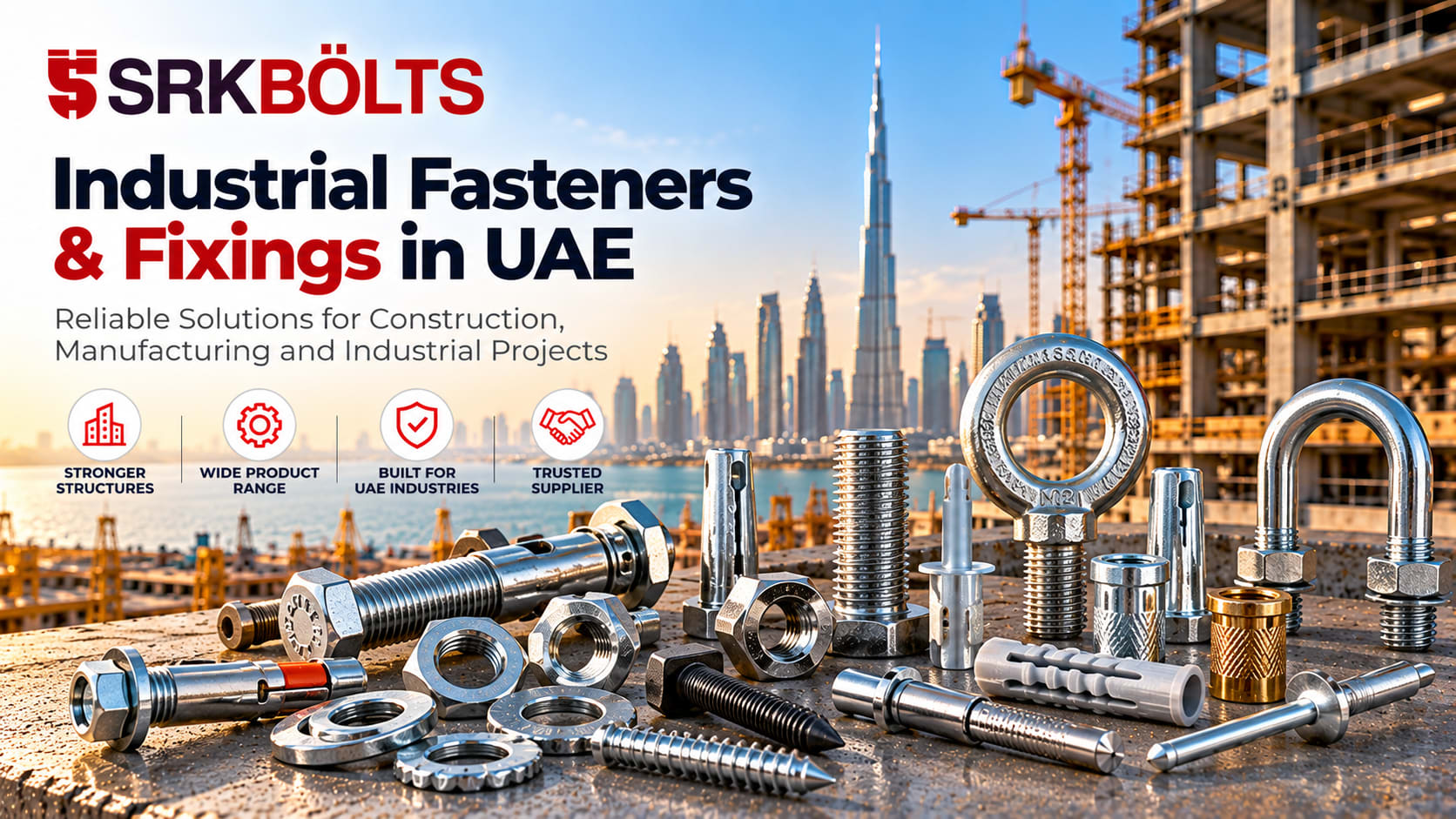
Introduction: Every Strong Structure Begins With a Reliable Connection
Think about the last time you walked past a construction site in Dubai or visited an industrial facility in Sharjah. You probably noticed the towering steel frameworks, heavy machinery, enormous cranes, and sophisticated equipment.
What you may not have noticed were the thousands of small mechanical components holding everything together.
Industrial fasteners and fixings rarely attract attention, yet they are essential to modern construction and engineering.
A single steel structure may contain thousands of bolts, nuts, and washers. Manufacturing equipment may rely on precisely engineered screws and pins. Electrical installations require specialized fixings, while industrial pipelines depend on carefully specified fastening assemblies.
These components may be small, but their responsibilities are significant.
An incorrectly selected fastener can create problems that extend far beyond the connection itself. Loose joints can cause excessive vibration, unsuitable materials can accelerate corrosion, and poorly matched components may lead to equipment failures or unnecessary maintenance.
For contractors, engineers, and procurement professionals operating in the UAE, choosing industrial fasteners is therefore not simply a purchasing decision. It is part of ensuring technical reliability and long-term project performance.
The challenge is that different applications require different fastening solutions.
A stainless steel bolt suitable for an architectural installation may not meet the mechanical requirements of a heavily loaded machine. Similarly, a standard expansion anchor may not be appropriate for a cracked-concrete installation with demanding structural loads.
This makes product knowledge and specification accuracy essential.
Working with a dependable industrial fasteners and fixings supplier in UAE can help businesses source products that match their project requirements.
This guide explores the most important types of industrial fasteners, where they are used, how to select suitable materials and grades, and what UAE industrial buyers should consider before placing an order.
What Are Industrial Fasteners and Fixings?
Industrial fasteners are mechanical components used to connect, secure, or position two or more parts.
Depending on their design, they may create removable connections, permanent joints, or specialized assemblies that allow adjustment and maintenance.
Fixings typically refer to fastening products used to attach equipment or components to supporting materials such as concrete, masonry, timber, or structural steel.
The two categories overlap considerably.
For example, a threaded bolt is a mechanical fastener, while a concrete anchor bolt may be described as both a fastener and a fixing.
Common industrial fastening products include bolts, nuts, washers, screws, threaded rods, rivets, pins, anchors, and other engineered components.
The correct product depends on several factors: connection geometry, expected loads, base material, operating environment, installation method, and maintenance requirements.
Types of Industrial Fasteners & Fixings Used Across UAE Industries
1. Industrial Bolts: Essential for Strong Mechanical Connections
Bolts are among the most widely used fastening components in construction, fabrication, and mechanical engineering.
They are commonly installed with compatible nuts to secure connected components.
Different bolt types are designed for different applications.
Hex head bolts are widely used in machinery and general construction. High tensile bolts are specified for selected heavily loaded assemblies, while flange bolts provide a larger bearing surface beneath the head.
U-bolts are often used in pipe-support applications, and structural bolts are designed for engineered steel connections.
Typical industrial applications:
Structural steel fabrication
Heavy machinery
Industrial equipment installation
Construction projects
Mechanical assemblies
Infrastructure development
For engineered connections, bolts should be selected according to the required dimensional standard, strength grade, and installation specification.
2. Industrial Nuts: Small Components With Important Responsibilities
Nuts are internally threaded components that work with bolts, threaded rods, and studs.
Their primary purpose is to help create and maintain the clamping force needed to secure an assembly.
Common nut designs include hex nuts, heavy hex nuts, flange nuts, coupling nuts, and prevailing-torque lock nuts.
A conventional hex nut may be suitable for many general applications, while a specialized locking nut may be specified where resistance to loosening is required.
However, locking arrangements must be selected according to actual vibration, temperature, and service conditions.
Choosing the correct nut also means checking the mating bolt's dimensions, strength grade, thread pitch, and material.
3. Industrial Washers: Supporting Connection Performance
Washers are often overlooked because of their simple appearance.
Yet properly specified washers can improve bearing conditions, distribute contact pressure, and help protect connected surfaces.
Common washer types include plain washers, hardened washers, large-diameter washers, sealing washers, and direct tension indicator washers.
A hardened washer may be necessary beneath certain high-strength fasteners, while a bonded sealing washer may be specified for a compatible fluid connection.
It is important to understand that washers perform different functions.
A conventional plain washer does not automatically prevent loosening under vibration, and a sealing washer should not be treated as a substitute for a structural washer.
4. Industrial Screws: Versatile Solutions for Different Materials
Industrial screws are used in applications ranging from sheet metal fabrication to precision machinery.
Machine screws are commonly installed into tapped holes or compatible nuts.
Self-tapping screws can form mating threads in suitable materials, while self-drilling screws incorporate a drill point that can create a hole during installation within their specified drilling capacity.
Countersunk screws are commonly used when a flush surface is required.
Socket head screws are useful in mechanical assemblies where access or clearance is limited.
The appropriate screw depends on the material being joined, required thread engagement, mechanical loads, and installation conditions.
5. Rivets, Pins and Threaded Inserts
Not every industrial connection requires a conventional bolt and nut.
Rivets are widely used for permanent fastening in sheet metal, enclosures, vehicle bodies, and fabricated assemblies.
Dowel pins help maintain alignment in machinery and precision equipment.
Spring pins and clevis pins are used for particular retention and mechanical connection functions.
Threaded inserts provide internal threads in materials where conventional threading may be unsuitable or require reinforcement.
For example, rivet nuts can be useful in thin sheet metal where access is limited to one side of the assembly.
6. Anchors and Heavy-Duty Fixings
Fixing equipment to concrete or masonry requires different considerations from joining two steel components.
Mechanical expansion anchors, concrete screws, chemical anchor systems, and threaded anchoring studs are commonly used for suitable applications.
Anchors may be required for machinery foundations, steel supports, building services, and structural attachments.
Their performance depends on the base material, embedment depth, spacing, edge distance, installation process, and applicable approvals.
For structural or safety-critical applications, anchor selection and design must follow approved engineering requirements.
7. Hook and Eye Products
Hook and eye hardware includes eye bolts, shackles, turnbuckles, and other attachment components.
These products are used in selected cable tensioning, equipment connection, rigging, and industrial support applications.
Some components are designed and rated for lifting, while others are intended only for general fastening.
Ordinary hook and eye hardware should never be assumed suitable for lifting without appropriate ratings and documentation.
Choosing Industrial Fasteners for UAE's Challenging Environmental Conditions
One of the most important considerations for UAE industrial projects is environmental exposure.
The country experiences high ambient temperatures, and many industrial installations are located near coastal or marine environments.
Fasteners may also be exposed to humidity, airborne salt, dust, chemical contaminants, and repeated temperature changes.
These conditions make material and coating selection particularly important.
Carbon Steel Fasteners
Carbon steel fasteners are widely used because they offer a practical combination of mechanical strength, availability, and cost.
They are suitable for many general engineering and construction applications.
However, corrosion protection may be necessary where the fasteners are exposed to moisture or aggressive environments.
Stainless Steel Fasteners
Stainless steel offers improved corrosion resistance in many environments.
A2 stainless steel, commonly associated with the 304 family, is frequently used for general corrosion-resistant applications.
A4 stainless steel, commonly associated with the 316 family, generally offers improved resistance to certain chloride-containing environments.
For UAE coastal installations, A4 stainless steel may be worth considering where its mechanical and corrosion properties meet the project requirements.
However, no stainless steel grade is universally resistant to all forms of corrosion.
Alloy Steel Fasteners
Alloy steel fasteners are used in selected high-strength and mechanically demanding applications.
Depending on the material and heat treatment, they can provide particular combinations of tensile strength, hardness, and toughness.
They are commonly specified for machinery and engineered mechanical assemblies.
Galvanized Fasteners
Galvanized fasteners feature a zinc coating designed to reduce corrosion of the underlying steel.
They are commonly considered for outdoor infrastructure, steel structures, and equipment supports.
However, galvanizing requirements must be matched to the fastener's mechanical properties, thread tolerances, and applicable specifications.
Understanding Fastener Grades and International Standards
Industrial fasteners are commonly specified using international standards such as ISO, DIN, ASTM, and ASME.
These standards may define dimensions, mechanical properties, materials, thread forms, testing requirements, and other characteristics.
For example, ISO 898-1:2013 specifies mechanical properties of applicable carbon and alloy steel bolts, screws, and studs. The standard was reviewed and confirmed in 2025.
Standard | Main application |
|---|---|
ISO 898-1 | Mechanical properties of carbon and alloy steel bolts, screws and studs |
ISO 898-2 | Mechanical properties of applicable steel nuts |
ISO 3506-1 | Mechanical properties of specified stainless steel bolts, screws and studs |
ISO 4014 | Hexagon head bolts |
ISO 4032 | Regular hexagon nuts |
ISO 4762 | Hexagon socket head cap screws |
ISO 7089 | Normal-series plain washers |
ASTM F3125/F3125M | Specified high-strength structural bolting |
These standards are not interchangeable. The correct standard must be selected according to the product type and application.
What Do Bolt Grades 8.8, 10.9 and 12.9 Mean?
For many metric carbon and alloy steel bolts, property classes indicate specified mechanical characteristics.
Property class | Nominal tensile strength |
|---|---|
4.6 | 400 MPa |
8.8 | 800 MPa |
10.9 | 1,000 MPa |
12.9 | 1,200 MPa |
A higher property class generally indicates higher nominal tensile strength, but it does not automatically mean the bolt is appropriate for every connection.
Actual performance also depends on the fastener's dimensions, material, fatigue behavior, joint design, and installation conditions.
For demanding applications, engineers should verify the suitability of the complete bolted assembly.
Where Industrial Fasteners & Fixings Are Used in UAE
Construction and Infrastructure
Structural steel projects, industrial warehouses, commercial buildings, and infrastructure installations use a wide range of mechanical fasteners.
Contractors require products that meet approved specifications and provide suitable mechanical performance.
Oil and Gas
Oil and gas facilities use specialized fasteners for piping systems, pressure-containing equipment, processing machinery, and structural supports.
These applications may involve elevated temperatures, corrosive environments, and demanding mechanical conditions.
Marine and Shipbuilding
Marine equipment requires particular attention to corrosion resistance and material compatibility.
Fasteners used in ports, vessels, shipyards, and coastal installations must be selected according to the expected service conditions.
Manufacturing and Heavy Machinery
Manufacturing plants use fasteners in production lines, mechanical equipment, conveyor systems, enclosures, and maintenance assemblies.
Precise dimensions, suitable materials, and correct tightening procedures contribute to dependable equipment operation.
Electrical and MEP Installations
Mechanical, electrical, and plumbing contractors rely on fasteners and fixings for cable trays, equipment supports, HVAC installations, switchgear, and mechanical services.
Renewable Energy and Power Infrastructure
Solar structures, power-generation equipment, and electrical infrastructure also rely on properly specified fastening systems.
Outdoor exposure, vibration, thermal expansion, and corrosion can influence product selection.
How to Select the Right Industrial Fasteners: A Practical Procurement Checklist
For contractors and industrial purchasing teams, the following considerations can help reduce procurement errors.
1. Confirm the application: Identify the materials being joined, the loads involved, and the operating environment.
2. Specify dimensions accurately: Include diameter, length, thread pitch, head design, and other relevant dimensions.
3. Verify material and grade: Select products that meet the mechanical and environmental requirements.
4. Check compatibility: Ensure bolts, nuts, washers, and other components work together as an approved assembly.
5. Confirm the surface finish: Specify appropriate corrosion protection and check any coating limitations.
6. Request technical documentation: Material certificates, manufacturer data, and inspection records may be required by the project.
7. Review installation requirements: The correct fastener can still perform poorly if installed incorrectly.
8. Consider total procurement value: Product quality, specifications, delivery coordination, and maintenance requirements matter alongside initial cost.
Common Fastener Procurement Mistakes and How to Avoid Them
Consider a contractor ordering 2,000 bolts for a steel fabrication project.
The purchase order simply states: "M16 hex bolts."
That description leaves several important questions unanswered.
What length is required? Should the bolts be fully or partially threaded? Which strength grade is specified? Is the project using metric coarse threads? What surface finish is required? Are compatible nuts and washers needed?
Without this information, the supplier may quote a product that does not match the engineering drawings.
The same problem occurs when buyers order stainless steel fasteners without specifying a material grade or request concrete anchors without identifying the base material and loading conditions.
These mistakes can result in rejected materials, installation delays, and unnecessary costs.
A better approach is to use complete product specifications and attach relevant drawings or project documentation whenever necessary.
The Importance of Selecting a Dependable Industrial Fasteners Supplier in UAE
Reliable fastener procurement involves more than simply finding the lowest quotation.
Industrial buyers often require specific materials, mechanical grades, dimensional standards, protective finishes, and quantities.
A suitable supplier should understand these requirements and provide clear product information.
For large projects, sourcing support can be particularly important because multiple fastening products may be required simultaneously.
For example, a steel fabrication contractor might need structural bolts, heavy hex nuts, hardened washers, and threaded studs.
A manufacturing facility may need machine screws, dowel pins, rivet nuts, and replacement bolts.
Having access to a broad product catalogue can simplify procurement and reduce the number of separate sourcing enquiries.
SRK Bolt: Industrial Fasteners & Fixings Supplier in UAE
SRK Bolt is a UAE-based supplier of industrial fastening products serving construction, structural steel, oil and gas, marine, manufacturing, automotive, and engineering applications.
Established in 2015, the company has developed a catalogue containing more than 5,000 fastener SKUs, with sourcing relationships across India, Europe, and the Far East.
Its principal product categories include industrial bolts, nuts, washers, screws, hook and eye products, rivets, inserts, and other specialty fastening components.
SRK Bolt also supports sourcing enquiries for non-standard or replacement fasteners where buyers can provide approved drawings, samples, materials, dimensions, and finishing requirements.
The company operates from Sharjah and supports project and bulk procurement requirements across major UAE industrial markets, including Dubai, Abu Dhabi, Sharjah, and Ajman, alongside regional markets in the GCC.
For contractors and procurement managers, SRK Bolt's product catalogue provides a starting point for identifying fastening solutions suited to specific project requirements.
Explore the Industrial Fasteners & Fixings range at SRK Bolt or submit an enquiry with your required standard, size, material, grade, finish, and quantity.
Product availability and project-specific certification requirements should be confirmed before ordering.
Frequently Asked Questions About Industrial Fasteners & Fixings in UAE
What are the most commonly used industrial fasteners in UAE?
Common industrial fastening products include hex bolts, high tensile bolts, nuts, washers, machine screws, self-tapping screws, rivets, threaded rods, and specialized anchors.
The correct choice depends on the project requirements.
What is the difference between industrial fasteners and fixings?
Industrial fasteners generally include mechanical components used to join materials, such as bolts, nuts, screws, and rivets.
Fixings commonly include products used to attach components to supporting materials, such as concrete anchors and masonry fixings.
Which fasteners are suitable for outdoor installations in Dubai?
Depending on the application, appropriately specified stainless steel or corrosion-protected steel fasteners may be suitable.
Coastal exposure, loading, material compatibility, and maintenance requirements must be considered.
Why are high tensile bolts used in industrial applications?
High tensile bolts are specified where particular mechanical strength and fastening performance are necessary.
Their use must be based on the connection design and relevant technical requirements.
Can stainless steel fasteners be used in marine environments?
Certain stainless steel grades can provide useful corrosion resistance in marine-related environments.
However, chloride exposure, galvanic compatibility, mechanical loading, and the exact stainless steel grade must be evaluated.
What information should I include when requesting a bulk quotation?
Provide the product type, size, thread specification, standard, grade, material, surface finish, quantity, and delivery location.
Any necessary inspection or certification documentation should also be specified.
Where can I find industrial fasteners and fixings in UAE?
Businesses can explore the industrial fastening catalogue at SRK Bolt and submit their project specifications for availability and quotation.
Conclusion: The Right Fasteners Make a Lasting Difference
Industrial fasteners and fixings may be relatively small components, but they contribute directly to the reliability of countless construction and engineering assemblies.
From steel structures and manufacturing equipment to marine installations and industrial infrastructure, different applications demand different materials, designs, mechanical properties, and installation methods.
For businesses operating in the UAE, choosing suitable fasteners involves understanding the complete connection rather than focusing only on the individual product.
Correct dimensions, compatible materials, appropriate strength grades, corrosion protection, and compliance with technical specifications are all important.
By prioritizing specification accuracy and working with established suppliers, contractors and procurement professionals can make better purchasing decisions and reduce avoidable project complications.
For businesses looking for Industrial Fasteners & Fixings in UAE, SRK Bolt offers a broad range of industrial fastening products and specification-based sourcing support.
Explore industrial fastening solutions at www.srkbolt.com/products