
Built for Strength, Engineered for Reliability: The Complete Guide to Industrial Fasteners & Fixings in UAE
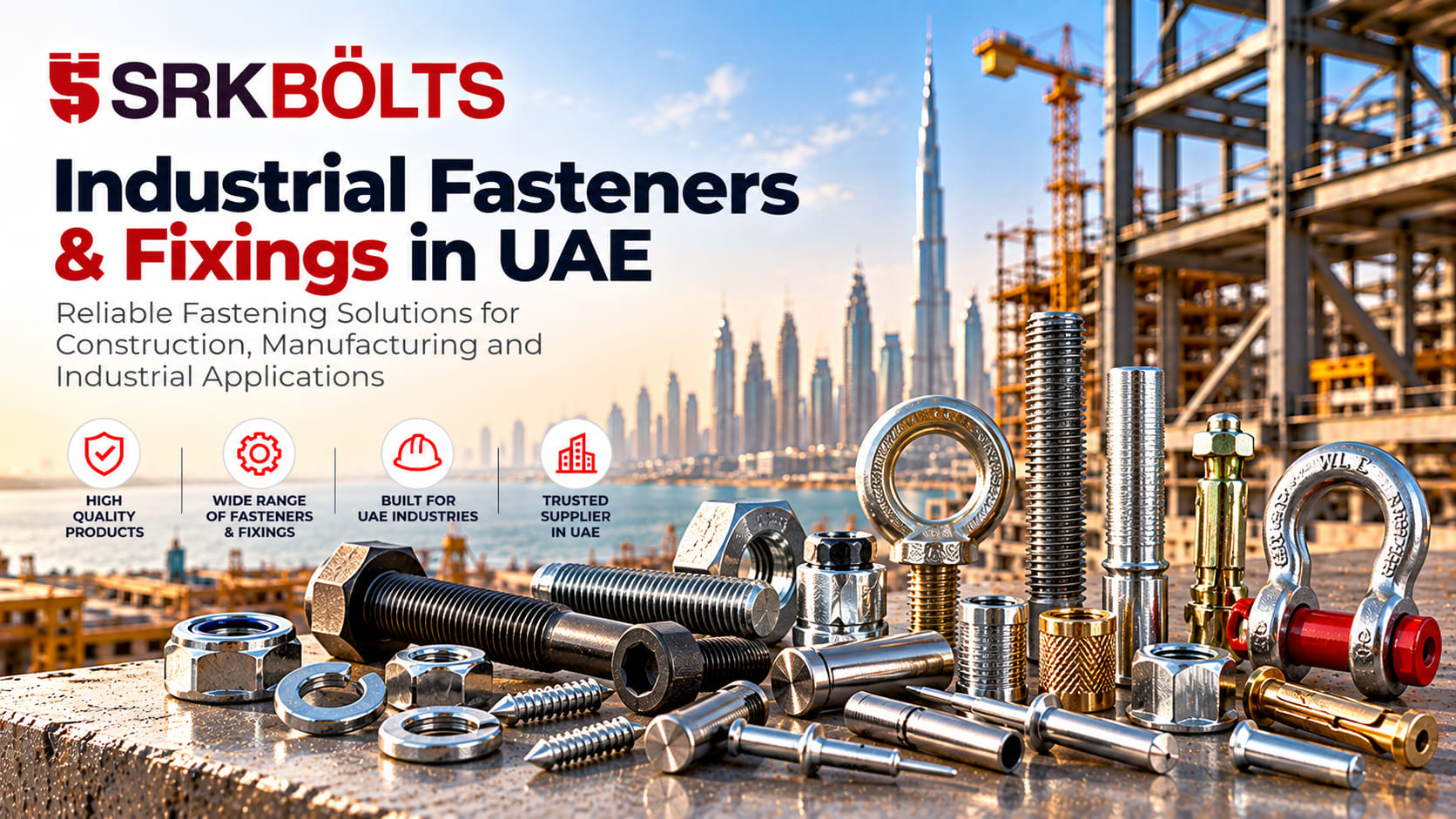
Introduction: Why Industrial Fasteners & Fixings Matter More Than You Think
Imagine standing inside a massive industrial warehouse in Dubai, watching cranes lift steel beams into position while engineers carefully assemble the building's structural framework.
Or picture a manufacturing facility in Sharjah, where heavy machinery operates continuously, producing components that must meet strict dimensional and performance requirements.
In both environments, the strength and reliability of the entire installation depend on something that is often overlooked: industrial fasteners and fixings.
Bolts, nuts, screws, washers, anchors, rivets, and other mechanical fastening components may appear insignificant compared with the structures and equipment they support. However, these relatively small components perform essential functions.
They connect structural elements, secure machinery, support mechanical installations, and help maintain equipment alignment.
An incorrectly specified fastener can cause loose connections, excessive vibration, premature corrosion, equipment damage, and unexpected maintenance costs.
For industries operating in the United Arab Emirates, selecting the correct fastening components is particularly important.
The UAE's industrial sector includes demanding construction projects, marine facilities, petrochemical operations, manufacturing plants, and infrastructure installations. Each environment creates different requirements for mechanical strength, corrosion resistance, durability, and compliance with technical standards.
This is why working with a reliable Industrial Fasteners & Fixings Supplier in UAE can help contractors, engineers, manufacturers, and procurement professionals source suitable products for their applications.
In this comprehensive guide, we explore the different types of industrial fasteners and fixings, their materials, international standards, applications, and the essential factors to consider when purchasing them in the UAE.
What Are Industrial Fasteners & Fixings?
Industrial fasteners and fixings are mechanical components used to join, secure, position, attach, or support two or more materials or parts.
Although the terms are often used interchangeably, there can be a practical distinction.
Fasteners commonly refer to mechanical joining components such as bolts, nuts, washers, screws, and rivets.
Fixings is a broader term that often includes components used to attach items to concrete, masonry, steel, timber, and other supporting materials. These may include anchors, threaded rods, brackets, and specialized attachment systems.
Different fastening solutions are designed to accommodate different loads, materials, and operating conditions.
The primary functions of industrial fasteners include:
Creating secure mechanical connections.
Transferring or resisting specified loads.
Maintaining component alignment.
Supporting machinery and equipment installations.
Allowing maintenance and component replacement.
Providing permanent or removable joining methods.
Supporting structural and mechanical assemblies.
However, no single fastener design is suitable for every application.
Selecting the correct product requires understanding the connection's mechanical requirements and intended service environment.
Major Types of Industrial Fasteners & Fixings Used in UAE
Industrial fastening products are available in a wide variety of sizes, designs, materials, and strength grades.
Here are some of the most commonly used categories.
1. Industrial Bolts
Bolts are among the most widely used fastening components in construction, engineering, and heavy industry.
They are externally threaded components commonly used with compatible nuts to create mechanical connections.
Depending on the design, bolts may also engage directly with threaded holes.
Common industrial bolt types include hex bolts, high tensile bolts, flange bolts, structural bolts, U-bolts, and socket head cap screws.
Common applications:
Structural steel connections
Heavy machinery assembly
Industrial equipment installations
Manufacturing facilities
Infrastructure projects
Mechanical engineering
High tensile bolts are particularly important in applications requiring specified mechanical strength and clamping performance.
For example, metric bolts of property classes 8.8 and 10.9 are widely specified in suitable engineered assemblies.
However, selecting a higher strength grade does not automatically make a bolt suitable for every application.
Engineers must also consider joint design, load conditions, fatigue resistance, and material compatibility.
2. Industrial Nuts
Industrial nuts are internally threaded components typically used with compatible bolts, threaded rods, and studs.
When properly installed and tightened, nuts contribute to the clamping force required to secure connected parts.
Common types include hex nuts, heavy hex nuts, flange nuts, nylon insert lock nuts, coupling nuts, and cap nuts.
Common applications:
Steel fabrication
Construction
Machinery installation
Automotive assemblies
Equipment maintenance
Industrial support structures
Nut selection must consider thread compatibility, strength class, material, and operating conditions.
For critical connections, the nut should be specified as part of the complete bolting assembly.
3. Industrial Washers
Washers are often small, flat components installed beneath bolt heads or nuts.
Despite their simple appearance, washers can perform important mechanical functions.
Depending on the design, they may distribute bearing loads, protect surfaces, provide sealing, or support specialized locking arrangements.
Common types include flat washers, spring washers, hardened washers, large-diameter washers, sealing washers, and direct tension indicator washers.
Common applications:
Structural steel assemblies
Machinery installations
Mechanical equipment
Pipe supports
Automotive manufacturing
General construction
It is important to understand that a conventional flat washer is not designed to prevent a fastener from loosening under vibration.
Similarly, ordinary split spring washers should not be treated as a universal locking solution.
For demanding applications, washer selection must be based on the connection's actual requirements.
4. Industrial Screws
Industrial screws are threaded fastening components used across manufacturing, construction, electrical equipment, and mechanical assemblies.
They are available in numerous thread forms, head designs, and materials.
Common types include machine screws, self-tapping screws, self-drilling screws, countersunk screws, socket head screws, and button head screws.
Common applications:
Electrical cabinets
Sheet metal fabrication
HVAC installations
Industrial machinery
Automotive components
Equipment enclosures
For example, self-drilling screws are commonly used in compatible sheet metal applications because they can create their own hole during installation.
Machine screws, on the other hand, usually require a compatible internal thread or nut.
Understanding these differences helps ensure that the selected screw provides the intended connection performance.
5. Rivets, Pins & Threaded Inserts
Rivets, pins, and threaded inserts serve different mechanical functions.
Rivets are generally used for permanent mechanical joining, while pins are frequently used for positioning, alignment, retention, or mechanical connections.
Threaded inserts create or reinforce internal threads in suitable materials.
Common products include blind rivets, solid rivets, dowel pins, spring pins, clevis pins, rivet nuts, and helical thread inserts.
Common applications:
Sheet metal fabrication
Automotive manufacturing
Precision machinery
Electrical enclosures
Industrial equipment
Thread repair and reinforcement
Blind rivets are particularly useful when installation access is available from only one side of a workpiece.
Dowel pins are commonly used for precise alignment, while threaded inserts can improve the durability of threaded connections in selected materials.
6. Hook & Eye Fastening Products
Hook and eye products include specialized hardware used for attaching, connecting, tensioning, and, where specifically rated, lifting-related applications.
Products include eye bolts, screw eyes, shackles, turnbuckles, swivels, and other connection components.
Common applications:
Marine equipment
Industrial cable systems
Construction installations
Steel fabrication
Machinery handling
Architectural tensioning systems
An important distinction is that not every hook, eye bolt, or shackle is suitable for lifting.
Components used in lifting operations must be specifically designed, rated, and approved for the intended loads and loading directions.
7. Anchors & Heavy-Duty Fixings
Anchors and heavy-duty fixing systems are used to attach equipment and structural components to concrete, masonry, and other supporting materials.
Depending on the application, these may include mechanical expansion anchors, concrete screws, chemical anchor systems, threaded studs, and specialized attachment hardware.
Common applications:
Structural equipment supports
Industrial machinery foundations
Steel-to-concrete connections
Mechanical and electrical installations
Pipe support systems
Building infrastructure
Anchor selection requires particular attention to the base material, embedment depth, edge distances, spacing, installation procedure, and applicable design approvals.
Concrete anchors must not be selected solely based on their diameter or appearance.
SRK Bolt also provides sourcing support for specialty and non-standard industrial fastening requirements, subject to specifications and availability.
Industrial Fasteners vs Fixings: Understanding the Difference
Although these terms frequently overlap, the distinction can be useful during procurement.
Industrial fasteners | Industrial fixings |
|---|---|
Bolts | Concrete anchors |
Nuts | Masonry fixings |
Washers | Expansion anchors |
Machine screws | Equipment anchoring studs |
Rivets | Specialty mounting fixings |
Dowel pins | Heavy-duty attachment systems |
In practice, many products fall into both categories.
For example, a concrete screw is both a screw fastener and a fixing used for installation into concrete.
The most important consideration is not the terminology but whether the selected component meets the application's engineering requirements.
Choosing the Right Fastener Materials for UAE Conditions
The UAE's climate creates unique challenges for industrial fastening systems.
High temperatures, coastal humidity, airborne salt, sand, and industrial contaminants can influence the durability of exposed components.
Choosing suitable materials and protective finishes is therefore essential.
Carbon Steel Fasteners
Carbon steel is one of the most common materials used in industrial fastening products.
It offers a practical balance of strength, cost, and availability.
However, untreated carbon steel may corrode when exposed to moisture or aggressive environments.
Suitable protective coatings can help improve its durability.
Stainless Steel Fasteners
Stainless steel fasteners are commonly selected where improved corrosion resistance is required.
Two frequently specified stainless steel families are:
A2 stainless steel: Generally associated with 304-type stainless steel and used in many corrosion-resistant applications.
A4 stainless steel: Generally associated with 316-type stainless steel and offers improved resistance to certain chloride-containing environments.
A4 fasteners may be appropriate for selected coastal or marine-related applications.
However, stainless steel grade selection must account for the actual environmental conditions and mechanical requirements.
ISO 3506-1:2020 defines mechanical properties for specified corrosion-resistant stainless steel bolts, screws, and studs.
Alloy Steel Fasteners
Alloy steel fasteners are used where specific strength, hardness, toughness, or other mechanical characteristics are required.
They are frequently found in heavy machinery and engineered industrial assemblies.
The correct material and heat treatment must match the application.
Galvanized Steel Fasteners
Galvanized fasteners have a protective zinc coating intended to reduce corrosion of the underlying steel.
They are commonly considered for suitable outdoor construction and infrastructure installations.
However, coating compatibility and installation requirements must be evaluated carefully, particularly for high-strength fasteners and engineered bolting assemblies.
Brass, Copper & Aluminium Fasteners
These materials are used in specialized applications requiring particular electrical, thermal, weight, or corrosion-related properties.
For example, brass threaded inserts may be used in suitable plastic components, while aluminium rivets are common in selected lightweight sheet metal assemblies.
These materials should not automatically replace high-strength steel components.
Understanding Industrial Fastener Grades & Standards
Industrial fasteners are manufactured according to international standards covering dimensions, mechanical properties, materials, thread requirements, and other characteristics.
Commonly referenced standards include ISO, DIN, ASTM, and ASME.
Standard | Main application |
|---|---|
ISO 898-1 | Mechanical properties of specified carbon and alloy steel bolts, screws, and studs |
ISO 898-2 | Mechanical properties of specified carbon and alloy steel nuts |
ISO 3506-1 | Mechanical properties of specified corrosion-resistant stainless steel bolts, screws, and studs |
ISO 4032 | Dimensions of regular hex nuts |
ISO 4762 | Hexagon socket head cap screws |
ISO 7089 | Normal-series plain washers |
ASTM F3125/F3125M | High-strength structural bolting assemblies |
ASTM F436/F436M | Hardened steel washers for specified applications |
These standards cover different product characteristics and should not be treated as interchangeable.
Understanding High Tensile Bolt Grades
For many metric carbon and alloy steel bolts, property classes indicate defined mechanical properties.
Bolt property class | Nominal tensile strength |
|---|---|
4.6 | 400 MPa |
5.8 | 500 MPa |
8.8 | 800 MPa |
10.9 | 1,000 MPa |
12.9 | 1,200 MPa |
These values are nominal tensile strengths, not allowable working loads.
Actual connection capacity depends on factors such as bolt dimensions, joint geometry, thread engagement, installation conditions, and the applicable engineering standard.
A higher strength class should not be substituted without design verification.
Major Industries Using Industrial Fasteners & Fixings in UAE
1. Construction & Infrastructure
The UAE construction sector depends on correctly specified fastening systems for structural steelwork, equipment installation, façade components, building services, and infrastructure assemblies.
Fastener compatibility, mechanical strength, and corrosion resistance are important considerations for long-term performance.
2. Oil, Gas & Petrochemical Industry
Oil and gas facilities use specialized fasteners in piping systems, processing equipment, machinery, and supporting installations.
Some applications involve high temperatures, pressures, vibration, and corrosive substances.
Approved materials, specifications, and documentation are essential in these environments.
3. Marine & Shipbuilding
Marine installations present significant corrosion challenges.
Fasteners used in shipyards, port facilities, vessels, and marine equipment must be selected for suitable mechanical performance and environmental compatibility.
Material selection is especially important where different metals may be exposed to saltwater.
4. Manufacturing & Heavy Machinery
Factories rely on industrial fasteners to assemble and maintain production equipment.
Bolts, screws, washers, pins, and threaded inserts are used in machinery frames, conveyors, gearboxes, motor assemblies, and other mechanical systems.
Correct fastening practices help support equipment reliability and reduce maintenance problems.
5. Automotive & Transportation
Automotive assemblies require specialized fasteners with appropriate mechanical properties and dimensional tolerances.
Manufacturers and maintenance professionals must follow approved specifications for load-bearing and safety-critical connections.
6. Electrical & MEP Installations
Mechanical, electrical, and plumbing contractors use fasteners and fixings in cable trays, switchgear, HVAC installations, pipe supports, equipment frames, and building services.
Fastener selection may involve considerations such as corrosion resistance, load capacity, substrate compatibility, and electrical requirements.
7. Renewable Energy & Power Infrastructure
Solar installations, power equipment, and energy infrastructure require fastening systems capable of operating reliably under environmental exposure and specified loads.
In outdoor applications, corrosion resistance and compatibility with structural materials are particularly important.
Seven Essential Tips for Choosing Industrial Fasteners & Fixings in UAE
1. Understand the Application
Begin by identifying the intended connection and its operating conditions.
A fastener used for general machinery maintenance may have very different requirements from a high-strength structural bolt or a concrete anchor.
2. Confirm the Correct Dimensions
Check nominal diameter, length, thread pitch, thread system, head dimensions, and installation requirements.
Even minor dimensional differences can create assembly problems.
3. Select Suitable Materials
Consider environmental exposure, mechanical strength, corrosion resistance, and compatibility with adjoining components.
4. Verify Strength Grades
Fasteners must meet the required mechanical properties.
For safety-critical applications, specifications should be approved by the responsible engineer.
5. Check Applicable Standards
Confirm the required ISO, DIN, ASTM, ASME, or other standard.
Buyers should avoid assuming that similarly sized products manufactured to different standards are fully interchangeable.
6. Request Technical Documentation
Depending on the project, procurement teams may need material certificates, dimensional drawings, inspection reports, manufacturer information, or traceability records.
7. Evaluate Supplier Reliability
A suitable industrial fastener supplier should provide clear product information and respond accurately to technical enquiries.
For large projects, consistent specifications, quotation support, and supply coordination can be particularly valuable.
Common Mistakes to Avoid When Purchasing Industrial Fasteners
Procurement errors often occur when fasteners are ordered using incomplete descriptions.
For example, requesting only "M16 bolts" does not specify the bolt length, strength class, dimensional standard, thread pitch, or surface finish.
Similarly, ordering "stainless steel screws" without specifying the grade may create uncertainty about corrosion resistance.
Other common mistakes include mixing metric and imperial threads, using incompatible nuts and bolts, overlooking washer hardness, and selecting fixings without checking the base material.
Another concern is choosing products solely based on their initial price.
A lower-cost fastener may become more expensive if it corrodes prematurely, causes installation problems, or needs frequent replacement.
Accurate specifications and application-based selection can reduce these risks.
How to Prepare an Accurate Industrial Fastener RFQ
For contractors and procurement professionals, a well-prepared Request for Quotation (RFQ) can significantly improve purchasing efficiency.
Consider the following example:
Example Industrial Fastener RFQ
CopySpecification | Requirement |
|---|---|
Product | Hex Head Bolt |
Standard | ISO 4014 |
Size | M16 × 80 mm |
Thread | Metric coarse |
Property Class | 8.8 |
Material | Carbon/Alloy Steel |
Finish | As specified by project |
Quantity | 2,000 Pieces |
Documentation | As required |
Delivery | Dubai, UAE |
Including these details can help suppliers identify suitable products and prepare more accurate quotations.
Why Choosing a Reliable Industrial Fasteners Supplier in UAE Matters
Industrial fastener procurement affects more than product availability.
It can influence installation schedules, equipment maintenance, project quality, and operating costs.
An experienced supplier can help customers source products according to required dimensions, materials, strength grades, and applicable standards.
For industrial buyers, access to a broad fastener catalogue is also valuable.
A single project may require hex bolts, nuts, washers, threaded rods, machine screws, and specialized anchors.
Coordinating these requirements through a suitable supplier can simplify the procurement process and reduce specification mismatches.
This becomes especially important for contractors handling large projects across Dubai, Abu Dhabi, Sharjah, and other UAE industrial markets.
SRK Bolt: Industrial Fasteners & Fixings Supplier in UAE
For businesses seeking a dependable Industrial Fasteners & Fixings Supplier in UAE, SRK Bolt provides a broad range of standard and specialty fastening products.
Established in 2015, SRK Bolt is a UAE-based industrial fastener supplier supporting construction, structural steel, oil and gas, marine, manufacturing, automotive, electrical, and general engineering applications.
The company lists more than 5,000 fastener SKUs and works with manufacturers across India, Europe, and the Far East to support different industrial sourcing requirements.
Its product range includes:
Industrial bolts and threaded fasteners
Nuts in different configurations
Plain and specialized washers
Machine and self-tapping screws
Hook and eye products
Rivets, pins, and threaded inserts
Heavy-load attachment products
Specialty and non-standard fasteners
For non-standard products, SRK Bolt also supports enquiries based on technical drawings, samples, materials, finishes, and project quantities.
SRK Bolt serves industrial buyers in Dubai, Abu Dhabi, Sharjah, and Ajman, with broader supply coverage across GCC markets including Saudi Arabia, Qatar, Kuwait, Bahrain, and Oman.
Businesses can explore the company's Industrial Fasteners & Fixings range and submit their technical specifications for availability and quotation.
For a supplier enquiry, buyers should provide their required standard, size, grade, finish, quantity, and delivery location.
Frequently Asked Questions About Industrial Fasteners & Fixings in UAE
What are industrial fasteners and fixings?
Industrial fasteners and fixings are components used to join, secure, position, or attach materials and equipment.
Common examples include bolts, nuts, washers, screws, rivets, anchors, and threaded inserts.
What are the most commonly used industrial fasteners in UAE?
Hex bolts, high tensile bolts, hex nuts, plain washers, stainless steel screws, self-drilling screws, rivets, and specialized fixings are commonly used across construction, manufacturing, and engineering applications.
What is the difference between grade 8.8 and 10.9 bolts?
Metric property class 8.8 bolts have a nominal tensile strength of 800 MPa, while class 10.9 bolts have a nominal tensile strength of 1,000 MPa.
The appropriate grade depends on the mechanical requirements and approved connection design.
Which fasteners are suitable for outdoor applications in UAE?
Appropriately specified stainless steel and corrosion-protected steel fasteners may be suitable for outdoor installations.
The correct material depends on environmental exposure, loads, mating components, and maintenance requirements.
Are stainless steel fasteners stronger than carbon steel fasteners?
Not necessarily.
Mechanical strength depends on the specific material grade and property class.
Certain carbon and alloy steel fasteners offer higher tensile strength than common stainless steel fasteners.
What should I check before buying fasteners in bulk?
Buyers should confirm the product type, dimensions, thread specification, material, grade, finish, applicable standard, quantity, documentation requirements, and delivery location.
Can industrial fasteners be customized for special projects?
Yes. Depending on supplier and manufacturer capability, certain non-standard fasteners can be sourced or manufactured against approved drawings and specifications.
Material availability, manufacturing feasibility, and minimum order quantities should be confirmed.
Where can I buy industrial fasteners and fixings in UAE?
Businesses can explore industrial fastening solutions through SRK Bolt and submit project requirements for quotation and sourcing support.
Conclusion: Strong Industrial Projects Start With Reliable Fastening Solutions
Industrial fasteners and fixings may represent a relatively small part of a construction or engineering project, but they perform functions that are essential to reliable mechanical connections.
From structural steel bolts and machinery screws to washers, anchors, rivets, and specialized connection hardware, every component must be selected according to its intended application.
For businesses operating in the UAE, factors such as mechanical strength, dimensional accuracy, corrosion resistance, material compatibility, and compliance with international standards are particularly important.
Choosing the correct fastener can help reduce maintenance problems, improve installation quality, and support dependable long-term performance.
Rather than focusing only on price, contractors, engineers, and procurement professionals should consider the complete technical requirements of each connection.
Working with a supplier that understands industrial fastening requirements can make sourcing more straightforward.
For businesses searching for Industrial Fasteners & Fixings in UAE, SRK Bolt provides a comprehensive product range and specification-based sourcing support for construction, manufacturing, oil and gas, marine, and general engineering applications.
Explore the complete industrial fasteners catalogue at www.srkbolt.com/products