
Strength You Can Measure: Why DTI Washers Are Essential for Reliable Structural Connections in UAE
Introduction: In Structural Steel Construction, Tightening a Bolt Is Not Enough
Imagine a structural steel project in Dubai where hundreds of high-strength bolts are being installed to connect beams, columns, and supporting steel members.
The bolts have been selected according to the approved engineering drawings. The nuts and washers meet the specified requirements, and the installation crew has the necessary tools.
But one important question remains.
How can the team verify that the required bolt tension has actually been achieved?
This is a critical consideration in structural bolting, particularly when connections require controlled pretension.
A bolt may appear properly tightened without developing the specified clamping force. Differences in thread friction, lubrication, surface conditions, installation procedures, and tightening methods can influence the relationship between applied torque and actual bolt tension.
For demanding structural connections, appearance alone is not sufficient evidence of proper installation.
This is where Direct Tension Indicator washers, commonly known as DTI washers, become valuable.
These specialized fastening components provide a way to assess whether a high-strength bolting assembly has reached a specified minimum pretension.
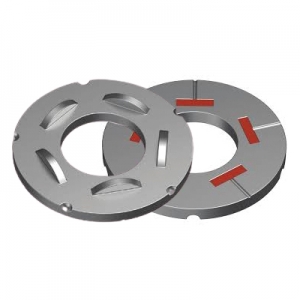
Unlike ordinary flat washers, DTI washers incorporate raised protrusions that compress as tension develops in the bolt.
The resulting changes in the gaps between the protrusions are evaluated using a specified inspection procedure.
Across the UAE, where industrial warehouses, steel-framed buildings, infrastructure projects, and heavy engineering installations rely on accurately installed bolted connections, DTI washers can play an important role in structural fastening quality control.
For contractors, engineers, and procurement professionals, selecting the correct DTI washer involves understanding its working principle, mechanical specifications, compatibility, and installation requirements.
Working with an established DTI Washers Supplier in UAE – SRK Bolt provides a starting point for exploring project-specific washer requirements.
In this article, we explain how DTI washers work, where they are used, which international standards apply, and what industrial buyers should consider before sourcing them in the UAE.
What Are DTI Washers?
DTI stands for Direct Tension Indicator.
A DTI washer is a specialized, compressible washer-type component used in designated high-strength structural bolting assemblies to indicate whether a specified minimum bolt tension has been achieved.
Unlike a conventional plain washer, a DTI washer features raised protrusions on one face.
When the bolting assembly is tightened, increasing tension compresses these protrusions against a suitable hardened bearing surface.
As compression progresses, the gaps associated with the protrusions become smaller.
An installer or inspector can then assess these gaps according to the approved installation procedure.
The applicable ASTM specification is ASTM F959/F959M, which covers compressible-washer-type direct tension indicators used with structural fasteners.
The current 2026 edition, ASTM F959/F959M-26, establishes requirements for DTI types, dimensions, compression performance, materials, and other relevant characteristics.
DTI washers are sometimes described as load-indicating washers, tension-indicating washers, or bolt tension indicator washers.
However, the critical distinction is that they are engineered to indicate a specified pretension condition, rather than functioning as ordinary load-distributing washers.
How Do DTI Washers Work?
The working principle of a DTI washer is based on controlled deformation.
DTI washer working principle
1. Before tightening
Raised protrusions2. During tightening
Protrusions compress3. Inspect gap
Verify against criteriaStep 1: Position the DTI Washer
The DTI washer is installed in the approved position within a compatible structural bolting assembly.
Its protrusions must bear against an appropriate hardened surface, following the specified arrangement.
Step 2: Tighten the Bolting Assembly
As the bolt is tightened, the assembly develops tension.
The protrusions of the DTI washer begin to compress under the applied clamping force.
Step 3: Assess the Inspection Gaps
The installer or inspector checks the gaps associated with the protrusions.
For conventional DTIs, this generally involves a feeler gauge of the prescribed thickness.
Step 4: Verify the Required Pretension
The measured or observed condition is compared with the applicable acceptance criteria.
Importantly, the aim is not necessarily to flatten the washer completely.
The 2020 Research Council on Structural Connections (RCSC) specification describes acceptance criteria based on feeler-gauge refusal at more than half of the protrusion spaces under its prescribed procedure.
The exact acceptance criteria must be taken from the governing project specification and approved installation procedure.
Why Are DTI Washers Important in Structural Steel Projects?
1. Help Verify Bolt Pretension
One of the main benefits of DTI washers is providing an indication that the specified minimum bolt tension has been achieved.
This is useful where the connection design requires controlled pretension.
2. Support Installation Quality Control
DTI washers offer a practical inspection method for qualifying and checking bolting work.
They can help installation teams identify connections that require further attention before final acceptance.
3. Reduce Dependence on Torque Alone
Applied torque is influenced by friction, lubrication, thread condition, and other factors.
DTI washers provide an alternative means of verifying pretension rather than inferring it solely from applied torque.
4. Assist Structural Inspection
A correctly specified DTI system provides observable inspection features that can support installation verification.
This can be valuable on projects involving large numbers of structural bolts.
5. Support Consistent Installation Procedures
When crews follow approved procedures, DTI washers can contribute to more consistent pretension verification across multiple connections.
However, they do not replace correct joint design, competent installation, or required inspections.
DTI Washers vs Regular Washers: What's the Difference?
Feature | DTI washer | Regular plain washer |
|---|---|---|
Primary purpose | Indicate specified bolt pretension | Provide a bearing surface |
Design | Raised compressible protrusions | Generally flat |
Pretension indication | Yes, under specified conditions | No |
Inspection method | Approved gap or indicating procedure | Visual or dimensional inspection |
Common application | Pretensioned structural bolting | General fastening assemblies |
Typical standard | ASTM F959/F959M | ISO 7089, ASTM F436 or other specifications |
A hardened structural washer and a DTI washer may both be included in certain approved bolting configurations, but they serve different functions.
One should not be substituted for the other without verification of the complete assembly requirements.
DTI Washers Standards: Understanding ASTM F959/F959M
ASTM F959/F959M is the principal ASTM specification for compressible-washer-type direct tension indicators used with structural fasteners.
The latest edition identified by ASTM is ASTM F959/F959M-26, updated on April 6, 2026.
The specification addresses matters such as dimensional requirements, protrusion geometry, compression performance, material requirements, and appropriate DTI types.
Common DTI Designations
DTI designation | Intended structural bolt association |
|---|---|
Type 325-1 | ASTM F3125 Grade A325 Type 1 |
Type 325-3 | ASTM F3125 Grade A325 Type 3 |
Type 490-1 | ASTM F3125 Grade A490 Type 1 |
Type 490-3 | ASTM F3125 Grade A490 Type 3 |
Type 8.8-1 | ASTM F3125 Grade A325M Type 1 |
Type 8.8-3 | ASTM F3125 Grade A325M Type 3 |
Type 10.9-1 | ASTM F3125 Grade A490M Type 1 |
Type 10.9-3 | ASTM F3125 Grade A490M Type 3 |
These designations are specific to the relevant structural bolting systems and should not be interpreted as approval for use with any bolt carrying a superficially similar strength marking.
Buyers should confirm the required DTI type, bolt grade, dimensions, corrosion protection, and compatibility with the mating structural fasteners.
Where Are DTI Washers Used in UAE?
Structural Steel Construction
Dubai, Abu Dhabi, Sharjah, and other UAE markets feature commercial, industrial, and infrastructure projects requiring engineered structural steel connections.
Where controlled bolt pretension is specified, DTI washers may provide an appropriate means of installation verification.
Industrial Warehouses and Steel Buildings
Large steel-framed warehouses, logistics centres, and manufacturing buildings may incorporate pretensioned structural bolting assemblies.
DTI washers can support the installation and inspection of compatible connections.
Bridges and Infrastructure
Bridge construction often involves highly engineered bolted connections with particular installation and inspection requirements.
DTI washers may be used where approved by the applicable design and construction specifications.
Oil and Gas Facilities
Oil and gas facilities contain structural platforms, steel supports, equipment structures, and other engineered assemblies.
DTI washers may be relevant to selected structural connections, but they should not automatically be substituted for specialized pressure-equipment bolting requirements.
Power and Heavy Engineering
Industrial power facilities and heavy engineering projects may use controlled-pretension bolting systems.
The suitability of DTI washers depends on the specified structural fasteners and the approved installation method.
How to Choose the Right DTI Washers for Your Project
For industrial procurement teams, selecting DTI washers requires careful attention to the complete structural bolting specification.
1. Confirm the applicable standard. Identify whether the project requires ASTM F959/F959M and which edition applies.
2. Verify the bolt grade. Ensure the DTI designation matches the specified structural bolting assembly.
3. Check dimensions. Confirm the nominal diameter and other required dimensions.
4. Evaluate corrosion protection. Consider the operating environment and required protective finish.
5. Review installation compatibility. The DTI, bolt, nut, hardened washer where required, and bearing surfaces must work together according to the approved arrangement.
6. Request technical documentation. Depending on the project, obtain manufacturer certificates, technical data, test reports, and traceability information.
7. Confirm inspection procedures. Ensure that the installation team and inspectors understand the prescribed gap-measurement method and acceptance criteria.
Common Mistakes to Avoid When Using DTI Washers
Despite their practical benefits, DTI washers must be selected and installed correctly.
One frequent mistake is assuming that all DTI washers are interchangeable.
Different DTI types are designed for specific structural bolting systems.
Another mistake is treating a DTI washer as an ordinary spring washer or vibration-locking washer. Its primary purpose is to indicate specified bolt pretension, not to act as a general-purpose locking device.
Incorrect orientation can also affect performance.
Other possible errors include using an incompatible bolt grade, following an unapproved inspection procedure, or assuming that fully flattening the protrusions is always the correct acceptance condition.
DTI washers do not automatically prevent over-tightening. Their use must follow the applicable installation and verification procedures.
For quality-critical projects, installers and inspectors should be trained in the approved method.
How to Prepare an Accurate RFQ for DTI Washers
A detailed Request for Quotation helps suppliers identify the correct products and clarify documentation requirements.
Specification | Example requirement |
|---|---|
Product | Direct Tension Indicator Washer |
Standard | ASTM F959/F959M |
DTI type | 8.8-1 |
Nominal diameter | M20 |
Mating bolt | ASTM F3125 Grade A325M Type 1 |
Material/finish | As per approved specification |
Quantity | 5,000 pieces |
Documentation | Certificates and inspection reports as required |
Delivery location | Dubai, UAE |
For large construction projects, buyers may also provide structural bolting schedules, approved drawings, and specific quality-assurance requirements.
Why Choosing a Reliable DTI Washers Supplier in UAE Matters
In structural steel projects, the performance of bolted connections depends on the compatibility of several components.
DTI washers must work with the specified bolts, nuts, and hardened bearing surfaces.
Purchasing incorrect products can result in rejected materials, installation delays, additional inspections, or costly replacement work.
For this reason, procurement teams should consider more than the unit price.
A suitable DTI washer supplier should be able to support detailed technical enquiries and clarify the product specifications, applicable standards, documentation, and available quantities.
For projects requiring high-strength structural bolts and washers together, coordinated procurement can also help reduce compatibility issues.
SRK Bolt: DTI Washers Supplier in UAE
SRK Bolt is a UAE-based supplier of industrial fasteners and fastening solutions, supporting construction, structural steel, engineering, manufacturing, oil and gas, and infrastructure requirements.
The company has published a dedicated resource on DTI Washers Supplier in UAE – SRK Bolt covering direct tension indicators, industrial fastening solutions, technical compliance, and regional supply capabilities.
According to its published information, SRK Bolt supplies DTI washers alongside structural washers, bolts, nuts, high-tensile fasteners, and other fastening products. It also describes export support for markets including Saudi Arabia, Qatar, Kuwait, Oman, and Iraq.
The company's wider washer category supports enquiries involving dimensional matching, material selection, surface finishes, and project-based quantities.
For structural steel contractors, EPC companies, engineers, and industrial buyers, SRK Bolt provides a point of contact for specification-based sourcing requirements.
Businesses can explore its Industrial Washers Collection and submit their required DTI designation, bolt specification, nominal diameter, finish, quantity, and documentation needs.
For complete fastening assemblies, buyers can also explore:
The specific DTI washer type, stock availability, certificates, and compliance with the project-required standard should be confirmed before placing an order.
Frequently Asked Questions About DTI Washers in UAE
What does DTI stand for in structural fastening?
DTI stands for Direct Tension Indicator. A DTI washer is used to indicate whether a specified minimum bolt pretension has been achieved in a compatible structural bolting assembly.
What is the purpose of a DTI washer?
A DTI washer helps verify bolt pretension during installation by using specially designed protrusions that compress under load.
Are DTI washers the same as spring washers?
No. Spring washers and DTI washers perform different functions. A DTI washer is designed primarily for tension indication rather than general-purpose locking.
Which standard applies to DTI washers?
ASTM F959/F959M is the relevant ASTM specification for compressible-washer-type direct tension indicators. The current edition is ASTM F959/F959M-26.
Can DTI washers be used with any high-tensile bolt?
No. DTI washers must be matched to the appropriate structural bolt type, grade, size, and approved assembly configuration.
How is bolt tension checked using a DTI washer?
Depending on the approved method, the installer or inspector uses a specified feeler gauge to evaluate the gaps between the compressed protrusions and bearing surface.
Certain approved products may also use self-indicating features.
Do DTI washers prevent bolts from loosening?
Not directly. DTI washers are designed to indicate pretension. They do not replace proper joint design or specialized locking systems where those are required.
Can DTI washers be used in UAE structural steel projects?
Yes, where they are specified or approved for the structural bolting system and installed according to the applicable engineering and inspection requirements.
Can I order DTI washers in bulk in UAE?
Industrial suppliers such as SRK Bolt support project and bulk enquiries. Buyers should provide the relevant standard, DTI type, diameter, bolt specification, finish, quantity, and required documentation.
Where can I find a DTI Washers Supplier in UAE?
Industrial buyers can explore SRK Bolt's DTI Washers information and submit project-specific enquiries through its industrial washer category.
Conclusion: The Right Bolt Tension Begins With the Right Indicator
In structural engineering, connection reliability depends on more than selecting high-strength bolts.
Correct installation and verification are essential, particularly in applications where specified bolt pretension must be achieved.
Direct Tension Indicator washers provide a practical way to assess pretension in compatible structural bolting assemblies.
Their compressible protrusions offer an inspection feature that can support installation quality control when used according to approved procedures.
For UAE contractors, structural engineers, steel fabricators, and procurement teams, selecting appropriate DTI washers requires attention to product standards, bolt compatibility, environmental conditions, installation requirements, and documentation.
They should never be treated as interchangeable with ordinary washers.
Working with a supplier familiar with structural fasteners can help simplify sourcing and reduce avoidable specification errors.
For businesses searching for a DTI Washers Supplier in UAE, SRK Bolt offers industrial fastening products and specification-based sourcing support for structural steel, construction, and engineering projects.
Explore the product information at DTI Washers Supplier in UAE – SRK Bolt