
Built to Last: How to Choose the Best Industrial Bolts Supplier in UAE for Heavy-Duty Applications
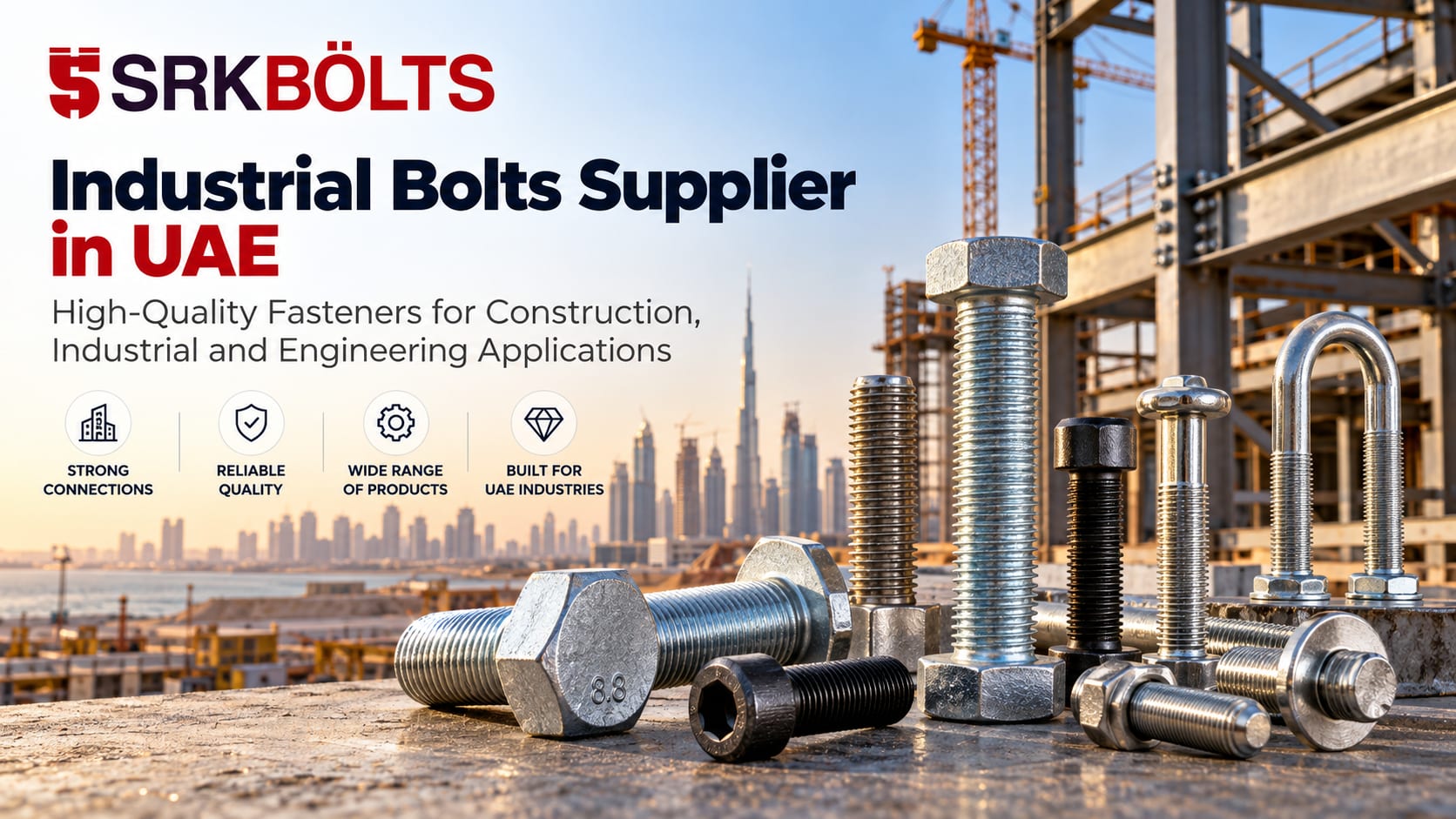
Introduction: Why the Right Industrial Bolts Matter More Than You Think
Walk through any major construction site in Dubai, manufacturing facility in Sharjah, or industrial installation in Abu Dhabi, and you will find thousands of components working together to keep everything secure.
Some of the most important are also the easiest to overlook: industrial bolts.
Whether they are holding structural steel beams together, securing heavy machinery, supporting industrial pipelines, or connecting mechanical equipment, bolts are essential to the strength and reliability of modern engineering systems.
However, not all bolts are created equal.
Two bolts may look almost identical but perform very differently under tension, vibration, temperature changes, or exposure to corrosive environments.
A high-strength steel bolt designed for heavy machinery, for example, may not be the best choice for an outdoor marine installation. Similarly, choosing the wrong thread size, material grade, or protective coating can create maintenance problems and potentially compromise the safety of an assembly.
For businesses operating in the UAE, these considerations become particularly important because of the region's demanding environmental conditions and diverse industrial requirements.
This is why selecting a dependable Industrial Bolts Supplier in UAE should involve more than comparing prices.
Understanding bolt specifications, material properties, industry standards, and application requirements can help engineers and procurement teams make informed purchasing decisions.
In this guide, we explore everything you need to know about industrial bolts, including the most commonly used types, strength grades, applications, and practical tips for sourcing quality fasteners in the UAE.
What Are Industrial Bolts and Why Are They Important?
Industrial bolts are externally threaded mechanical fasteners used to create secure connections between two or more components.
They are commonly installed with compatible nuts and washers, although certain designs are threaded directly into tapped components.
When properly tightened, a bolted connection develops the clamping force needed to hold assembled parts together.
The performance of this connection depends on several factors:
Material strength and mechanical properties
Bolt diameter and thread pitch
Required clamping force and tightening method
Compatibility with nuts and washers
Operating temperature and environmental exposure
Corrosion protection and surface treatment
Compliance with relevant engineering standards
Unlike permanent joining methods such as welding, many bolted connections can be disassembled for inspection, maintenance, repair, or equipment replacement.
This makes industrial bolts essential across construction, manufacturing, mechanical engineering, energy, and infrastructure development.
Common Types of Industrial Bolts Used in UAE Industries
Different applications demand different bolt designs. Selecting the right one requires understanding how its shape, dimensions, and mechanical characteristics influence performance.
1. Hex Head Bolts
Hex head bolts are among the most widely used industrial fastening components.
They feature a six-sided head that allows convenient tightening with standard spanners and sockets.
These bolts are used in structural assemblies, machinery, fabrication, and general mechanical installations.
Common applications:
Structural steel frameworks
Industrial machinery
Building construction
Heavy equipment
Mechanical engineering
General fabrication
Hex head bolts are available in various lengths, diameters, materials, and strength grades.
Common dimensional specifications include DIN 931 for partially threaded hexagon bolts and DIN 933 for fully threaded hexagon bolts, alongside relevant ISO equivalents.
2. High Tensile Bolts
High tensile bolts are manufactured to meet higher mechanical strength requirements than many general-purpose fasteners.
They are commonly specified in applications where significant loads, clamping forces, or demanding operating conditions must be considered.
Popular metric property classes include 8.8, 10.9, and 12.9, although the appropriate choice depends on the bolt design and relevant engineering standard.
Common applications:
Heavy machinery
Industrial equipment
Engineered structural connections
Automotive assemblies
Mechanical power transmission equipment
It is important to understand that a higher strength grade does not automatically mean a bolt is suitable for every application.
Material toughness, coating compatibility, fatigue behavior, and joint design are also important.
3. Stainless Steel Bolts
Stainless steel bolts are commonly used where improved corrosion resistance is required.
For UAE businesses operating near coastal locations or in humid environments, corrosion resistance is often an important procurement consideration.
Common stainless steel designations include A2 and A4.
A2 stainless steel is generally suitable for many everyday corrosion-resistant applications, while A4 stainless steel offers improved resistance to certain chloride-containing environments.
Common applications:
Marine equipment
Architectural metalwork
Outdoor installations
Food-processing equipment
Selected chemical-processing applications
Stainless steel grades should still be evaluated against the actual operating environment, as no grade is universally corrosion-proof.
4. Socket Head Cap Screws (Allen Bolts)
Socket head cap screws feature an internal hexagonal drive.
They are useful where the available installation space makes conventional external wrenching difficult.
Common applications:
Precision machinery
Industrial automation
Equipment assembly
Automotive components
Mechanical maintenance
DIN 912 and ISO 4762 are commonly referenced dimensional standards for socket head cap screws.
5. Flange Bolts
Flange bolts feature an integrated flange below the head.
This flange provides a broader bearing surface and may reduce the need for a separate washer in suitable applications.
Common applications:
Automotive manufacturing
Industrial machinery
Metal fabrication
Equipment assembly
Mechanical installations
DIN 6921 is a commonly referenced specification for hexagon flange bolts.
6. U-Bolts
U-bolts have a distinctive U-shaped design with threaded ends.
They are commonly used to support or secure pipes, tubes, cylindrical components, and other assemblies.
Common applications:
Pipe-support installations
Industrial piping
Mechanical equipment
Vehicle suspension systems
Utility installations
For industrial pipe supports, correct dimensions, material selection, and loading considerations are essential.
7. Structural Bolts
Structural bolts are specifically designed for engineered steel connections.
They are typically manufactured and supplied according to defined structural bolting standards.
Common applications:
Steel buildings
Industrial warehouses
Bridges
Infrastructure installations
Heavy structural frameworks
Structural bolts must be selected as part of a compatible bolting assembly, including suitable nuts and washers where required.
SRK Bolt's bolts collection includes hexagon bolts, flange bolts, socket head fasteners, U-bolts, threaded rods, engineering studs, and structural fastening products.
Understanding Industrial Bolt Grades: 8.8, 10.9, and 12.9
One of the most important things to understand when purchasing industrial bolts is the difference between strength grades.
For many metric carbon steel and alloy steel bolts, ISO 898-1 establishes mechanical property classes.
These property classes help engineers identify suitable fasteners for specific applications.
Property class | Nominal tensile strength | Typical application |
|---|---|---|
4.6 | 400 MPa | General-purpose, lower-load connections |
5.8 | 500 MPa | Selected general engineering applications |
8.8 | 800 MPa | Machinery and engineered connections |
10.9 | 1,000 MPa | Highly loaded mechanical assemblies |
12.9 | 1,200 MPa | Specialized high-strength fastening applications |
These are nominal strength values, not universal allowable working loads. Actual capacity depends on bolt size, joint design, applicable standard, and installation conditions.
Which Bolt Grade Should You Choose?
For many industrial applications, property class 8.8 provides a useful combination of strength and practicality.
Property class 10.9 may be specified when higher mechanical strength is necessary.
Property class 12.9 is generally reserved for particular high-strength fastener designs and demanding mechanical assemblies.
However, procurement teams should never replace one bolt grade with another without verifying engineering requirements.
Higher-strength bolts can have different toughness characteristics and greater sensitivity to particular manufacturing or coating processes.
Choosing the Right Bolt Material for UAE Weather Conditions
The UAE's climate presents unique challenges for industrial fastening systems.
High temperatures, coastal humidity, airborne salts, industrial contaminants, and sand exposure can influence long-term performance.
Choosing an appropriate bolt material can help reduce corrosion problems and maintenance requirements.
Carbon Steel Bolts
Carbon steel bolts are widely used in industrial and construction applications.
They are generally economical and available in a broad range of sizes and strength grades.
However, carbon steel requires suitable corrosion protection when exposed to aggressive environments.
Alloy Steel Bolts
Alloy steel bolts are used in applications requiring particular strength, hardness, or mechanical performance.
Depending on their specifications, they may be suitable for heavily loaded machinery and engineered industrial connections.
Stainless Steel Bolts
Stainless steel bolts are frequently considered for applications exposed to moisture or corrosive conditions.
For coastal locations such as Dubai, Abu Dhabi, and other UAE industrial areas, selecting an appropriate stainless steel grade can be an important part of long-term corrosion management.
Stainless steel fastener mechanical properties are addressed by ISO 3506-1, which covers specified corrosion-resistant stainless steel bolts, screws, and studs.
Hot-Dip Galvanized Bolts
Hot-dip galvanized bolts have a protective zinc coating.
They are commonly used in suitable outdoor construction and infrastructure applications.
However, coating thickness, thread compatibility, mechanical grade, and applicable standards must be considered.
Not every high-strength fastener is suitable for hot-dip galvanizing, so the correct specification should always be confirmed.
Industrial Applications of Bolts Across the UAE
Industrial bolts are used throughout the UAE's economy, from construction sites and energy facilities to transportation infrastructure and manufacturing plants.
Construction and Structural Steel
Construction companies regularly use bolts in structural steel frameworks, equipment supports, prefabricated assemblies, and mechanical connections.
In cities such as Dubai and Abu Dhabi, industrial and commercial projects frequently involve steel fabrication and engineered bolted assemblies.
The correct bolt specifications help ensure connections meet structural design requirements.
Oil, Gas, and Petrochemical Industries
The UAE's oil and gas sector requires specialized fastening solutions for equipment operating under demanding conditions.
Bolts may be used in:
Pipeline flange connections
Pressure-containing equipment
Industrial processing plants
Mechanical support assemblies
Maintenance and turnaround operations
In these environments, temperature, pressure, corrosion, and material traceability may all influence fastener selection.
Marine and Shipbuilding
Marine installations are particularly vulnerable to corrosion caused by saltwater exposure.
Bolts used in ports, shipyards, vessels, and marine equipment must be evaluated for environmental compatibility.
Material selection, protective coatings, and inspection practices contribute to long-term connection reliability.
Manufacturing and Heavy Machinery
Manufacturing equipment often depends on correctly specified bolts to maintain alignment and securely connect mechanical components.
In machinery exposed to vibration or repeated loading, bolt preload and locking arrangements can be especially important.
Electrical and MEP Installations
Mechanical, electrical, and plumbing contractors use fasteners to install equipment supports, cable management systems, HVAC units, and other building services.
Choosing the correct bolt diameter, length, grade, and finish helps ensure appropriate installation and maintenance performance.
Seven Essential Factors to Consider When Buying Industrial Bolts in UAE
Before placing an order, procurement professionals should evaluate more than product availability and price.
1. Define Your Project Requirements
Identify the application's operating conditions, loading requirements, and relevant project specifications.
A bolt intended for a warehouse steel connection may have different requirements from one used in a manufacturing machine.
2. Confirm the Correct Size and Thread
Always verify diameter, length, thread pitch, and thread system.
For example, an M16 × 2.0 bolt has a different thread pitch from an M16 × 1.5 bolt.
Mixing incompatible threads can damage components and lead to unreliable connections.
3. Select an Appropriate Strength Grade
The selected bolt grade must meet the application's engineering requirements.
Do not assume that selecting the highest available grade always produces the best result.
4. Consider Corrosion Resistance
Evaluate whether the installation is indoors, outdoors, near the coast, or exposed to industrial chemicals.
Protective finishes and material selection should reflect the expected service environment.
5. Check Standards and Certifications
Depending on the project, bolts may need to comply with ISO, DIN, ASTM, or other relevant specifications.
Buyers should confirm product markings, certification requirements, and any necessary inspection documentation.
6. Evaluate Supplier Reliability
A reliable supplier should provide clear product specifications and accurate quotation information.
For large projects, consistency of supply and the ability to source specified products are important considerations.
7. Compare Long-Term Value
Price matters, but so do durability, maintenance requirements, product compatibility, and the cost of possible replacement.
A low-cost bolt that corrodes prematurely or fails to meet specifications can become significantly more expensive over time.
Common Mistakes to Avoid When Purchasing Industrial Bolts
Even experienced purchasing teams can encounter problems when ordering industrial fasteners.
One frequent mistake is ordering bolts based only on diameter and length without specifying the mechanical grade or thread pitch.
Another is assuming all stainless steel bolts provide equivalent corrosion resistance.
Some buyers also overlook coating requirements or purchase nuts and bolts separately without checking their compatibility.
For large construction projects, failing to request the necessary documentation can cause material approval delays.
A good procurement process should therefore include clear specifications, reliable documentation, and communication between engineers, contractors, and suppliers.
Why Working With a Reliable Industrial Bolts Supplier in UAE Matters
Industrial projects often operate under tight timelines.
When a particular size or grade of bolt is unavailable, installation and maintenance work may be delayed.
A dependable supplier can help businesses source suitable products, clarify technical specifications, and prepare orders according to project requirements.
Important supplier qualities include:
A broad range of industrial fasteners
Clear material and grade information
Support for project-specific enquiries
Access to standard and specialty fasteners
Documentation support where required
Responsive quotation and procurement assistance
These considerations become especially valuable for large projects requiring multiple bolt sizes, grades, and surface finishes.
SRK Bolt: Industrial Bolts and Fasteners Supplier in UAE
For construction companies, manufacturers, engineering contractors, and industrial procurement teams, SRK Bolt offers an established source of industrial fastening products.
Founded in 2015, SRK Bolt serves customers across the UAE and GCC, supplying standard and specialty fastening solutions for construction, structural steel, oil and gas, marine, manufacturing, and general engineering applications.
The company's catalogue includes more than 5,000 fastener SKUs, with sourcing support from manufacturers across India, Europe, and the Far East.
Its industrial bolts range includes products such as hexagon bolts, high tensile bolts, socket head cap screws, flange bolts, U-bolts, threaded rods, and engineering studs.
Businesses can explore the industrial bolts range at SRK Bolt and submit their required specifications for quotation and availability confirmation.
For complete fastening assemblies, buyers can also explore the company's industrial nuts and industrial fasteners collection.
By providing accurate requirements—including size, grade, material, surface finish, quantity, and applicable standard—buyers can make the sourcing process more efficient.
Frequently Asked Questions About Industrial Bolts in UAE
What are the most commonly used industrial bolts in UAE?
Hex head bolts, high tensile bolts, stainless steel bolts, socket head cap screws, structural bolts, and flange bolts are commonly used across construction and industrial applications.
What is the difference between grade 8.8 and 10.9 bolts?
Property class 8.8 bolts have a nominal tensile strength of 800 MPa, while property class 10.9 bolts have a nominal tensile strength of 1,000 MPa. Their suitability depends on the application's engineering requirements.
Which industrial bolts are suitable for outdoor use?
Depending on the environment, appropriately specified stainless steel or galvanized bolts may be suitable for outdoor installations. Coastal exposure, corrosion risk, mechanical requirements, and maintenance conditions should be considered.
Are stainless steel bolts stronger than carbon steel bolts?
Not necessarily. Mechanical strength depends on the specific grade and property class. Certain high-strength carbon or alloy steel bolts offer greater tensile strength than common austenitic stainless steel fasteners.
What information should I provide when ordering industrial bolts in bulk?
Provide the bolt type, dimensions, thread specifications, material, strength grade, surface finish, required standard, quantity, and any project-specific certification requirements.
Where can I find an industrial bolts supplier in UAE?
Businesses can explore industrial fastening solutions through SRK Bolt at www.srkbolt.com/bolts and submit their specifications to request availability and pricing.
Conclusion:
Every reliable industrial structure, mechanical assembly, and engineering installation depends on correctly selected components.
Industrial bolts may represent a relatively small portion of overall project costs, but their role in maintaining safe and dependable mechanical connections is significant.
For construction companies, manufacturers, contractors, and procurement professionals operating in the UAE, understanding bolt materials, mechanical grades, dimensional standards, and environmental requirements is essential.
Rather than choosing fasteners solely on price, businesses should focus on technical suitability, consistency, documentation, and long-term performance.
Partnering with a dependable industrial fastener supplier can simplify procurement and help ensure the correct components are sourced for demanding applications.
For businesses searching for a trusted Industrial Bolts Supplier in UAE, SRK Bolt provides a broad selection of industrial fastening products for construction, manufacturing, engineering, and maintenance requirements.
Explore industrial bolts at SRK Bolt – Industrial Bolts Supplier in UAE.