
Strong Connections, Safer Lifting: How to Choose the Right Hook & Eye Fastener Supplier in UAE
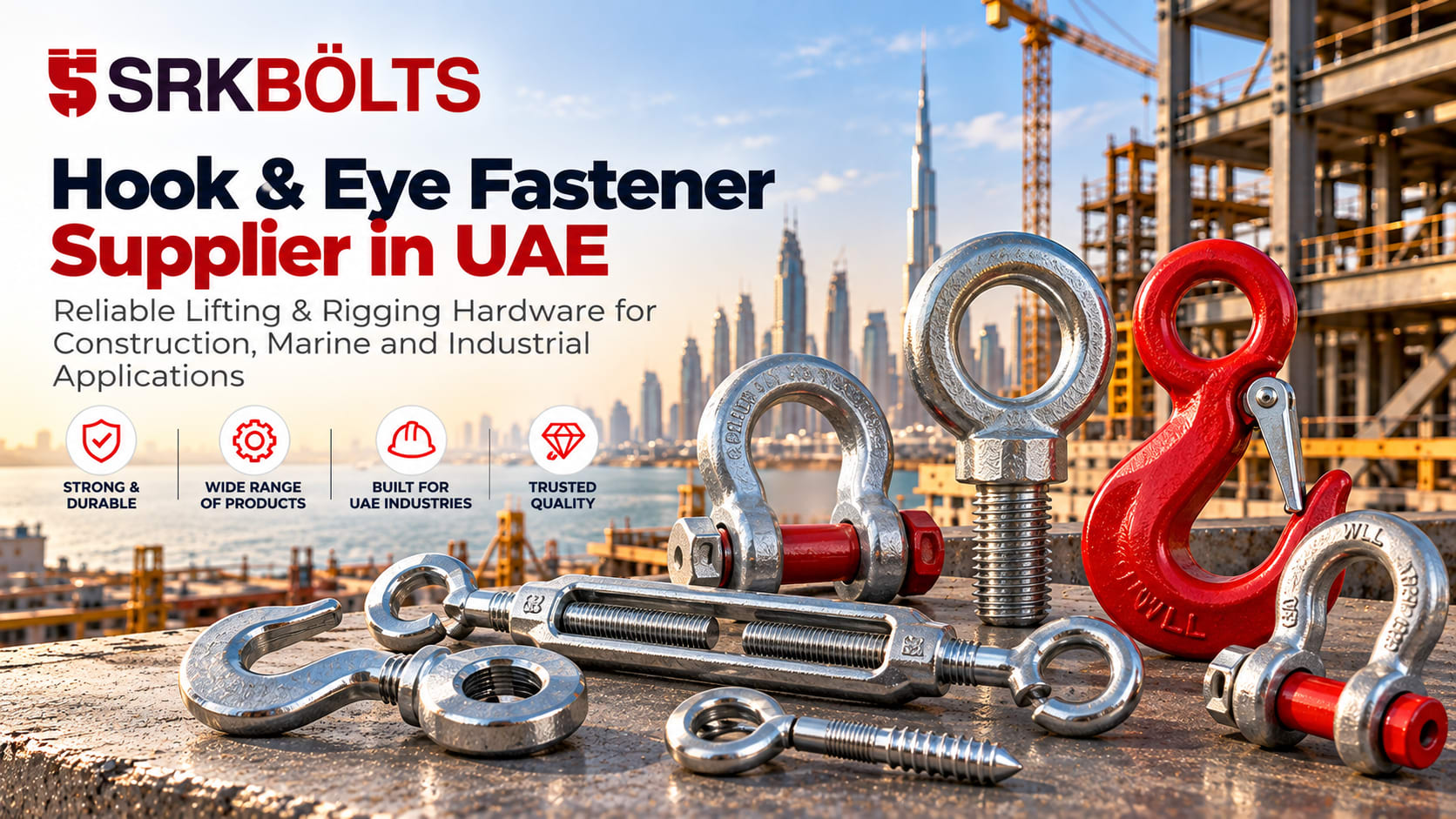
Introduction: Why the Right Hook & Eye Fasteners Matter in Industrial Projects
Picture a busy construction site in Dubai where a heavy steel beam needs to be lifted into position. A crane operator prepares the equipment, the rigging team inspects the connections, and everyone relies on the lifting arrangement to perform safely.
While the crane attracts most of the attention, smaller components such as lifting eye bolts, shackles, hooks, and other rigging accessories play a critical role in the operation.
These components may be relatively small, but their selection directly affects how loads are connected, tensioned, positioned, and secured.
Now consider what could happen if the wrong eye bolt is installed, a shackle is unsuitable for the load direction, or a turnbuckle is used beyond its rated capacity.
The result could be damaged equipment, interrupted operations, or a serious lifting accident.
That is why choosing hook and eye hardware is not simply about finding a component that fits.
Across the UAE, construction contractors, marine operators, steel fabricators, industrial manufacturers, and maintenance professionals depend on suitable fastening and rigging components for their daily operations.
From shipyards in Dubai to industrial facilities in Abu Dhabi and steel fabrication workshops in Sharjah, different applications require different materials, designs, and performance specifications.
Working with an established Hook & Eye Fastener Supplier in UAE can help procurement teams identify appropriate products for their requirements.
This guide explains the major types of hook and eye hardware, their applications, materials, technical considerations, and the important factors to evaluate when sourcing these products in the UAE.
What Are Hook & Eye Fasteners?
Hook and eye fasteners are a broad category of hardware components used to connect, secure, tension, suspend, or attach equipment and materials.
Depending on their design, they may form part of lifting assemblies, rigging systems, structural supports, cable tensioning arrangements, or general fastening installations.
Common products in this category include eye bolts, lifting hooks, screw eyes, turnbuckles, shackles, and swivels.
Although these components share certain mechanical functions, they are not interchangeable.
For example, a lifting-rated eye bolt is designed for specific load conditions, while an ordinary screw eye may only be suitable for non-lifting applications.
Similarly, a turnbuckle used to tension a cable is not automatically suitable for overhead lifting.
Understanding the intended purpose of each product is essential.
Common Types of Hook & Eye Fasteners Used in UAE
1. Eye Bolts
Eye bolts are threaded fasteners featuring a loop or eye at one end.
They provide an attachment point for a rope, cable, chain, shackle, or other compatible hardware.
However, eye bolts are manufactured in different designs and load classifications.
Common applications:
Machinery handling
Equipment installation
Industrial maintenance
Structural attachments
Rigging assemblies
Mechanical equipment connections
Eye bolts used for lifting must be specifically designed and rated for that purpose.
Important selection considerations include thread engagement, load direction, attachment geometry, and the manufacturer's working load limit.
2. Heavy-Duty Lifting Eye Bolts
Heavy-duty lifting eye bolts are designed for specified load-handling applications.
They may be used in equipment lifting arrangements, machinery installation, and industrial maintenance operations.
Some designs include shoulders or other features intended to accommodate particular loading conditions.
Common applications:
Heavy machinery installation
Industrial equipment handling
Fabrication workshops
Maintenance operations
Engineered lifting arrangements
It is important to understand that not all heavy-duty eye bolts are suitable for angled loading.
The allowable load may be reduced depending on the direction of the applied force.
Lifting hardware should always be selected and installed according to the manufacturer's rated capacities and engineering instructions.
3. Hook & Eye Turnbuckles
Turnbuckles are mechanical devices used to adjust tension or length in an assembly.
A typical turnbuckle has a central body with threaded end fittings that move inward or outward when the body is rotated.
Hook and eye turnbuckles feature a hook at one end and an eye at the other.
They are commonly used in cable tensioning and selected supporting arrangements.
Common applications:
Cable tensioning
Architectural installations
Fencing support systems
Industrial bracing
Marine-related applications
General tensioning systems
Turnbuckles must be selected according to their intended function, rated capacity where applicable, environmental conditions, and end-fitting design.
They should not be used for lifting unless explicitly rated and approved for that purpose.
4. Eye & Eye Turnbuckles
Eye and eye turnbuckles feature closed eye fittings at both ends.
These provide connection points for compatible hardware such as shackles or other approved components.
Common applications:
Cable tensioning systems
Structural bracing
Industrial supports
Marine installations
Architectural tension assemblies
The closed-eye configuration can be useful where more secure captive connections are required.
However, overall performance still depends on the complete assembly and the approved application.
5. Hook & Hook Turnbuckles
Hook and hook turnbuckles feature hooks at both ends.
They may be useful where connections need to be attached and removed conveniently.
Common applications:
Temporary tensioning arrangements
General maintenance
Light industrial applications
Selected cable systems
Open hooks are not appropriate for every loading condition.
The possibility of accidental disengagement must be considered, especially when movement, vibration, or changing load direction is involved.
6. D Shackles
D shackles, sometimes called chain shackles, are U-shaped connecting components with a relatively narrow profile.
They are commonly used to connect compatible rigging hardware.
Common applications:
Industrial rigging
Chain connections
Marine equipment
Machinery handling
Structural attachment systems
For lifting applications, only certified, suitably rated shackles should be used.
Shackle selection must consider the expected loading direction, working load limit, pin type, and inspection requirements.
7. Bow Shackles
Bow shackles have a rounded body that provides more room for certain types of connections than a conventional D shackle.
They are commonly used in rigging arrangements involving slings and other compatible components.
Common applications:
Crane rigging
Machinery handling
Marine operations
Equipment installation
Industrial maintenance
A bow shackle is not automatically suitable for every multi-leg or side-loading arrangement.
The manufacturer's specific loading instructions must be followed.
8. Screw Eyes
Screw eyes are threaded fasteners with a loop-shaped head.
They are often used for attaching wires, ropes, and lightweight components to suitable base materials.
Common applications:
Architectural installations
General hardware assemblies
Equipment enclosures
Non-lifting suspension systems
Light-duty fastening
Ordinary screw eyes should not be used for overhead lifting unless they are specifically engineered, tested, and rated for that application.
9. Swivels
Swivels are connecting components designed to permit relative rotation between connected parts.
They are available in configurations such as eye-and-eye, eye-and-jaw, and jaw-and-jaw.
Common applications:
Marine hardware
Cable systems
Equipment attachments
Selected rigging arrangements
Industrial mechanical assemblies
For lifting operations, swivels must be explicitly rated for lifting and appropriate for the load conditions.
Some swivels are designed primarily to prevent twisting during positioning rather than to rotate continuously under load.
Hook & Eye Products Available Through SRK Bolt
SRK Bolt's published fastener catalogue includes several hook, eye, shackle, and tensioning product categories.
These include J-shaped anchor bolts, D shackles, bow shackles, heavy-duty eye bolts, screw eyes, different turnbuckle configurations, and swivel connections.
The company's online product listings are currently being updated, so availability, dimensions, materials, load ratings, and product specifications should be confirmed directly before ordering.
Choosing the Right Material for UAE Industrial Conditions
The UAE's environment can present demanding conditions for industrial fastening and rigging hardware.
High temperatures, coastal humidity, saline environments, industrial chemicals, and airborne dust can affect component performance.
Choosing appropriate materials and finishes is therefore essential.
Carbon Steel
Carbon steel is widely used in industrial fastening hardware because it provides useful mechanical properties and can be manufactured in different strength levels.
However, corrosion protection is often necessary in outdoor or aggressive environments.
Stainless Steel
Stainless steel hook and eye components are commonly considered where improved corrosion resistance is required.
AISI 304 and 316 stainless steel are widely recognized material designations.
Grade 316 generally offers improved resistance to certain chloride-containing environments compared with 304.
However, stainless steel material alone does not make a component suitable for lifting.
Its rated capacity, manufacturing standard, design, and intended use must also be verified.
Galvanized Steel
Galvanized steel features a zinc coating that provides corrosion protection to the underlying steel.
It is commonly considered for outdoor structures, marine-related installations, and industrial fastening systems.
For lifting components, the coating process and product certification must be appropriate for the component's design and strength.
Alloy Steel
Alloy steel is used in certain engineered lifting and rigging components requiring specific mechanical properties.
Heat treatment and manufacturing controls may be used to achieve the required strength and toughness.
Buyers should verify the exact material specification and rated performance rather than relying solely on generic descriptions such as high strength or heavy duty.
Understanding Working Load Limits and Safety Requirements
One of the most important considerations when purchasing lifting or rigging hardware is the Working Load Limit (WLL).
The WLL represents the maximum load that a component is permitted to support under specified conditions.
It is not the same as the minimum breaking load.
For example, a shackle marked with a particular WLL must not be assumed to support that load under every angle, configuration, or operating condition.
Actual permitted loading depends on factors such as component design, load direction, installation, and manufacturer instructions.
Important Safety Considerations
Verify the rated capacity: Lifting components must have documented ratings appropriate for the intended application.
Check load direction: Side loading or angular loading can reduce the permitted working load of certain hardware.
Inspect before use: Threads, pins, bodies, and connection points should be checked for deformation, corrosion, cracks, wear, and other defects.
Avoid unauthorized modifications: Welding, drilling, grinding, or modifying rigging hardware can compromise its performance.
Use qualified personnel: Lifting plans, equipment selection, and rigging arrangements should be assessed by competent professionals.
Follow applicable requirements: The use of lifting hardware in the UAE must comply with the relevant site, regulatory, manufacturer, and project-specific safety requirements.
Industrial Applications of Hook & Eye Fasteners Across UAE
Construction and Infrastructure
Construction projects often require temporary and permanent fastening, tensioning, and attachment solutions.
Hook and eye products may be used in construction equipment, cable assemblies, fabricated steel components, and approved rigging systems.
For lifting tasks, engineered and properly rated components are essential.
Oil and Gas Industry
Oil and gas facilities use various industrial attachment and lifting components for maintenance, equipment handling, and supporting installations.
These environments may involve high temperatures, corrosive substances, and demanding operating conditions.
Appropriate material selection and technical documentation are particularly important.
Marine and Shipbuilding
Marine operations frequently involve ropes, cables, chains, shackles, and tensioning hardware.
Products may be exposed to moisture, saltwater, and corrosive conditions.
The correct material, corrosion protection, mechanical rating, and inspection schedule all contribute to safe and dependable performance.
Steel Fabrication and Manufacturing
Fabrication workshops use lifting and connection hardware when handling machinery, fabricated components, and equipment.
Eye bolts and shackles may form part of approved material-handling systems.
Turnbuckles may also be used in suitable tensioning assemblies.
Warehousing and Industrial Maintenance
Warehouses and industrial facilities regularly perform equipment installations and maintenance.
Properly rated lifting points and rigging accessories can support controlled handling of heavy components.
However, lifting equipment must always be matched to the actual load, including its weight, centre of gravity, and attachment arrangement.
Architectural and Structural Applications
Hook and eye components are also used in certain architectural tensioning systems, cable structures, and supporting arrangements.
In such applications, appearance may matter, but material performance, corrosion resistance, and engineering specifications remain essential.
Seven Factors to Consider Before Buying Hook & Eye Fasteners in UAE
1. Identify the Intended Application
Start by determining whether the component is needed for lifting, cable tensioning, general attachment, or structural support.
This is important because products that look similar may have very different ratings and permitted uses.
2. Confirm the Required Load Rating
If the product will form part of a lifting operation, verify the manufacturer's WLL and relevant operating limitations.
Never assume an ordinary hardware component is suitable for lifting.
3. Choose the Correct Material
Consider corrosion exposure, environmental conditions, mechanical loads, and project requirements.
The appropriate material may differ between an indoor factory and a coastal marine installation.
4. Verify Dimensions and Thread Compatibility
Check the diameter, thread pitch, length, opening dimensions, pin specifications, and any required connection clearances.
Incompatible hardware can cause connection problems or equipment damage.
5. Evaluate the Surface Finish
Depending on the application, components may require galvanized, stainless steel, or other specified finishes.
Protective coatings should be compatible with the component's mechanical and operating requirements.
6. Request Documentation
For lifting applications, request the necessary manufacturer information, load-rating evidence, certificates, and inspection or traceability documentation required by the project.
Documentation requirements may differ depending on the type of component and intended use.
7. Consider Supplier Reliability
Choose a supplier that can respond accurately to technical enquiries and provide clear details about product specifications, availability, and quotations.
For construction and industrial projects, reliable communication is often as important as the initial price.
Common Mistakes to Avoid When Purchasing Hook & Eye Hardware
A frequent mistake is assuming that every eye bolt or hook is designed for lifting.
In reality, many products are intended only for general fastening or non-lifting applications.
Another mistake is choosing hardware based solely on physical size.
Two shackles with similar dimensions may have different working load limits depending on their design, material, and manufacturing standards.
Buyers may also overlook load direction, material compatibility, and corrosion exposure.
Using an unapproved turnbuckle in a lifting arrangement is another potentially serious error.
To reduce these risks, procurement teams should use complete technical descriptions and request the necessary product documentation.
A clear enquiry should describe the application rather than simply requesting a generic eye bolt, hook, or shackle.
Why Choosing a Reliable Hook & Eye Fastener Supplier in UAE Matters
Industrial procurement involves more than comparing prices.
For many projects, accurate technical information and dependable sourcing are essential to avoiding specification errors and installation delays.
A suitable supplier should support buyers with clear product descriptions, material options, dimensional information, and project-based quotations.
Where lifting equipment is involved, the supplier should also be able to provide or source the appropriate manufacturer documentation and rated products.
This is especially important for engineering contractors, marine businesses, and industrial maintenance teams.
Working with a supplier offering both general industrial fasteners and specialized hook and eye products can also help simplify purchasing.
SRK Bolt: Hook & Eye Fastener Supplier in UAE
SRK Bolt is a UAE-based industrial fastener supplier serving construction, engineering, marine, manufacturing, structural steel, and oil and gas requirements.
Established in 2015, the company supports buyers across the UAE and GCC with standard and specialty fastener sourcing.
Its broader catalogue includes more than 5,000 fastener SKUs sourced through manufacturers in India, Europe, and the Far East.
For hook and eye requirements, SRK Bolt supports specification-led enquiries covering hardware type, material, thread, size, finish, quantity, and intended application.
The company's range of sourcing enquiries covers marine, structural, industrial, and architectural requirements, with RFQ and bulk-order support.
Businesses can explore the Hook & Eye Fasteners collection at SRK Bolt and submit their technical requirements for quotation and availability confirmation.
SRK Bolt's head office is located in Sharjah, and it serves industrial markets throughout the UAE, including Dubai, Abu Dhabi, Sharjah, and Ajman, alongside other GCC markets.
For related fastening requirements, buyers can explore the company's industrial bolts, industrial nuts, and complete industrial fasteners catalogue.
Frequently Asked Questions About Hook & Eye Fasteners in UAE
What are hook and eye fasteners used for?
Hook and eye hardware is used for various attachment, tensioning, securing, and lifting-related applications.
The permitted use depends on the specific product design and rating.
What is the difference between an eye bolt and a screw eye?
Eye bolts generally feature machine threads and are used in compatible threaded assemblies.
Screw eyes often feature threads intended for materials such as wood or other specified base materials.
Neither product should be assumed suitable for lifting unless specifically designed and rated for that purpose.
What is the difference between a D shackle and a bow shackle?
A D shackle has a narrower body, while a bow shackle has a more rounded profile that can accommodate certain connection configurations.
Their suitability depends on their individual design and manufacturer-approved loading conditions.
Are stainless steel eye bolts suitable for marine applications?
Certain stainless steel eye bolts may be suitable for marine environments, depending on their grade, corrosion exposure, and application.
If they are used for lifting, they must also have an appropriate rated capacity and certification.
Can turnbuckles be used for lifting heavy loads?
Only turnbuckles specifically designed, rated, and approved for lifting should be used in lifting arrangements.
General-purpose cable tensioning turnbuckles must not be assumed to be suitable.
What information should I provide when ordering hook and eye fasteners?
Provide the product type, dimensions, thread specifications, material, finish, quantity, intended application, and any required working load limit or certification details.
Where can I find a hook and eye fastener supplier in UAE?
Businesses can explore hook and eye hardware through SRK Bolt and submit their technical requirements for sourcing and quotation.
Conclusion: Reliable Connections Begin With the Right Hardware
Hook and eye fasteners are essential components in many construction, industrial, marine, and engineering applications.
From eye bolts and shackles to turnbuckles and specialized attachment hardware, every component has a particular purpose and performance requirement.
For businesses operating in the UAE, selecting suitable hardware involves more than matching dimensions.
Material compatibility, load ratings, connection geometry, corrosion resistance, technical specifications, and safety requirements must all be considered.
For lifting applications in particular, only appropriately rated equipment should be used under the supervision of competent personnel.
By understanding the different types of hook and eye hardware and working with experienced suppliers, contractors and procurement professionals can make better sourcing decisions.
For businesses looking for a Hook & Eye Fastener Supplier in UAE, SRK Bolt provides sourcing support for industrial fastening, attachment, and rigging hardware requirements.
Explore the product category at www.srkbolt.com/hook-eye