
Small Screws, Big Strength: How to Choose the Right Industrial Screws Supplier in UAE for Reliable & Long-Lasting Connections
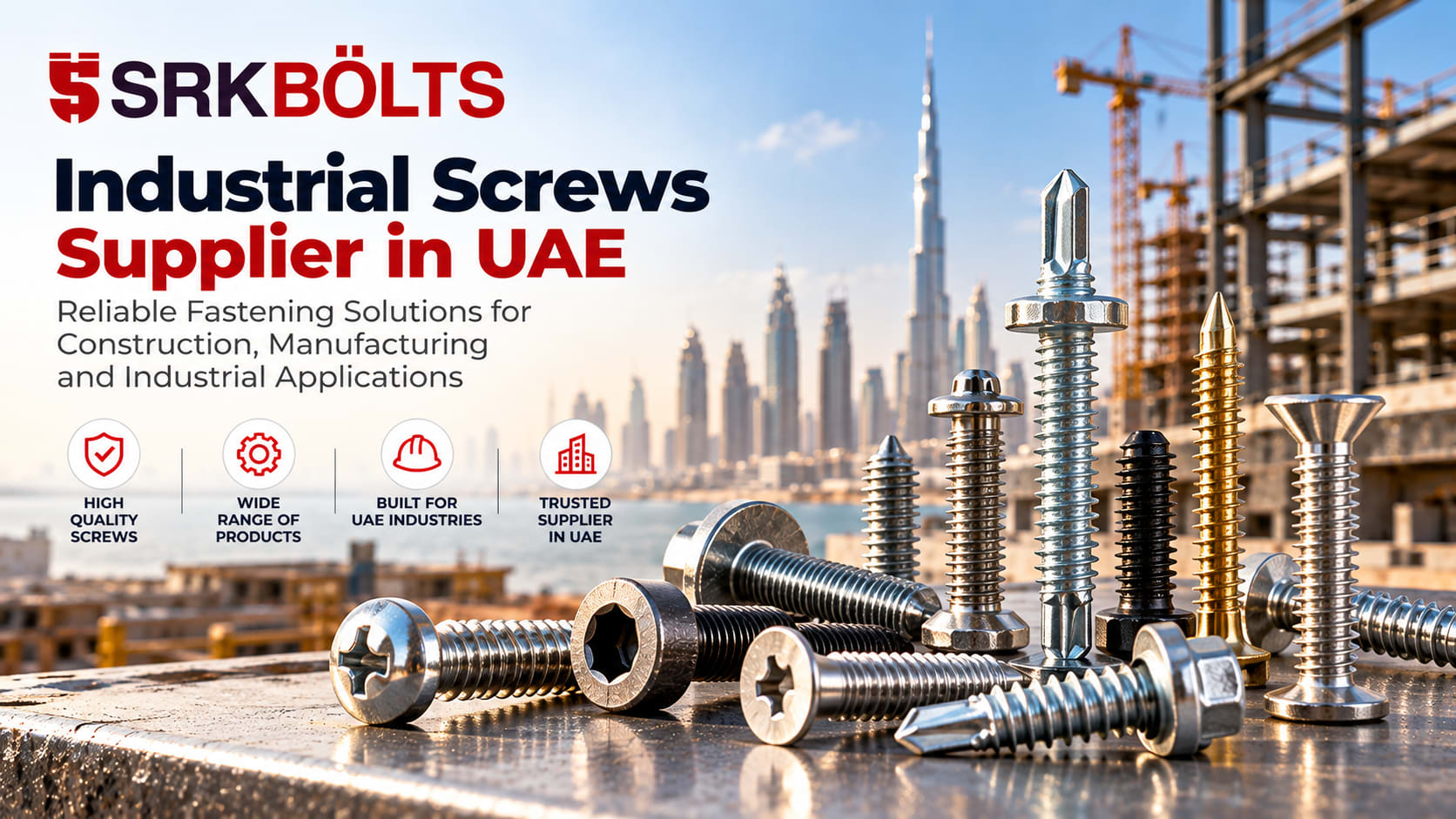
Introduction: Why Choosing the Right Industrial Screws Matters
Imagine installing an expensive industrial machine, assembling an electrical control panel, or completing a large commercial construction project. Every component must fit correctly, withstand operating conditions, and remain securely connected.
Now imagine that a small screw fails.
Although screws are among the smallest components used in industrial applications, an incorrect fastener can cause loose connections, equipment vibration, premature corrosion, production downtime, and costly repairs.
That is why selecting industrial screws is about much more than choosing the correct diameter and length.
Across the UAE, industries such as construction, manufacturing, automotive, marine engineering, electrical installations, and metal fabrication depend on accurately specified fastening components.
From industrial workshops in Sharjah to commercial developments in Dubai and engineering facilities in Abu Dhabi, different environments require different screw designs, materials, and mechanical properties.
For contractors, engineers, manufacturers, and procurement professionals, understanding these requirements is essential.
Working with a dependable Industrial Screws Supplier in UAE can help businesses source suitable fastening solutions for their applications while reducing specification errors.
This comprehensive guide explains the most commonly used industrial screws, their materials, technical standards, applications, and the important factors to consider when purchasing screws in the UAE.
What Are Industrial Screws?
Industrial screws are externally threaded fasteners designed to connect components through threaded engagement.
Unlike conventional bolts, which are commonly installed with nuts, many screws engage directly with threaded holes or form their own threads in compatible materials.
However, the technical distinction between a bolt and a screw depends on the relevant fastening standard and application.
Industrial screws are available in numerous configurations depending on:
Head design
Drive type
Thread profile
Diameter and length
Material composition
Strength and hardness
Surface treatment
Installation requirements
Their versatility makes them useful in machinery, electrical systems, automotive assemblies, construction, and many other industrial applications.
Different Types of Industrial Screws Used in UAE
Understanding the different screw types helps engineers and purchasing teams select the correct product for each application.
1. Machine Screws
Machine screws are designed for use with compatible tapped holes or nuts.
They generally have uniform threads and are available in different head and drive configurations.
Machine screws are particularly useful for precision assemblies where accurate thread engagement and secure fastening are required.
Common applications:
Industrial machinery
Electrical control panels
Mechanical equipment
Automotive components
Metal assemblies
Electronic equipment
Popular machine screw designs include pan head, countersunk, and other specialized head types.
For example, DIN 7985 is commonly referenced for cross-recessed raised cheese head, or pan-style, machine screws.
The appropriate screw must be selected according to the assembly's dimensions and relevant standard.
2. Self-Tapping Screws
Self-tapping screws are designed to form mating threads in suitable materials during installation.
They are widely used in sheet metal, plastic components, and selected fabricated assemblies.
Unlike machine screws, self-tapping screws may not require a previously tapped internal thread.
However, many applications still require an appropriately sized pilot hole.
Common applications:
Sheet metal fabrication
HVAC ductwork
Electrical enclosures
Metal cabinets
Automotive components
Industrial equipment covers
DIN 7981 and DIN 7982 are commonly associated with traditional pan head and countersunk self-tapping screw designs.
The correct screw type and pilot hole size depend on material thickness, hardness, and installation requirements.
3. Self-Drilling Screws
Self-drilling screws feature a specially designed drill point that can create a hole while the screw is being installed.
This can reduce installation steps when fastening compatible materials within the screw's drilling capacity.
They are widely used in metal roofing, cladding, and light-gauge steel construction.
Common applications:
Steel roofing sheets
Metal cladding
Light-gauge steel framing
Industrial warehouses
Prefabricated buildings
Metal fabrication
For outdoor UAE installations, appropriate corrosion protection and sealing arrangements may also be necessary.
4. Stainless Steel Screws
Stainless steel screws are selected for applications requiring improved corrosion resistance.
These screws are available in numerous head styles, thread types, and dimensions.
Common material families include A2 and A4 stainless steel.
A2 Stainless Steel: Generally associated with 304-type stainless steel and used in many general corrosion-resistant applications.
A4 Stainless Steel: Generally associated with 316-type stainless steel and often selected for improved resistance to chloride-containing environments.
Common applications:
Marine installations
Outdoor equipment
Architectural metalwork
Food-processing machinery
Selected chemical-processing equipment
Stainless steel is not completely immune to corrosion. Selection must consider environmental exposure, material compatibility, and the specific stainless steel grade.
5. Countersunk Screws
Countersunk screws feature a head designed to sit flush with, or below, the surrounding material when installed in a suitable countersunk hole.
They are frequently used where a smooth surface is important.
Common applications:
Metal panels
Equipment covers
Furniture manufacturing
Architectural fittings
Precision assemblies
The countersink angle and dimensions must match the screw specification to achieve correct seating.
6. Socket Head Screws
Socket head screws contain an internal drive, often hexagonal, allowing them to be tightened with an appropriate tool.
They are commonly used in machinery and mechanical assemblies, especially where installation space is limited.
Common applications:
Industrial automation
Precision machinery
Mechanical equipment
Automotive manufacturing
Engineering assemblies
ISO 4762 is an important dimensional standard for hexagon socket head cap screws.
7. Wood Screws
Wood screws are designed for fastening timber and certain wood-based materials.
They feature thread profiles suited to engaging with wood fibres.
Common applications:
Furniture manufacturing
Wooden fixtures
Interior construction
Joinery
Wooden enclosures
The correct screw length, diameter, coating, and pilot-hole requirements should be selected according to the timber type and connection design.
8. Button Head Screws
Button head screws feature a low-profile, rounded head.
They are commonly used where appearance, clearance, or a relatively smooth exposed head is required.
Common applications:
Equipment covers
Machine guards
Industrial furniture
Mechanical assemblies
Fabricated metal components
For example, ISO 7380-2 specifies hexagon socket button head screws with a collar.
SRK Bolt's industrial screws collection includes machine screws, self-tapping screws, countersunk screws, and socket button head screws for different engineering requirements.
Understanding Industrial Screw Materials
Material selection significantly influences the strength, durability, corrosion resistance, and service life of industrial screws.
In the UAE, environmental conditions must be considered when choosing fastener materials.
Carbon Steel Screws
Carbon steel screws are commonly used in construction, manufacturing, and mechanical assemblies.
They offer a practical combination of strength, cost-effectiveness, and availability.
However, untreated carbon steel may corrode when exposed to moisture or aggressive environments.
Protective finishes may be necessary.
Stainless Steel Screws
Stainless steel screws offer corrosion resistance in many industrial environments.
They are often selected for outdoor installations, marine-related equipment, and applications requiring a clean or corrosion-resistant finish.
The correct stainless steel grade should be chosen according to the actual environmental conditions.
Alloy Steel Screws
Alloy steel screws are used in applications requiring specific mechanical properties.
Depending on the grade and manufacturing process, these fasteners may offer higher tensile strength and hardness.
They are commonly used in precision machinery, industrial equipment, and specialized mechanical assemblies.
Brass Screws
Brass screws are used in selected electrical, decorative, and mechanical applications.
They offer useful corrosion-resistance characteristics and are generally non-magnetic.
However, brass screws should not be substituted for steel screws in highly loaded applications without engineering approval.
Coated Steel Screws
Steel screws may be supplied with coatings such as zinc plating, zinc flake systems, or other specified protective finishes.
Coatings can improve corrosion resistance but may also influence friction, thread fit, and fastening performance.
The correct finish depends on the environment and project requirements.
Important Industrial Screw Standards
Industrial screws are manufactured according to internationally recognized standards defining their dimensions, thread profiles, mechanical properties, and other characteristics.
Standard | Screw type or specification |
|---|---|
ISO 4762 | Hexagon socket head cap screws |
ISO 7380-2 | Hexagon socket button head screws with collar |
ISO 7045 | Cross-recessed pan head screws |
ISO 7046-1 | Cross-recessed countersunk flat head screws |
ISO 7049 | Cross-recessed pan head tapping screws |
ISO 7050 | Cross-recessed countersunk tapping screws |
ISO 3506-1 | Mechanical properties of specified stainless steel bolts, screws and studs |
ISO 898-1 | Mechanical properties of specified carbon and alloy steel bolts, screws and studs |
These standards serve different purposes, and dimensional standards should not be confused with mechanical-property specifications.
Before placing an order, engineers and procurement managers should confirm the applicable standard, material, dimensions, and mechanical requirements.
Industrial Screw Applications Across UAE Industries
Construction and Infrastructure
Construction projects require screws for cladding systems, metal fabrication, building services, equipment installations, and architectural assemblies.
In the UAE, large commercial and industrial developments frequently involve a combination of metal, concrete, timber, and composite materials.
Each material requires a fastening solution suited to its specific properties.
For example, screws designed for thin sheet metal may not be appropriate for thicker structural steel connections.
Manufacturing and Heavy Machinery
Manufacturing facilities rely on screws for assembling machines, production equipment, conveyors, guards, and mechanical components.
Proper screw selection helps maintain assembly reliability and supports future maintenance.
For equipment exposed to vibration, engineers should also evaluate suitable locking methods and tightening procedures.
Oil and Gas Industry
Oil and gas facilities use specialized screws and fasteners in instrumentation, electrical enclosures, machinery, and supporting equipment.
These environments may involve high temperatures, pressure, corrosive substances, or demanding operating conditions.
Material compatibility and compliance with approved specifications are essential.
Electrical and Switchgear Industry
Electrical panels, switchgear systems, cable-management equipment, and industrial enclosures frequently use machine screws and self-tapping screws.
Fastener selection may need to consider mechanical strength, electrical conductivity, grounding requirements, and corrosion exposure.
Marine and Shipbuilding
Marine environments create particular corrosion challenges.
Industrial screws used in marine equipment must be selected according to exposure conditions, mechanical loads, and material compatibility.
Suitable stainless steel grades or engineered protective coatings may be necessary.
Automotive and Transportation
Automotive manufacturing and maintenance use a variety of specialized screws for mechanical, electrical, and interior assemblies.
Different connections require specific thread forms, tightening requirements, and material grades.
For critical applications, manufacturer-approved fastener specifications should always be followed.
How to Choose the Right Industrial Screws for Your Project
Selecting industrial screws requires a systematic approach.
Here are seven practical considerations for engineers, contractors, and purchasing professionals in the UAE.
1. Understand the material being fastened
Determine whether the screw will be used in metal, plastic, timber, or another material.
Different materials require different thread designs and installation methods.
2. Verify the screw dimensions
Check the diameter, length, thread pitch, head dimensions, and drive type.
Using incorrect dimensions can damage components or prevent proper installation.
3. Select the appropriate mechanical properties
The screw must have adequate strength for the expected loads.
For high-strength applications, check the specified mechanical property class and relevant standard.
4. Evaluate corrosion exposure
Consider whether the screw will be installed indoors, outdoors, near the coast, or in a chemically aggressive environment.
Material and coating selection should reflect these conditions.
5. Check the required head and drive type
Head shape influences clearance, bearing conditions, and surface appearance.
Drive design affects installation-tool compatibility and tightening requirements.
6. Confirm international standards
Where engineering drawings specify ISO, DIN, ASTM, or another standard, ensure that the supplied screw meets the required specification.
7. Request product documentation
For larger industrial projects, procurement teams may need dimensional drawings, material certificates, inspection documents, or other technical information.
Providing these requirements at the quotation stage can reduce purchasing errors.
Common Mistakes to Avoid When Buying Industrial Screws
Some fastening problems begin long before installation.
One common mistake is choosing screws based only on their appearance.
Two screws may have similar heads but entirely different thread profiles, materials, or mechanical properties.
Another mistake is assuming all stainless steel screws provide equal corrosion resistance.
Improper pilot-hole sizing can also cause problems when installing self-tapping screws.
An oversized hole may reduce thread engagement, while an undersized hole can increase installation torque or damage the screw.
Other potential problems include overtightening, using incompatible tools, mixing different thread systems, and selecting unsuitable coatings.
For procurement teams, incomplete product descriptions can result in incorrect orders.
Instead of requesting only "M6 screws," buyers should specify the screw type, length, thread pitch, head design, drive type, material, finish, standard, and quantity.
This improves quotation accuracy and reduces the risk of receiving unsuitable components.
Why Choosing a Reliable Industrial Screws Supplier in UAE Matters
Industrial projects often operate under strict installation schedules.
Delays in sourcing a particular screw type can affect production, equipment maintenance, and construction work.
A dependable supplier should offer access to appropriate products and provide accurate information about available specifications.
Important factors to consider include product range, supplier experience, access to specialty fasteners, technical documentation, and support for bulk orders.
It is also beneficial to work with a supplier offering complementary fastening products.
For example, an industrial equipment manufacturer may require machine screws, bolts, nuts, and washers for the same assembly.
Coordinating these requirements can simplify purchasing and help maintain specification consistency.
SRK Bolt: Industrial Screws and Fasteners Supplier in UAE
For contractors, industrial manufacturers, maintenance teams, and procurement professionals searching for an Industrial Screws Supplier in UAE, SRK Bolt offers a range of standard and specialty fastening solutions.
Founded in 2015, SRK Bolt is a UAE-based industrial fastener supplier supporting construction, structural steel, oil and gas, marine engineering, manufacturing, electrical, and general engineering applications.
The company offers a catalogue of more than 5,000 fastener SKUs and works with a sourcing network across India, Europe, and the Far East.
Its screws category includes products such as:
ISO 7380-2 Hexagon Socket Button Head Screws with Flange
DIN 7981 Pan Head Self-Tapping Screws
DIN 7982 Countersunk Self-Tapping Screws
DIN 7985 Pan Head Machine Screws
DIN 965 Countersunk Phillips Machine Screws
These products are listed in the company's online screws collection, with quotation options for project-specific requirements.
SRK Bolt supports enquiries from industrial markets throughout the UAE, including Dubai, Abu Dhabi, Sharjah, and Ajman, as well as other GCC markets.
Businesses can explore the SRK Bolt industrial screws catalogue and provide their required specifications for pricing and availability confirmation.
For related fastening requirements, buyers can also explore industrial bolts, industrial nuts, and the complete industrial fasteners collection.
Frequently Asked Questions About Industrial Screws in UAE
What are the most commonly used industrial screws?
Machine screws, self-tapping screws, self-drilling screws, socket head screws, countersunk screws, and stainless steel screws are commonly used across industrial applications.
The most suitable type depends on the fastening material and installation requirements.
What is the difference between machine screws and self-tapping screws?
Machine screws are normally used with compatible pre-threaded holes or nuts.
Self-tapping screws are designed to create or form mating threads in suitable materials during installation.
Which screws are suitable for outdoor installations in UAE?
Appropriately specified stainless steel or corrosion-protected steel screws may be suitable for outdoor installations.
The best choice depends on coastal exposure, temperature, mechanical requirements, and compatibility with the connected materials.
Are stainless steel screws stronger than carbon steel screws?
Not necessarily.
Mechanical strength depends on the specific grade and property class.
Some carbon and alloy steel screws have higher tensile strength than common stainless steel fasteners.
What screws are commonly used for sheet metal?
Self-tapping screws and self-drilling screws are frequently used for suitable sheet metal applications.
The selection depends on metal thickness, material hardness, required connection strength, and installation conditions.
Can I order industrial screws in bulk in UAE?
Yes. Industrial fastener suppliers commonly support bulk and project-based enquiries.
For an accurate quotation, provide the screw type, dimensional standard, size, material, finish, quantity, and any required certifications.
Where can I find an industrial screws supplier in UAE?
Businesses can explore the available industrial screw range through SRK Bolt and submit project specifications for quotation and availability.
Conclusion: Reliable Industrial Connections Begin With the Right Screws
Industrial screws are small components with a significant responsibility.
They secure machinery, support electrical installations, connect fabricated materials, and contribute to the reliability of countless industrial assemblies.
For construction companies, manufacturers, engineering contractors, and industrial buyers across the UAE, selecting the right screw involves understanding material compatibility, mechanical properties, thread specifications, corrosion resistance, and installation requirements.
A screw that performs well in one environment may not be appropriate for another.
That is why careful product selection and clear technical specifications are essential.
Working with an established supplier can also simplify sourcing, particularly when projects require multiple sizes, materials, finishes, and screw designs.
For businesses searching for a reliable Industrial Screws Supplier in UAE, SRK Bolt provides access to industrial screw options and complementary fastening solutions for construction, engineering, manufacturing, and maintenance applications.
Explore the industrial screws range at www.srkbolt.com/screws