
Precision That Holds Everything Together: How to Choose the Best Rivets, Pins & Inserts Supplier in UAE
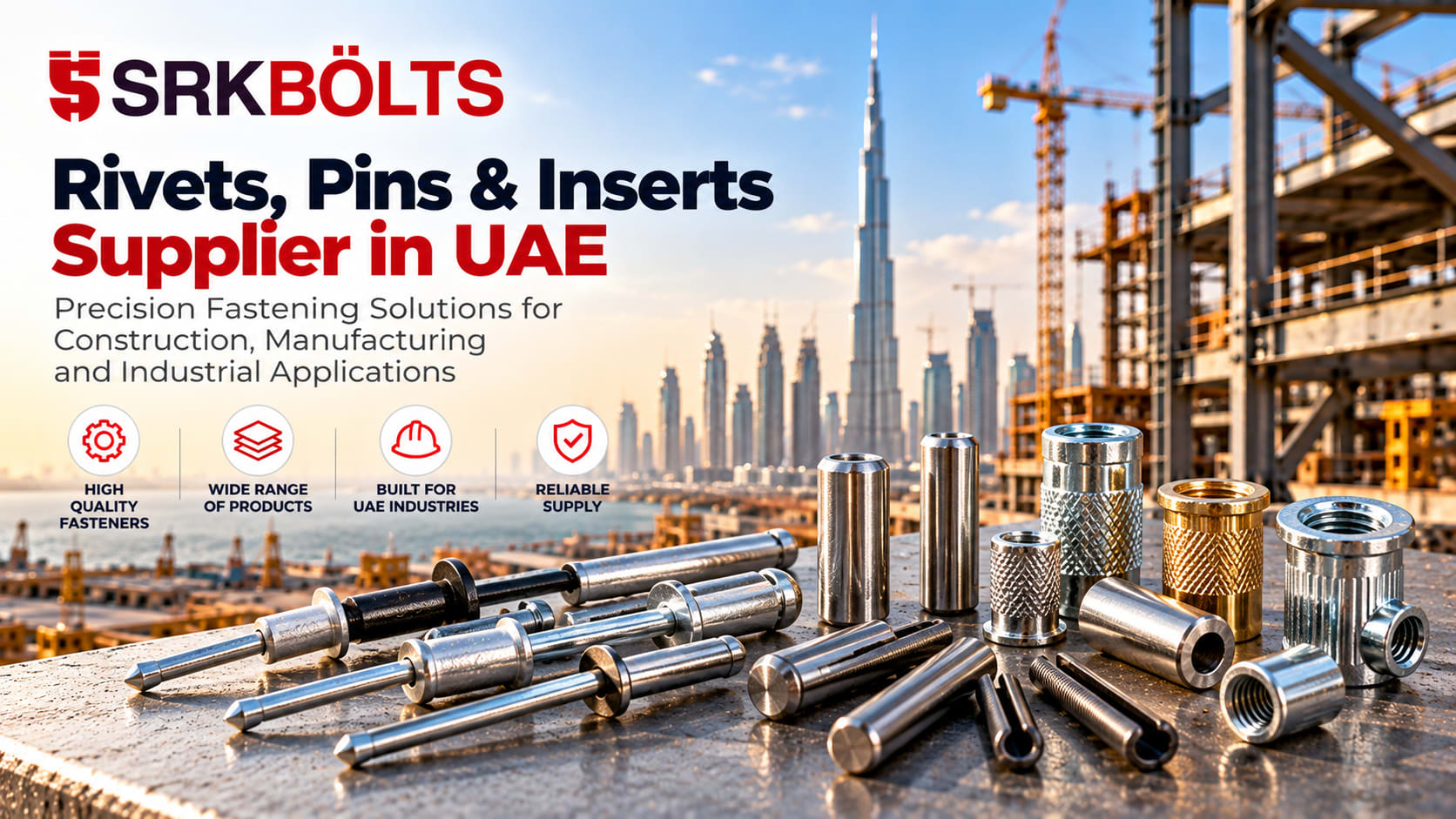
Introduction: Small Fasteners, Big Responsibilities
Imagine a large manufacturing facility in Sharjah assembling hundreds of metal components every day. Each product requires precise alignment, secure connections, and reliable performance.
Some connections are made with bolts and nuts. Others require permanent fastening methods or specialized components designed to withstand movement, vibration, and repeated mechanical loads.
This is where industrial rivets, pins, and threaded inserts become essential.
Although these components rarely receive the same attention as heavy machinery or structural steel, they play an important role in maintaining assembly accuracy, mechanical strength, and product durability.
From automotive workshops in Dubai to marine engineering companies in Abu Dhabi and fabrication facilities across the UAE, industrial businesses rely on the correct fastening components to keep their operations running efficiently.
However, choosing the right rivet, pin, or insert is not always straightforward.
A blind rivet designed for thin sheet metal may not be suitable for a heavily loaded structural connection. Similarly, an incorrectly sized dowel pin can affect machinery alignment, while a threaded insert installed in an unsuitable base material may fail prematurely.
Material selection, dimensional accuracy, installation methods, and environmental conditions all influence performance.
Working with a reliable Rivets, Pins & Inserts Supplier in UAE can help engineers, contractors, manufacturers, and procurement teams source suitable fastening components for their projects.
In this comprehensive guide, we will explore the different types of rivets, pins, and inserts, their applications, material specifications, and practical considerations for sourcing industrial fasteners in the UAE.
What Are Rivets, Pins & Inserts?
Rivets, pins, and threaded inserts are specialized fastening components used for joining materials, positioning mechanical parts, and reinforcing threaded connections.
Although they are often grouped together within industrial fastener catalogues, each serves a different purpose.
Rivets are commonly used to create permanent mechanical joints between two or more components. They are particularly useful in sheet metal fabrication and assemblies where access for conventional nuts and bolts may be limited.
Industrial pins are used for alignment, positioning, retention, and certain load-transmitting functions in mechanical assemblies.
Threaded inserts provide internal threads within materials such as sheet metal, plastic, timber, or damaged threaded holes, depending on the insert design.
Together, these components support manufacturing accuracy, efficient assembly, and dependable mechanical connections.
Types of Industrial Rivets Used in UAE
Rivets are available in different designs to suit specific installation conditions and mechanical requirements.
Understanding these variations can help engineers and purchasing teams choose the appropriate fastening solution.
1. Blind Rivets (Pop Rivets)
Blind rivets are among the most widely used rivets in sheet metal fabrication.
Their major advantage is that they can be installed when access is available from only one side of the assembly.
A typical blind rivet consists of a hollow rivet body and a mandrel. During installation, a riveting tool pulls the mandrel, deforming the rivet body to secure the connected materials.
Common applications:
Sheet metal fabrication
HVAC ductwork
Metal enclosures
Automotive body panels
Electrical cabinets
Lightweight industrial assemblies
Blind rivets are available in aluminium, steel, stainless steel, and other material combinations.
The correct rivet must be selected according to material thickness, grip range, hole diameter, and required joint performance.
2. Solid Rivets
Solid rivets are traditional permanent fasteners consisting of a solid shank and a manufactured head.
During installation, the opposite end is mechanically deformed to create a second head.
Solid rivets are used in engineered applications where appropriate strength and joint performance are required.
Common applications:
Heavy metal fabrication
Industrial equipment
Structural assemblies
Specialized transport equipment
Selected aerospace applications
Unlike blind rivets, conventional solid rivets generally require access to both sides of the joint.
3. Semi-Tubular Rivets
Semi-tubular rivets contain a partially hollow end that can be formed during installation.
Because only the hollow portion needs to be deformed, they typically require less installation force than comparable solid rivets.
Common applications:
Hinges
Mechanical linkages
Furniture fittings
Automotive components
Industrial equipment assemblies
Their suitability depends on the joint design, mechanical loads, and intended movement.
4. Countersunk Rivets
Countersunk rivets feature a head designed to sit flush with the surrounding material when installed in a correctly prepared countersunk hole.
They are commonly used where surface smoothness or clearance is important.
Common applications:
Metal panels
Transport equipment
Machinery covers
Precision fabricated components
Aerodynamic assemblies
The countersink geometry must match the rivet design to ensure correct seating and joint performance.
5. Structural Blind Rivets
Structural blind rivets are engineered for specified strength and retention characteristics.
They may be used in applications requiring higher joint performance than general-purpose blind rivets.
Common applications:
Commercial vehicle bodies
Industrial equipment
Metal structures
Heavy sheet metal fabrication
Specialized mechanical assemblies
Buyers should verify the manufacturer's tensile and shear performance data rather than assuming that all products described as structural have identical capabilities.
Common Types of Industrial Pins
Industrial pins are precision components used to locate, align, secure, or connect mechanical parts.
Different pin designs serve different purposes.
1. Dowel Pins
Dowel pins are cylindrical components used primarily for accurate positioning and alignment.
They are commonly installed in precisely machined holes and may rely on a controlled interference fit.
Common applications:
Precision machinery
Manufacturing equipment
Tooling and fixtures
Gearbox assemblies
Mechanical alignment systems
Dowel pins help maintain consistent component positioning during assembly and maintenance.
ISO 8734 is a commonly referenced standard for hardened, ground parallel pins.
2. Spring Pins (Roll Pins)
Spring pins are hollow, resilient pins designed to compress during installation and exert radial pressure against the surrounding hole.
Common designs include slotted spring pins and coiled spring pins.
Common applications:
Mechanical linkages
Automotive components
Machinery assemblies
Equipment positioning
General industrial maintenance
Spring pins can be useful in assemblies requiring retention without conventional threaded fastening.
However, their load capacity depends on the pin design, material, hole dimensions, and operating conditions.
3. Split Pins (Cotter Pins)
Split pins are simple mechanical retaining devices commonly used with castellated nuts and other compatible components.
After insertion through a hole, their legs are bent to prevent accidental removal.
Common applications:
Automotive assemblies
Machinery maintenance
Mechanical linkages
Agricultural equipment
Industrial retaining systems
Split pins are generally inexpensive and convenient, but should not be reused in safety-critical connections unless explicitly permitted by the applicable procedure.
4. Clevis Pins
Clevis pins are cylindrical pins typically featuring a head at one end and a hole or other retention feature at the opposite end.
They are commonly used in pivoting mechanical connections.
Common applications:
Mechanical linkages
Industrial equipment
Hydraulic cylinder attachments
Agricultural machinery
Control mechanisms
The pin diameter, bearing area, retention arrangement, and expected loads must be appropriate for the assembly.
5. Taper Pins
Taper pins have a gradually changing diameter along their length.
They are commonly used to locate or secure components in appropriately tapered holes.
Common applications:
Machinery positioning
Mechanical assemblies
Shaft connections
Equipment maintenance
Precision engineering
The correct taper specification and installation procedure are important for reliable performance.
What Are Threaded Inserts and Why Are They Important?
Threaded inserts are components designed to provide or reinforce internal threads in another material.
They are especially useful where the base material may not offer sufficient thread strength or where repeated assembly and disassembly are expected.
Threaded inserts are available in various configurations.
1. Rivet Nuts (Nutserts)
Rivet nuts are internally threaded fasteners that can be installed from one side of a workpiece.
They are particularly useful in thin sheet metal or hollow sections where conventional nuts may be difficult to access.
Common applications:
Automotive manufacturing
Metal enclosures
Industrial cabinets
Equipment frames
Sheet metal assemblies
Correct installation requires appropriate hole preparation, grip range, and setting force.
2. Helical Thread Inserts
Helical thread inserts are precision-formed wire inserts used to create durable internal threads in prepared holes.
They are commonly used in materials such as aluminium and magnesium alloys, as well as for repairing damaged threads.
Common applications:
Machinery repair
Automotive components
Precision engineering
Equipment maintenance
Thread reinforcement
The insert's thread system and installation procedure must match the base material and fastening requirements.
3. Solid Threaded Inserts
Solid threaded inserts provide internal threads through a solid metal body.
Depending on their design, they may be installed through press fitting, screwing, heat installation, or other methods.
Common applications:
Industrial machinery
Plastic components
Cast metal parts
Equipment housings
Engineered assemblies
4. Heat-Set Inserts
Heat-set inserts are commonly used in thermoplastic components.
During installation, controlled heat allows the insert to become embedded in the surrounding plastic.
Once cooled, the insert provides an internal threaded connection.
Common applications:
Injection-moulded components
Electronic enclosures
Plastic equipment housings
Consumer and industrial products
3D-printed thermoplastic components
Correct temperature, installation depth, surrounding wall thickness, and plastic material are important for achieving reliable performance.
Rivets vs Pins vs Threaded Inserts: What's the Difference?
Although these components may appear similar in size, their mechanical functions are quite different.
Feature | Rivets | Pins | Threaded inserts |
|---|---|---|---|
Primary function | Join components | Align, locate or retain parts | Provide internal threads |
Typical connection | Usually permanent | Depends on pin design | Supports threaded fasteners |
Common installation | Deformation or setting tool | Press-fit, insertion or retention | Setting, threading or embedding |
Typical applications | Sheet metal, fabrication | Machinery, alignment, linkages | Sheet metal, plastic, thread repair |
Removal | Often destructive | Frequently removable | Depends on insert type |
Understanding these differences helps prevent incorrect product substitution.
For example, a rivet nut should not be selected simply because it looks similar to a hollow rivet. Their intended functions are different.
Materials Used in Industrial Rivets, Pins & Inserts
Material selection plays a major role in connection performance.
For applications in the UAE, engineers should evaluate mechanical loads, corrosion exposure, temperature, and material compatibility.
Carbon Steel
Carbon steel is widely used for industrial pins, rivets, and certain threaded inserts.
It provides useful mechanical properties and is generally cost-effective.
Protective finishes may be necessary in corrosive environments.
Stainless Steel
Stainless steel fasteners are commonly used in applications requiring improved corrosion resistance.
A2 and A4 stainless steel are frequently specified for suitable industrial applications.
A4 grades are often considered where greater resistance to certain chloride-containing environments is required.
However, material strength and corrosion suitability should be evaluated separately.
Aluminium
Aluminium rivets are lightweight and commonly used in thin sheet metal, transport, and equipment assemblies.
They are particularly useful where weight reduction is important.
However, aluminium rivets should not automatically replace steel rivets where higher mechanical strength is required.
Brass
Brass inserts are commonly used in thermoplastic components and selected electrical or mechanical assemblies.
They offer useful corrosion resistance and can provide durable internal threads when correctly installed.
Alloy Steel
Alloy steel may be used for specialized industrial pins and other fasteners requiring particular hardness, wear resistance, or strength characteristics.
Material grade and heat treatment should match the relevant design requirements.
Important Standards for Rivets, Pins & Inserts
International standards define dimensions, mechanical characteristics, tolerances, and other product requirements.
Standard | Application |
|---|---|
ISO 15977 | Open-end blind rivets with break pull mandrel |
ISO 15978 | Open-end blind rivets with break pull mandrel |
ISO 8734 | Hardened and ground parallel pins |
ISO 8752 | Slotted spring-type straight pins |
ISO 1234 | Split pins |
ISO 2341 | Clevis pins with head |
DIN 6325 | Hardened cylindrical dowel pins |
NASM 21209 | Screw-thread inserts of specified helical-coil types |
These specifications address different product designs and are not automatically interchangeable.
For example, two rivets with identical nominal diameters may have different grip ranges, mandrel designs, materials, or mechanical performance.
Procurement teams should always confirm the exact standard and product details stated in the approved engineering documentation.
Major Industries Using Rivets, Pins & Inserts in UAE
Construction and Steel Fabrication
Construction and metal fabrication companies use rivets, pins, and inserts in selected assemblies, equipment enclosures, sheet metal components, and mechanical systems.
Rivets are particularly useful for permanent joining applications where welding or conventional threaded fasteners are not preferred.
Automotive and Transportation
Automotive manufacturers and maintenance workshops use specialized rivets, locating pins, and threaded inserts in vehicle components.
These may include body panels, interior assemblies, equipment brackets, and mechanical linkages.
Fasteners used in safety-critical systems must meet the relevant manufacturer or engineering specifications.
Marine and Shipbuilding
Marine equipment can be exposed to saltwater, humidity, vibration, and varying mechanical loads.
Stainless steel and appropriately coated fastening components may be suitable for selected marine applications.
However, material compatibility and galvanic corrosion must also be considered.
Manufacturing and Heavy Machinery
Precision pins help maintain alignment between machinery components.
Threaded inserts provide durable fastening points in suitable materials.
Rivets may be used in covers, housings, fabricated assemblies, and other manufacturing applications.
Electrical and Switchgear Industry
Electrical enclosures, control panels, and equipment cabinets often require permanent fastening or reliable threaded attachment points.
Blind rivets and rivet nuts are especially useful when access is limited to one side of a panel.
Aerospace and Precision Engineering
Certain rivets and locating pins are used in aerospace and precision engineering applications.
These applications generally require strict dimensional control, approved materials, traceability, and compliance with specialized specifications.
General-purpose industrial fasteners should never be substituted for aerospace-approved components without formal engineering authorization.
How to Choose the Right Rivets, Pins & Inserts for Your Project
When sourcing industrial fastening components, buyers should consider the following factors.
1. Understand the Application
Start by identifying whether the component is required for permanent joining, precise alignment, retention, or thread reinforcement.
This determines which product category is appropriate.
2. Confirm the Dimensions
Check diameter, length, grip range, hole dimensions, thread pitch, and other relevant measurements.
Even small dimensional errors can affect assembly performance.
3. Check Mechanical Requirements
Consider tensile loading, shear forces, fatigue, vibration, and wear.
For demanding applications, refer to manufacturer performance data and approved engineering specifications.
4. Select an Appropriate Material
Choose a material based on mechanical strength, corrosion resistance, and compatibility with adjoining components.
5. Evaluate Installation Requirements
Different fasteners require different installation tools and procedures.
For example, blind rivets require a suitable riveting tool, while rivet nuts need a compatible setting tool.
6. Verify Product Standards
Ensure the product meets the specified ISO, DIN, ASTM, NASM, or other relevant standards.
7. Request Technical Documentation
For industrial procurement, manufacturers' technical data, dimensional drawings, inspection records, and material certificates may be necessary.
Providing these requirements at the enquiry stage can prevent delays.
Common Mistakes to Avoid When Buying Industrial Rivets, Pins & Inserts
One common purchasing mistake is selecting a rivet based only on its diameter.
Rivet length, grip range, material, head design, and installation conditions all influence joint performance.
Another mistake is assuming that all dowel pins have the same fit tolerance.
In precision machinery, incorrect tolerances may result in alignment problems or assembly damage.
For threaded inserts, insufficient thread engagement or unsuitable installation methods can cause the insert to loosen or pull out.
Buyers should also avoid mixing incompatible materials without considering corrosion behavior.
For example, certain combinations of aluminium and stainless steel can increase galvanic corrosion risk when exposed to an electrolyte.
Clear product specifications and application-based selection help reduce these problems.
Why Choosing a Reliable Rivets, Pins & Inserts Supplier in UAE Matters
For UAE industrial businesses, sourcing the correct fastening component is essential for maintaining production schedules and installation quality.
A dependable supplier should be able to support buyers with product specifications, dimensional matching, material options, and accurate quotations.
This is particularly important when specialized fasteners are required.
A manufacturing business may need hundreds of precision dowel pins, while a metal fabrication contractor may require large quantities of blind rivets in different grip ranges.
Both customers need reliable sourcing, but their technical requirements are different.
Working with an experienced industrial fastener supplier can help simplify procurement and reduce the possibility of ordering incorrect components.
SRK Bolt: Rivets, Pins & Inserts Supplier in UAE
For businesses searching for a reliable Rivets, Pins & Inserts Supplier in UAE, SRK Bolt provides sourcing support for industrial fastening requirements.
Established in 2015, SRK Bolt is a UAE-based industrial fastener supplier serving construction, manufacturing, structural steel, engineering, automotive, marine, and maintenance-related markets.
The company's broader product catalogue covers more than 5,000 fastener SKUs, sourced through a network of manufacturers across India, Europe, and the Far East.
SRK Bolt's rivets, pins, and inserts category supports specification-based enquiries for permanent fastening, alignment, and thread reinforcement applications.
Buyers can submit requirements based on product type, standard, material, diameter, length, finish, and quantity. The online category listings are being updated, so specific product availability and quotations should be confirmed directly.
SRK Bolt serves customers throughout the UAE, including Dubai, Abu Dhabi, Sharjah, and Ajman, while also supporting enquiries from other GCC countries and selected Middle Eastern markets.
Businesses can explore the Rivets, Pins & Inserts category at SRK Bolt and share their technical specifications for sourcing assistance.
For complementary industrial fastening requirements, the company also offers:
Industrial Bolts – For mechanical assemblies, structural connections, and engineering applications.
Industrial Nuts – For compatible threaded fastening systems.
Industrial Washers – For bearing surfaces, load distribution, and specialized fastening requirements.
Industrial Screws – For machinery, fabrication, and general manufacturing.
Complete Industrial Fasteners Catalogue – For additional standard and specialty fastener requirements.
Frequently Asked Questions About Rivets, Pins & Inserts in UAE
What are the most commonly used industrial rivets?
Blind rivets, solid rivets, semi-tubular rivets, countersunk rivets, and structural blind rivets are commonly used in different industrial applications.
The correct choice depends on the materials, joint design, and required performance.
What is the difference between a blind rivet and a solid rivet?
Blind rivets can generally be installed from one side of a connection.
Conventional solid rivets normally require access to both sides for installation.
Their mechanical performance depends on the specific design and application.
What are dowel pins used for?
Dowel pins are used primarily for accurate alignment and positioning in machinery, tooling, and mechanical assemblies.
They help maintain consistent component location.
What are threaded inserts used for?
Threaded inserts provide internal threads in materials such as sheet metal, plastic, and certain metals.
They may also be used to reinforce or repair threaded holes.
Are stainless steel rivets suitable for marine applications?
Certain stainless steel rivets may be suitable for marine environments.
However, the correct grade, corrosion exposure, adjoining materials, and mechanical requirements must be considered.
What is the difference between a rivet nut and a regular nut?
A regular nut is typically installed onto an externally threaded fastener.
A rivet nut is installed into a prepared hole to create an internal threaded attachment point, often with access from only one side.
Can I order industrial rivets, pins, and inserts in bulk in UAE?
Yes. Suppliers such as SRK Bolt support project and bulk enquiries.
For accurate quotations, buyers should provide the product type, standard, dimensions, material, quantity, and any required technical documentation.
Where can I find a Rivets, Pins & Inserts Supplier in UAE?
Industrial buyers can explore SRK Bolt's Rivets, Pins & Inserts category and submit their product specifications for sourcing and availability confirmation.
Conclusion: Precision Fastening Starts With the Right Components
Rivets, pins, and threaded inserts may be small components, but they perform important functions in industrial manufacturing and engineering.
From permanently joining sheet metal to maintaining machinery alignment and reinforcing threaded connections, each product has a specific purpose.
For contractors, manufacturers, engineers, and procurement teams across the UAE, choosing the correct component requires careful attention to material properties, dimensions, installation methods, mechanical performance, and applicable standards.
A fastener that performs well in one application may not be suitable for another.
This makes technical specifications and reliable sourcing essential.
Working with an established supplier can help industrial businesses identify suitable components, streamline procurement, and reduce unnecessary specification errors.
For businesses looking for a Rivets, Pins & Inserts Supplier in UAE, SRK Bolt provides sourcing support for standard and specialty fastening requirements across construction, manufacturing, automotive, marine, and general engineering industries.
Explore the product category at www.srkbolt.com/rivets.